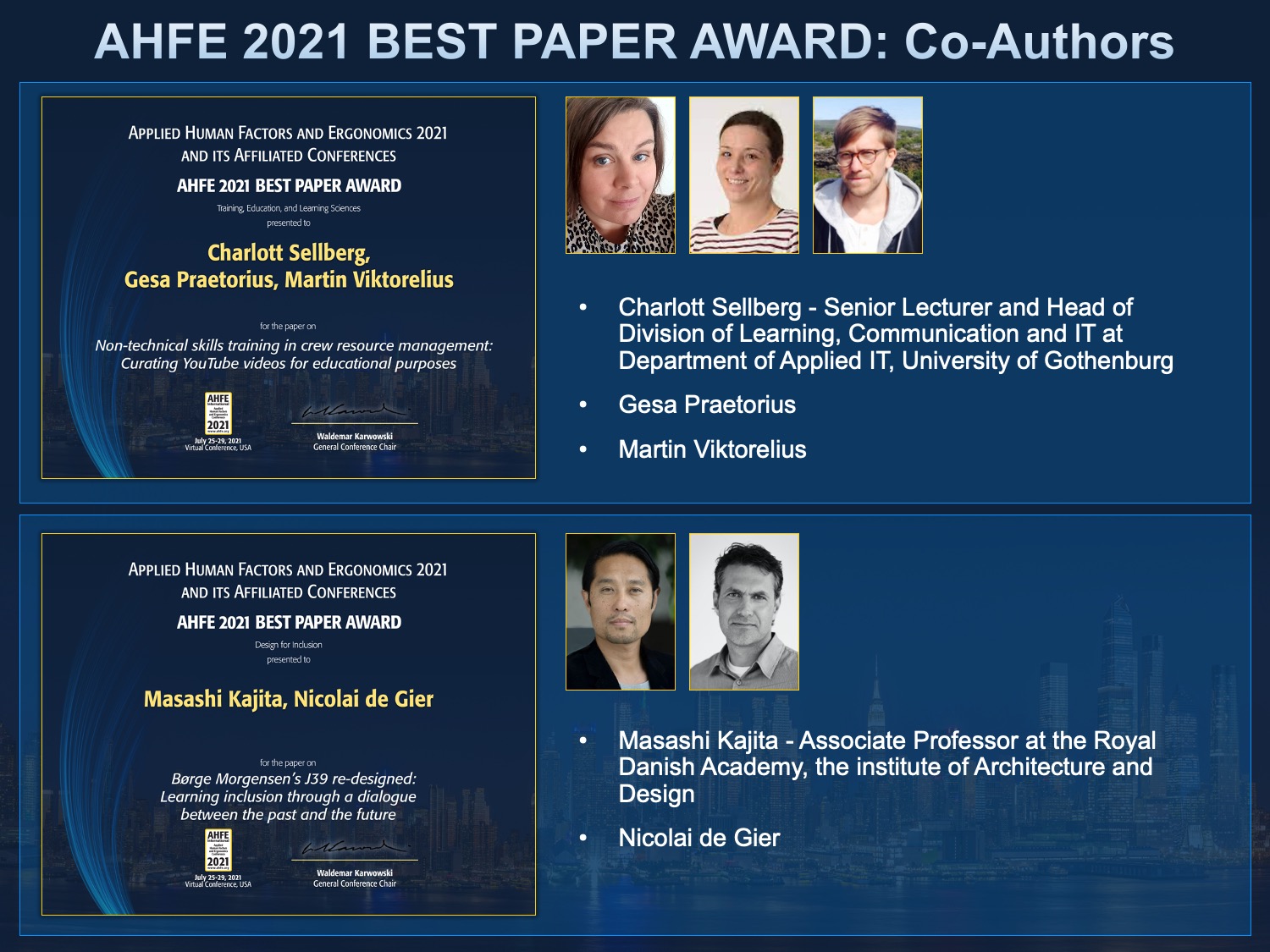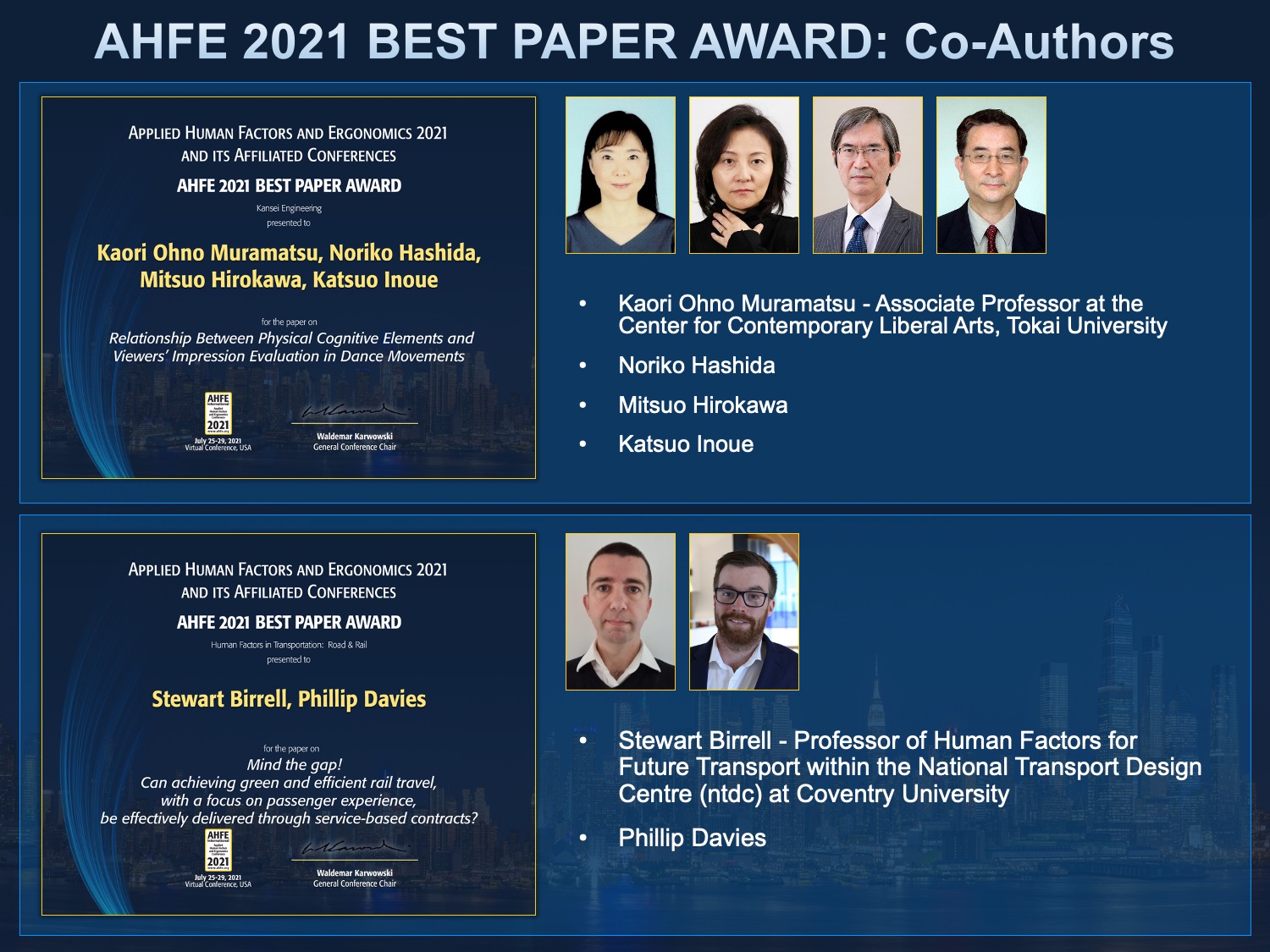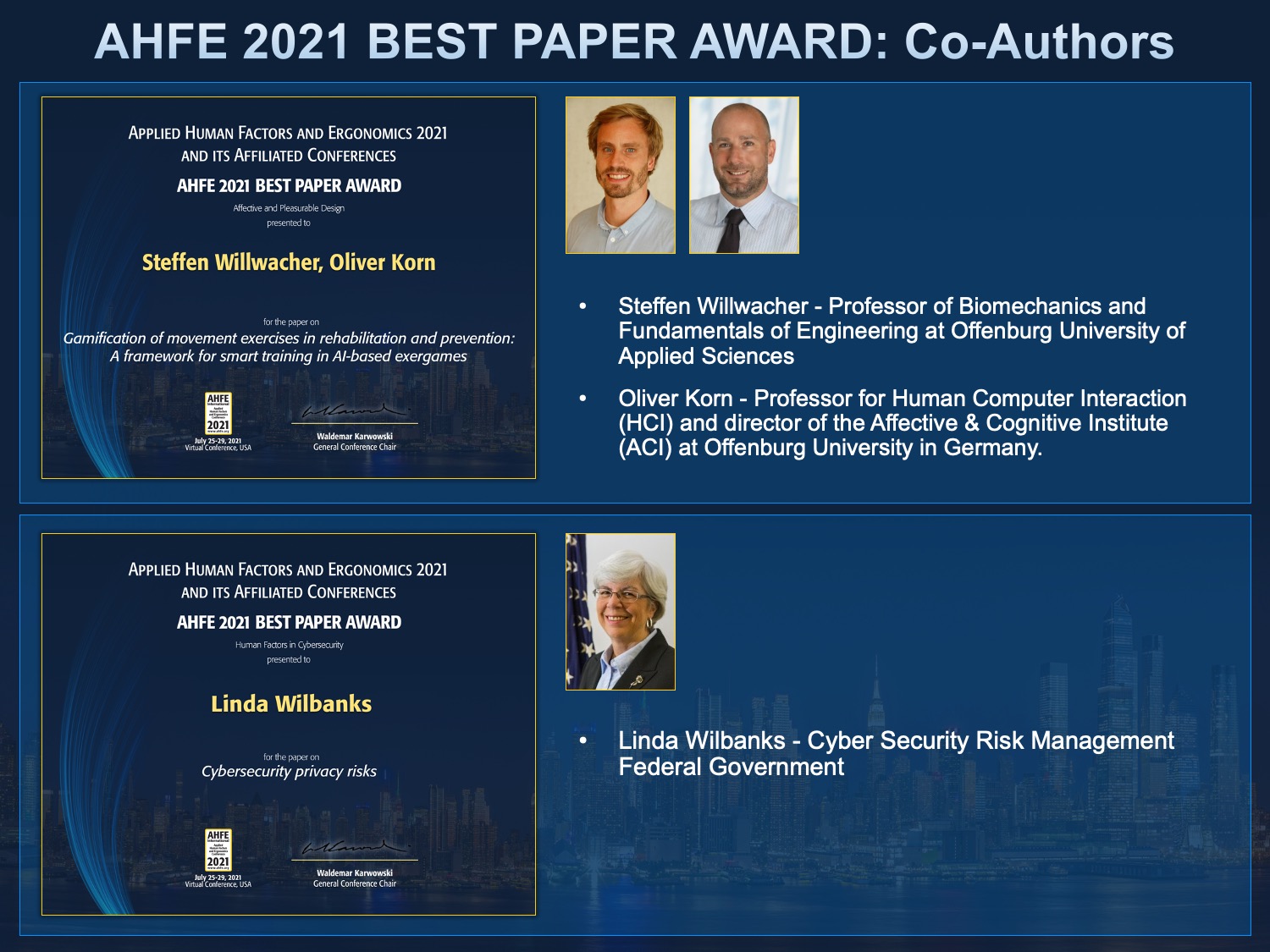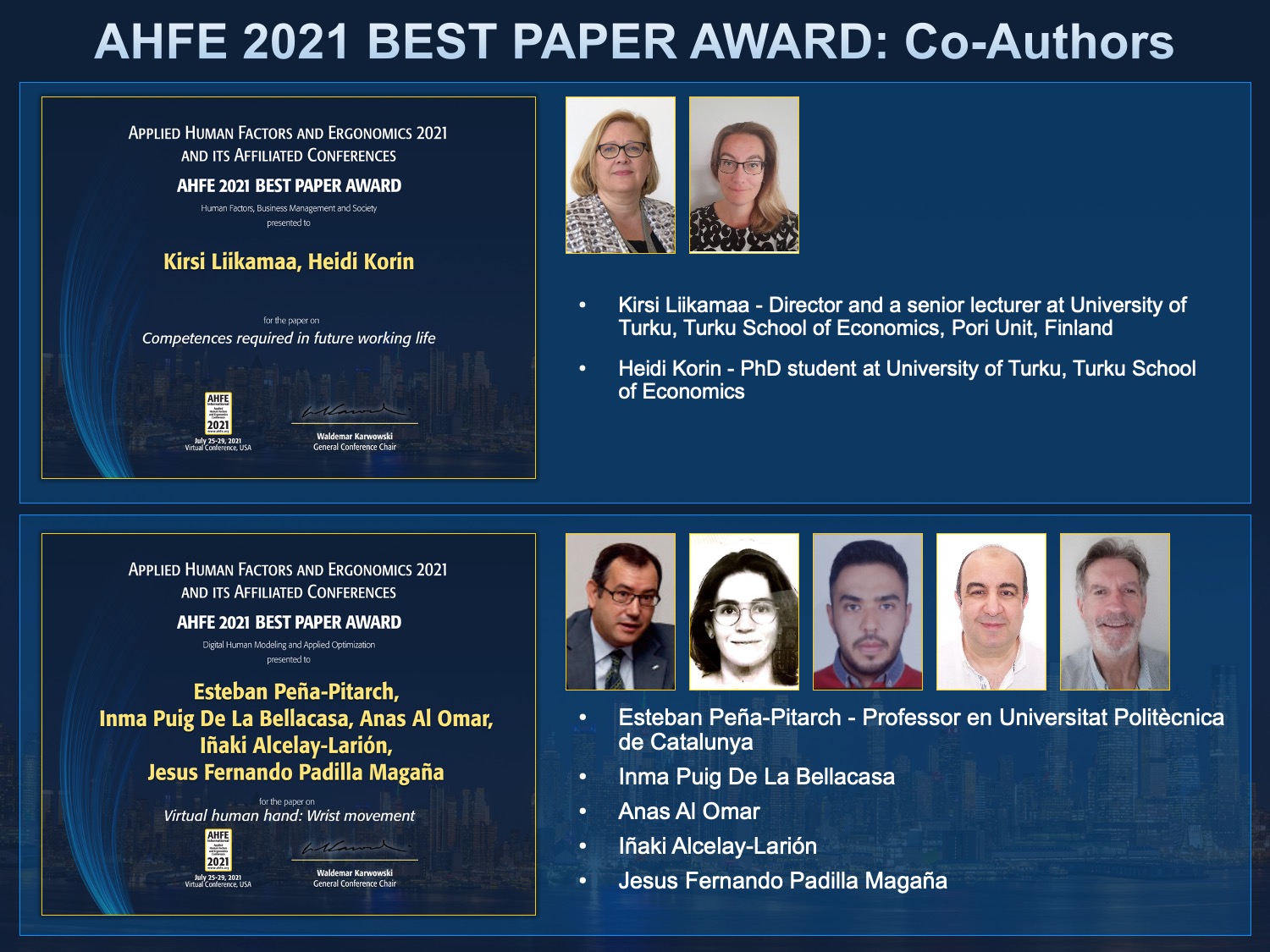
Best Paper Awards Archive

Conference Best Paper Awards:

The AHFE Scientific advisory board members, program track chairs and international scientific advisors annually nominates and recognizes outstanding research papers published in Proceedings of the AHFE Series that is of broad significance and has potential long-term impact. Best Paper Awards typically prioritize originality, the quality of the argument presented, the paper's positioning within existing literature, and the clarity and organization of the writing style. Specific criteria often include the innovation of theoretical development, empirical results, or policy development, as well as the thoroughness and clarity of the research.

Originality: This refers to the paper's contribution to the field of knowledge, emphasizing its innovativeness and originality in areas like theoretical development, empirical findings, or policy recommendations.

Quality of Research: This assesses the paper's ability to critically analyze concepts, theories, and findings, ensuring consistency and coherence in the argumentation.

Positioning: The paper's ability to clearly position itself within the existing international literature and draw convincing conclusions with significant potential is evaluated.

Writing Style: The clarity, accuracy, readability, and organization of the paper's writing style are crucial.

Other Important Factors: Beyond these main criteria, other aspects like the paper's importance to the research community, impact of research, technical excellence, and the clarity of presentation are also considered.

Evaluation Process: The selection of Best Paper Award winners often involves a committee of experienced Human Factors professionals, potentially including technical committee members and session chairs, who review submissions and make a final selection based on the defined criteria.

Benefits of Award: Winning a Best Paper Award can provide recognition within the academic or professional community of over 28K AHFE researcher and member, potentially leading to publication opportunities in reputable journals and enhanced visibility, according to the International Engineering and Technology Institute.

Browse the full Best Paper Awards archive below. The latest year appears first, followed by previous years in descending order.


Your can search and download papers of all AHFE Global community awardees using the AHFE Open Access System.


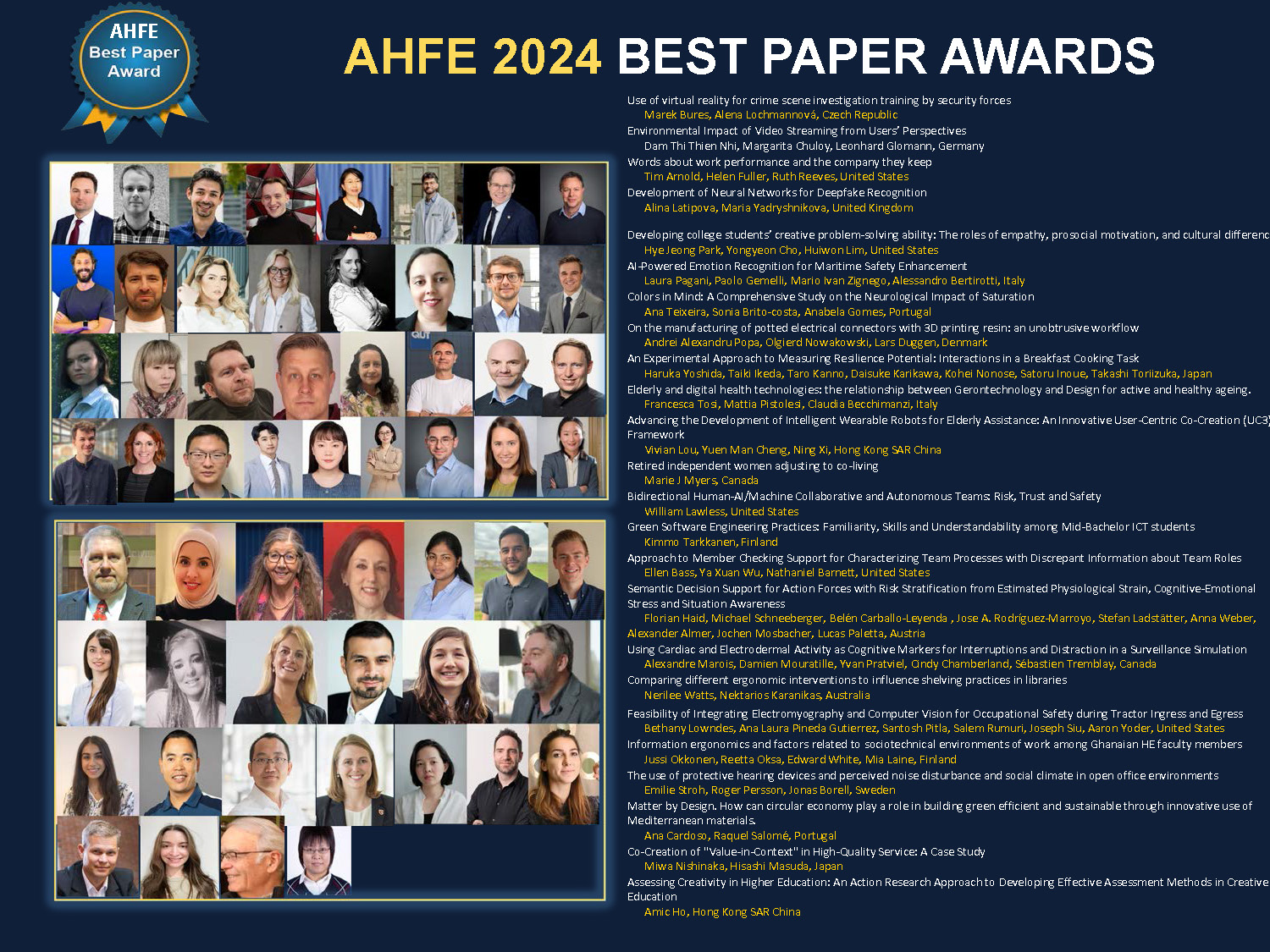
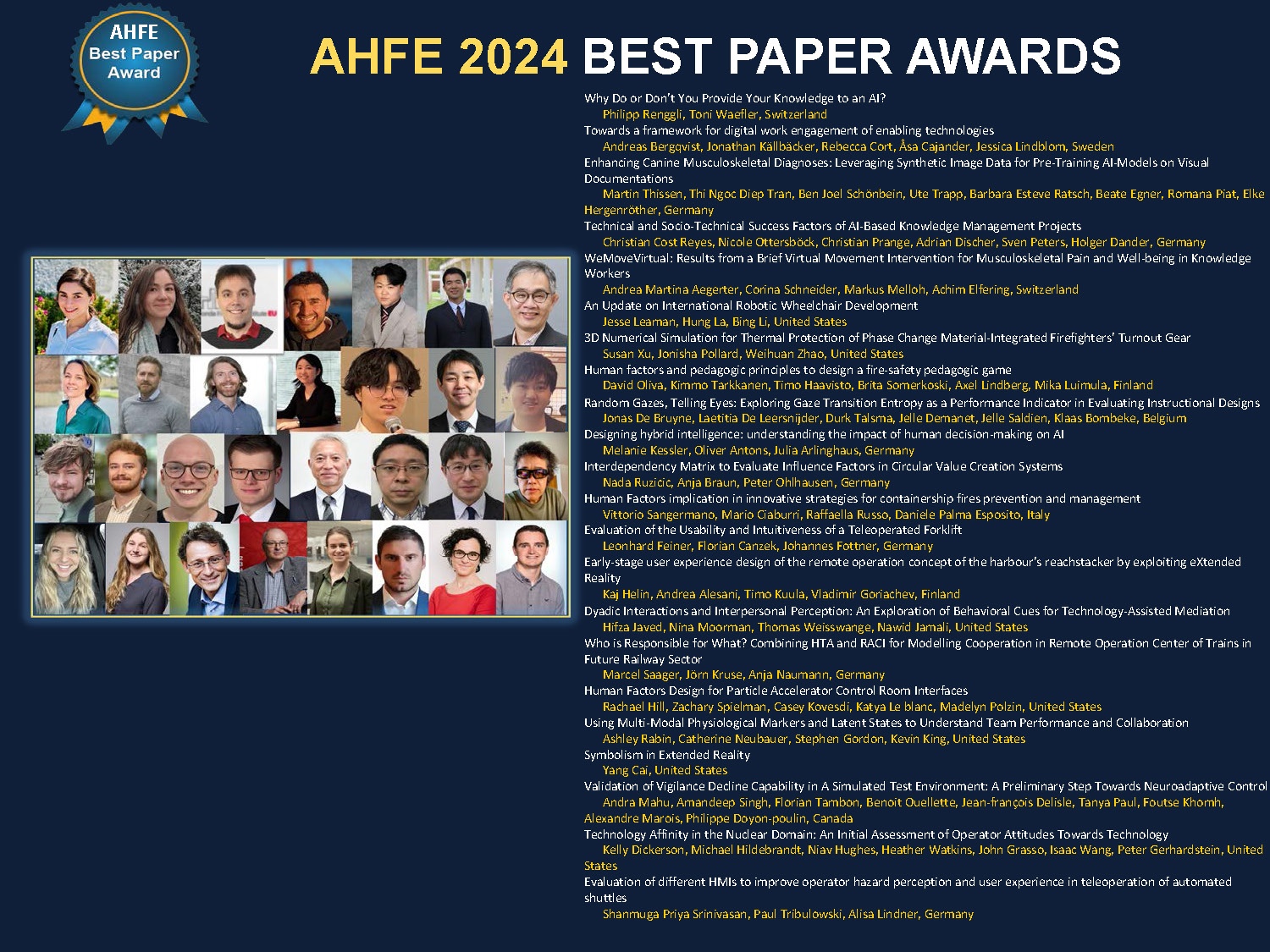
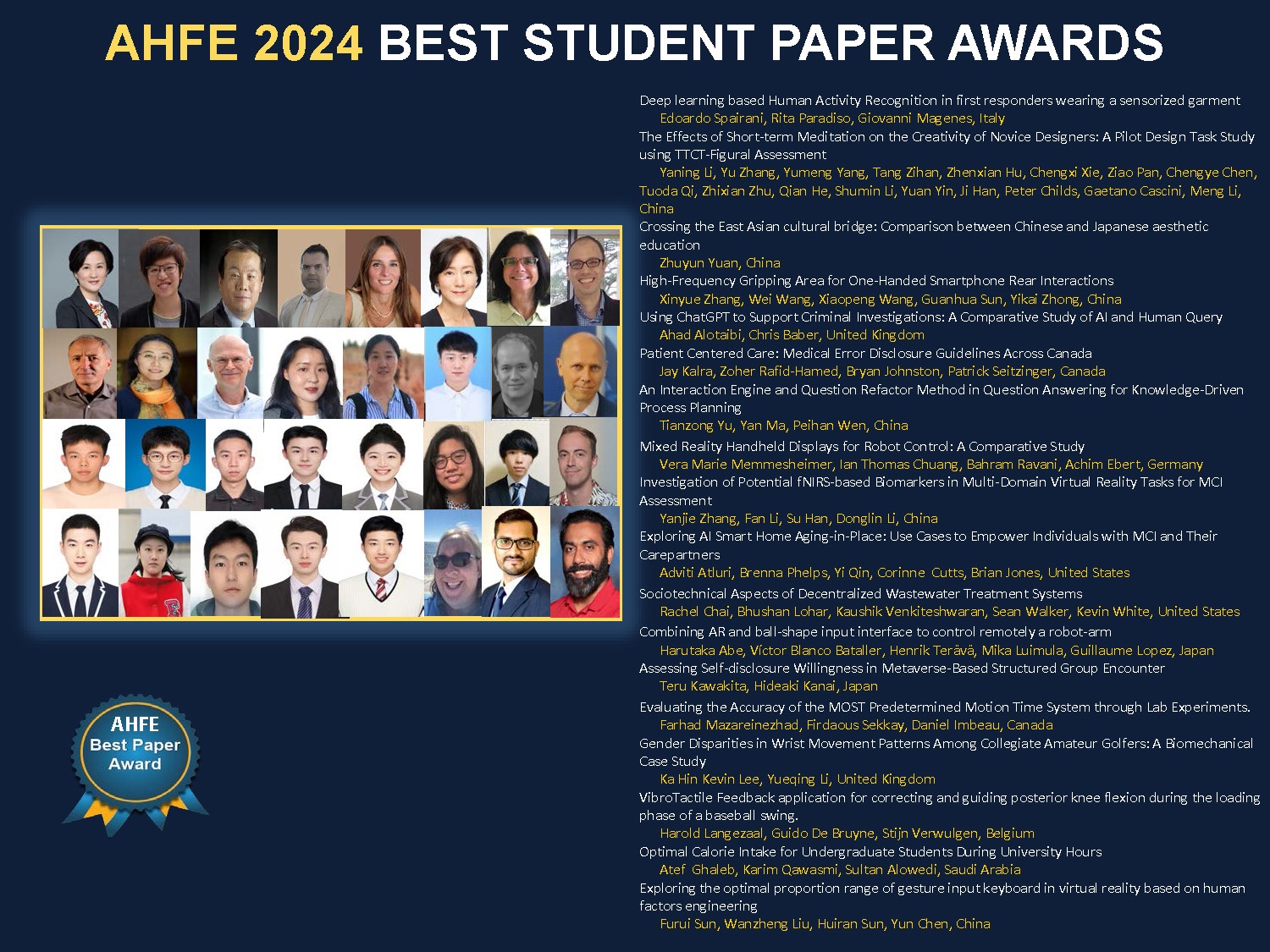
AHFE 2024 Best Paper Awards

🏆 Best Paper Awards

AHFE 2024 BEST PAPER AWARDS


Download AHFE 2024 Best Paper Awards (PDF)
AHFE2024_awards_1

AHFE2024_awards_2

AHFE2024_awards_3

AHFE2024_awards_4


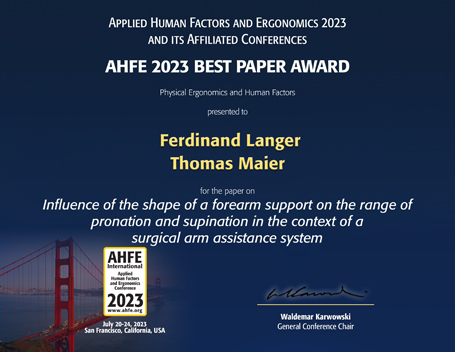
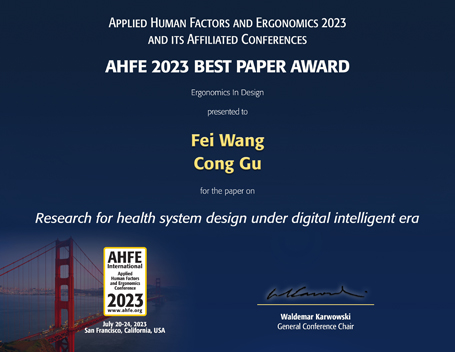
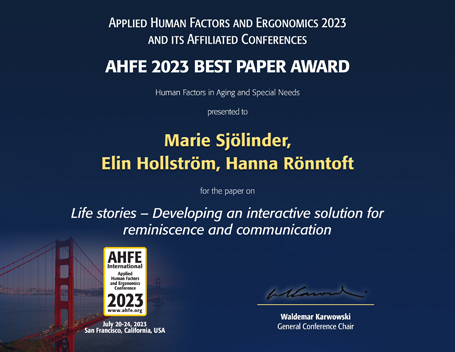
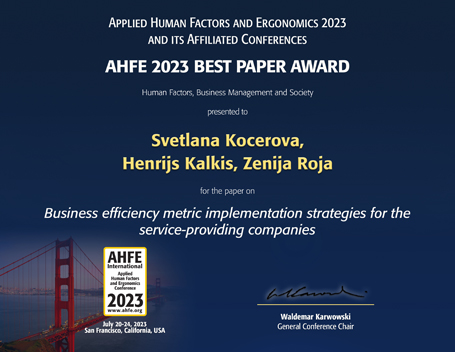
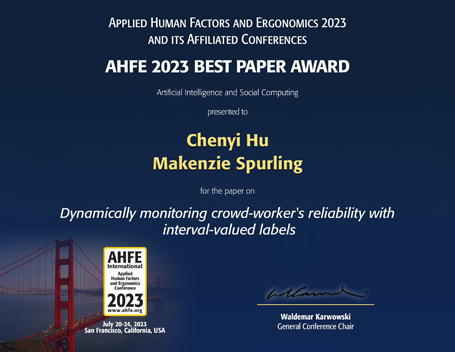
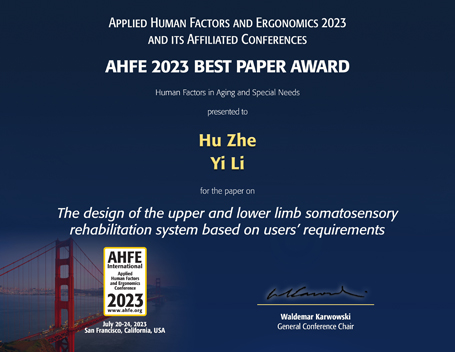
AHFE 2023 Best Paper Awards

🏆 Best Paper Awards


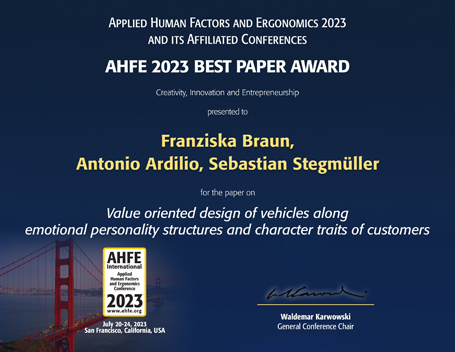
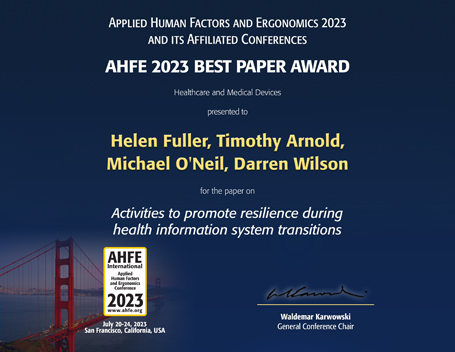
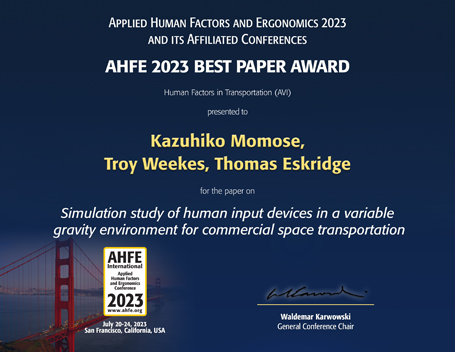
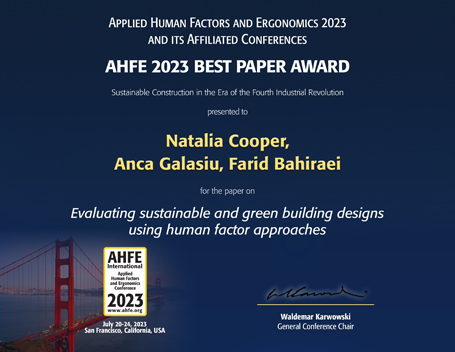
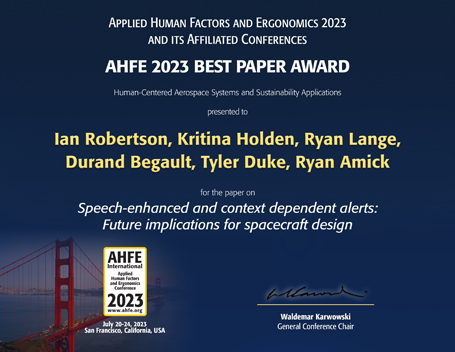
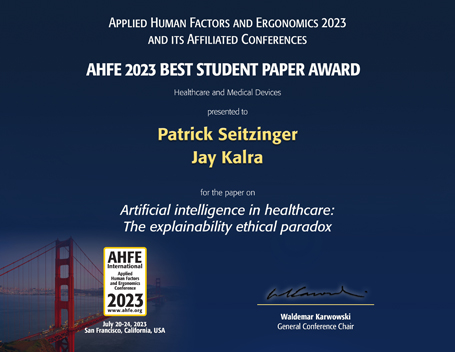
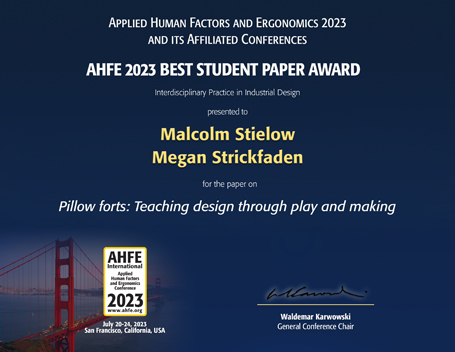
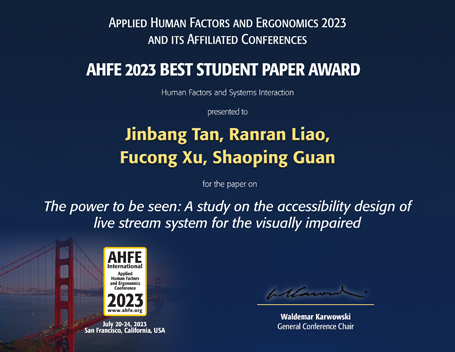
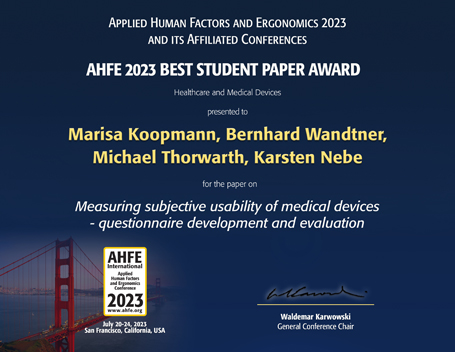
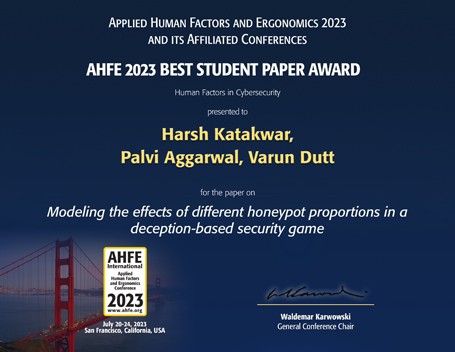
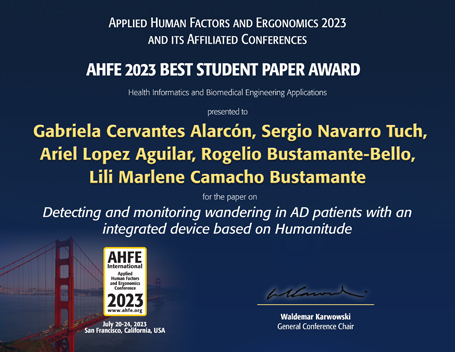
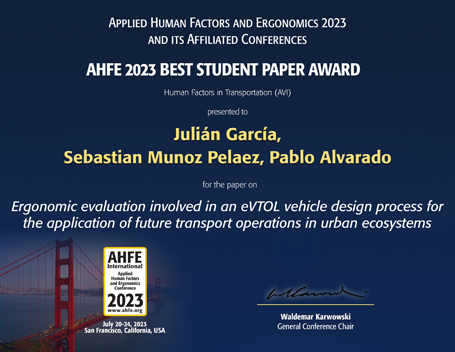
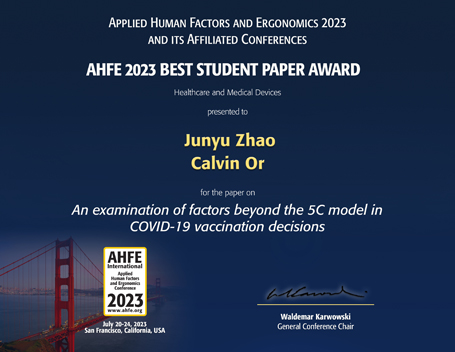
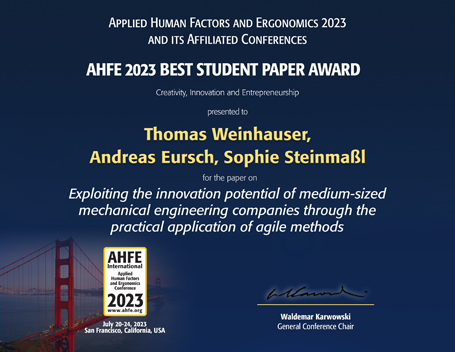
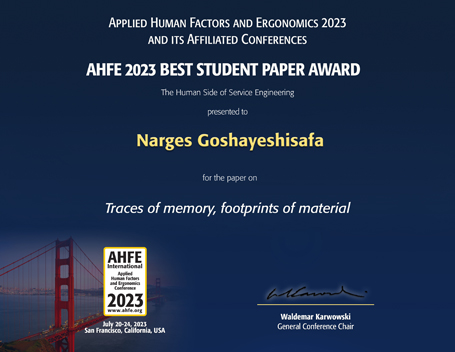
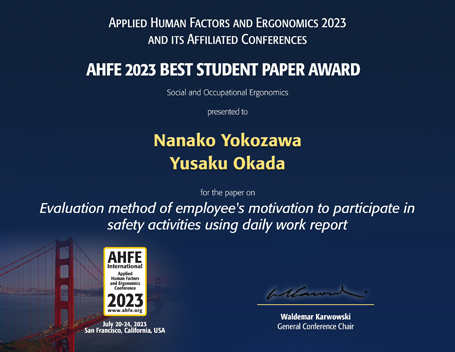
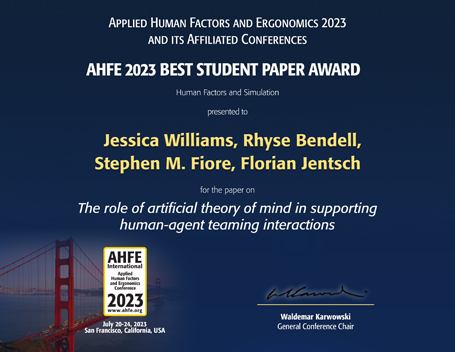
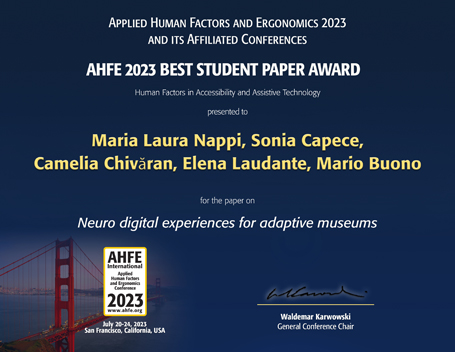
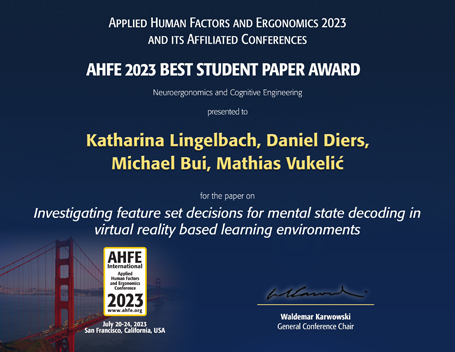
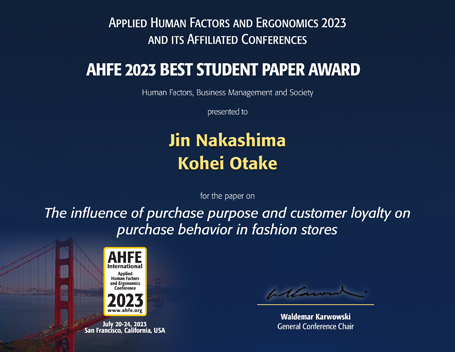
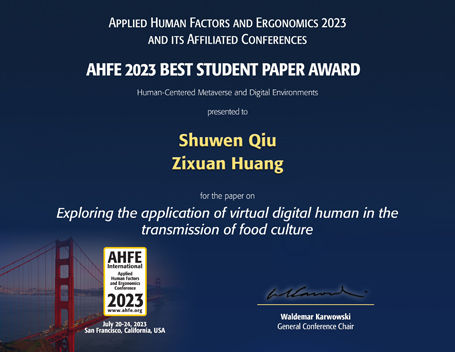
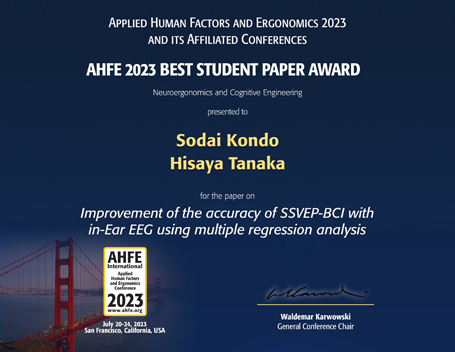
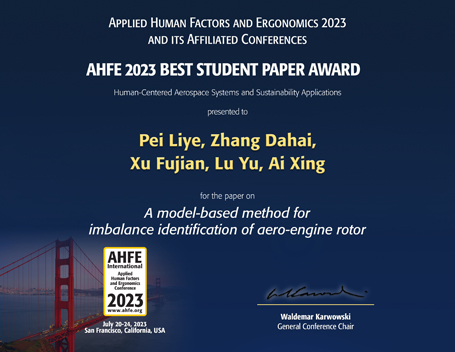
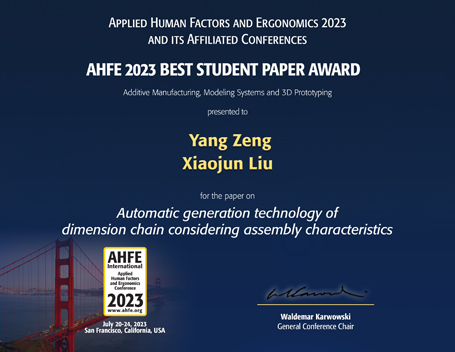
AHFE 2023 BEST PAPER AWARDS


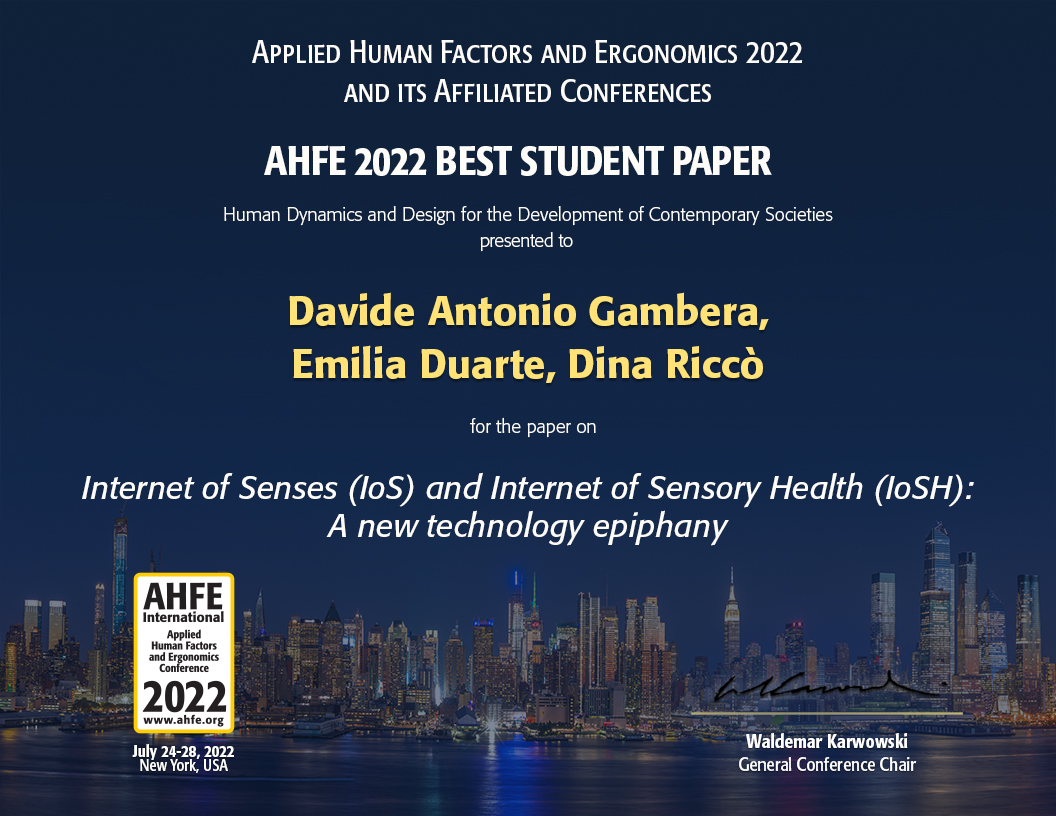
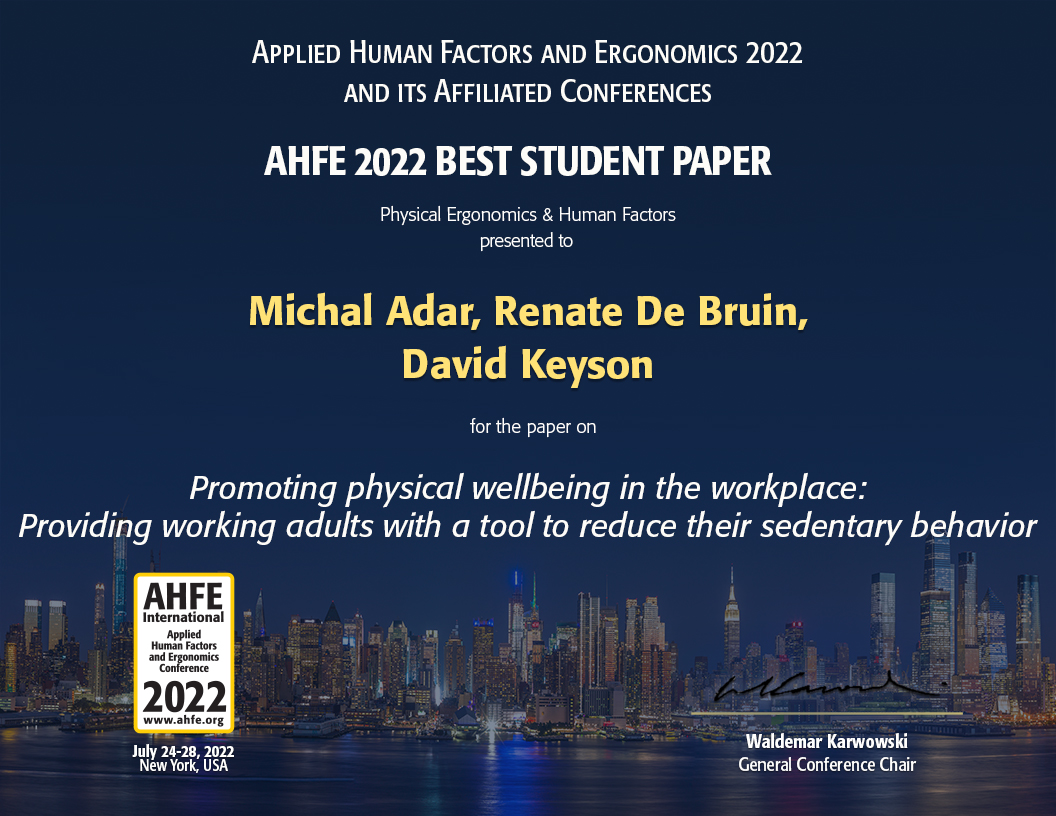
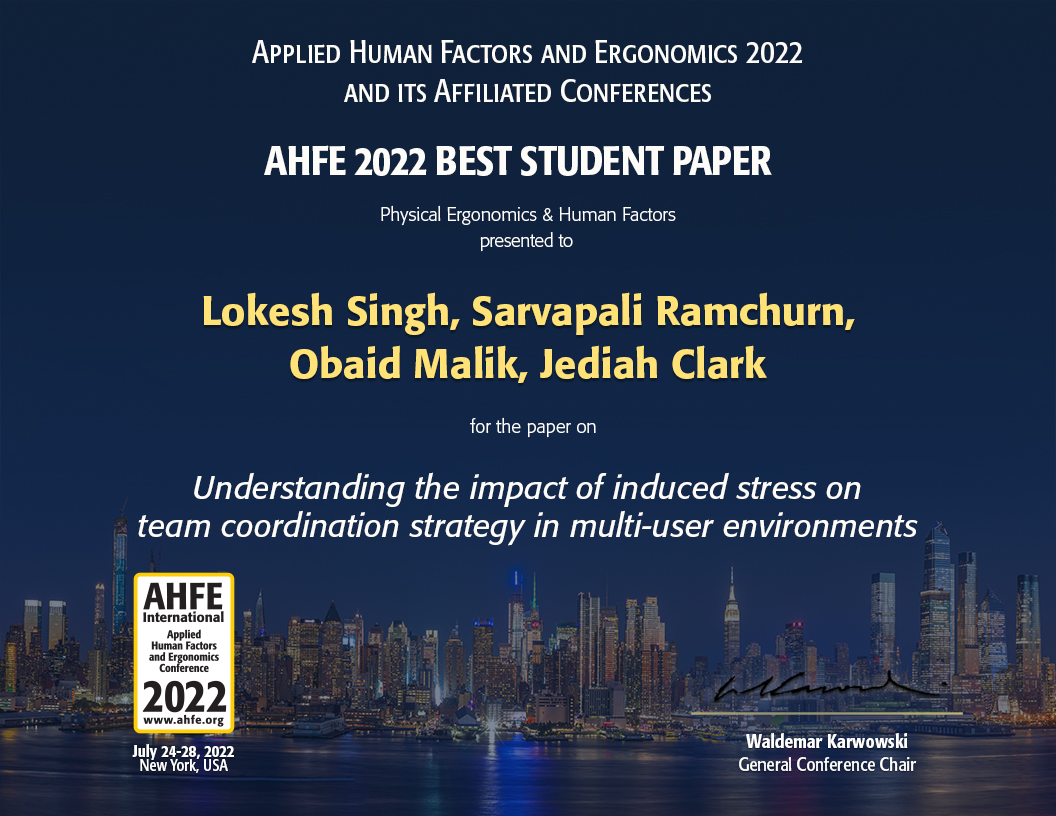
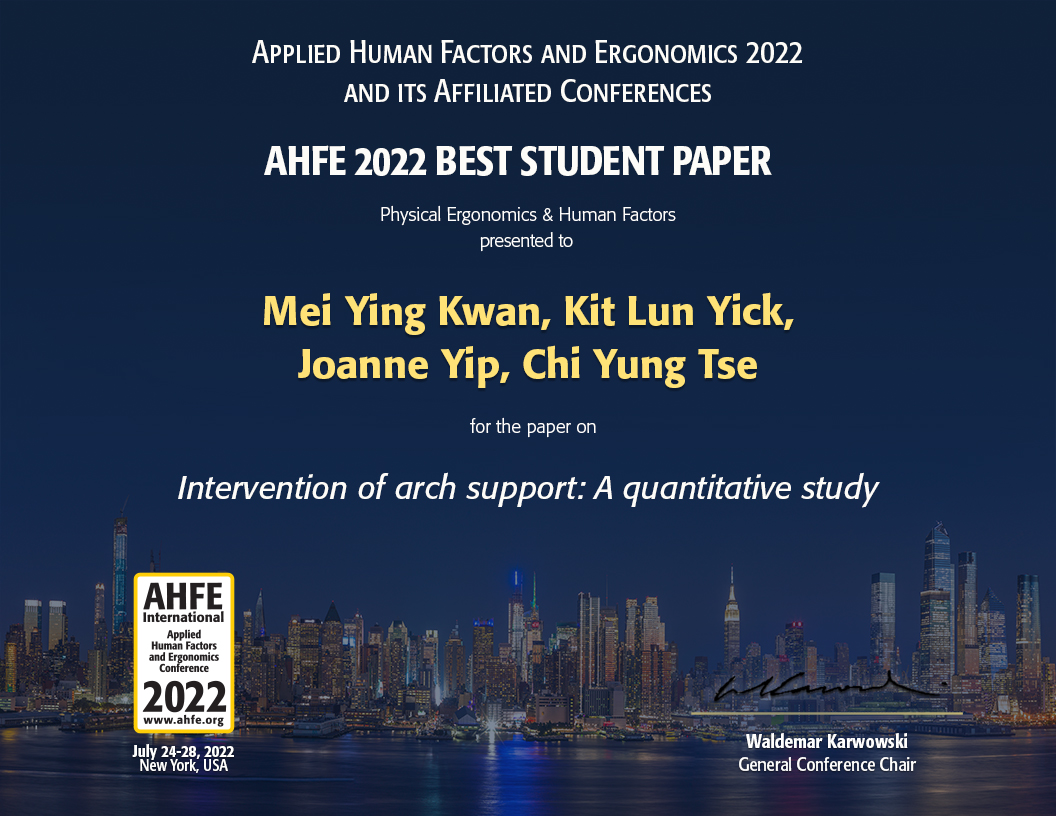
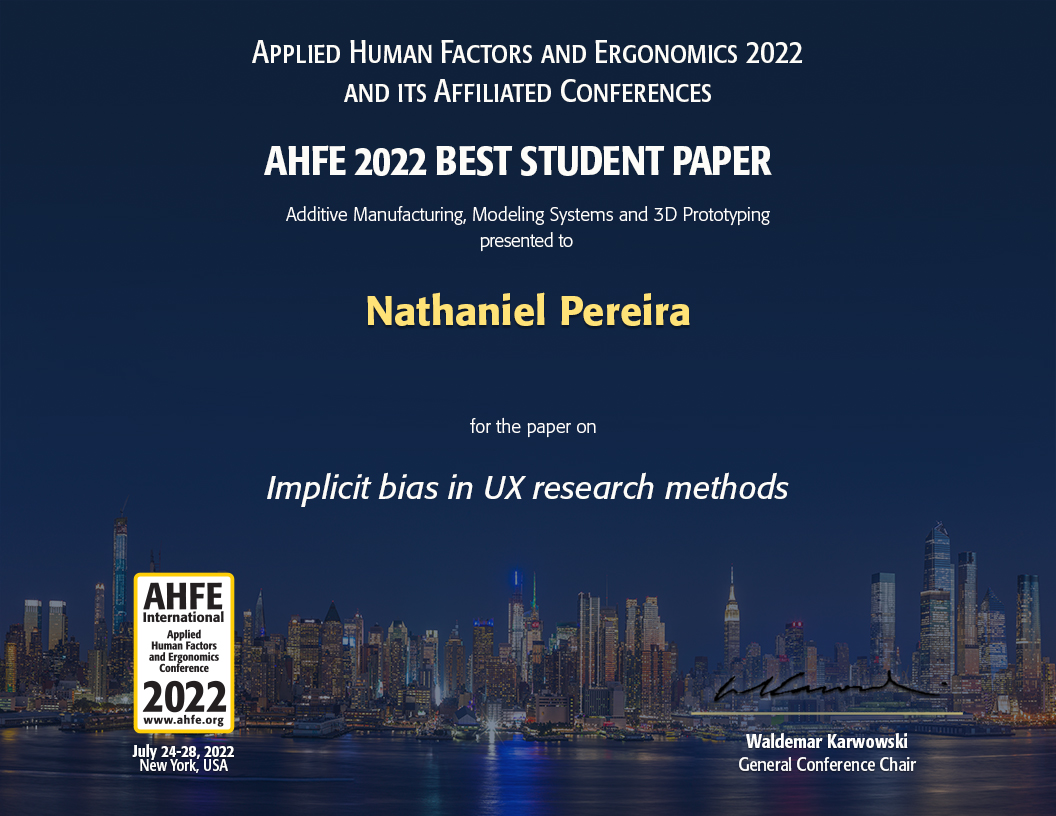
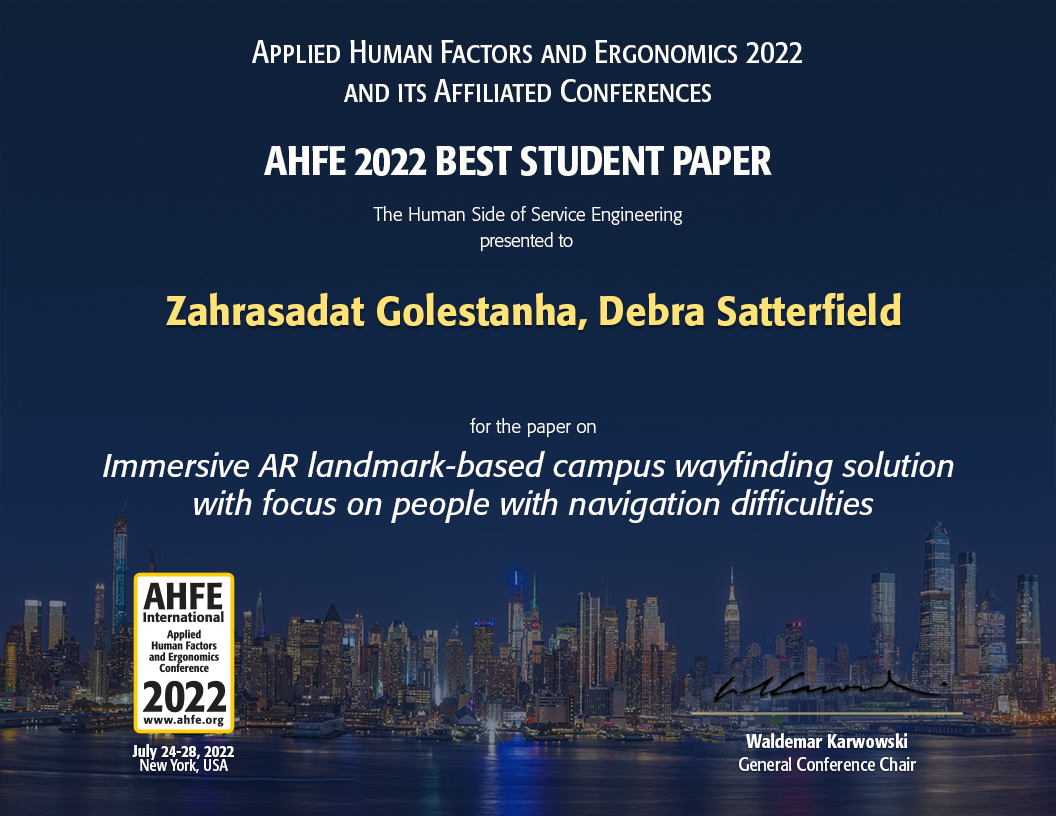
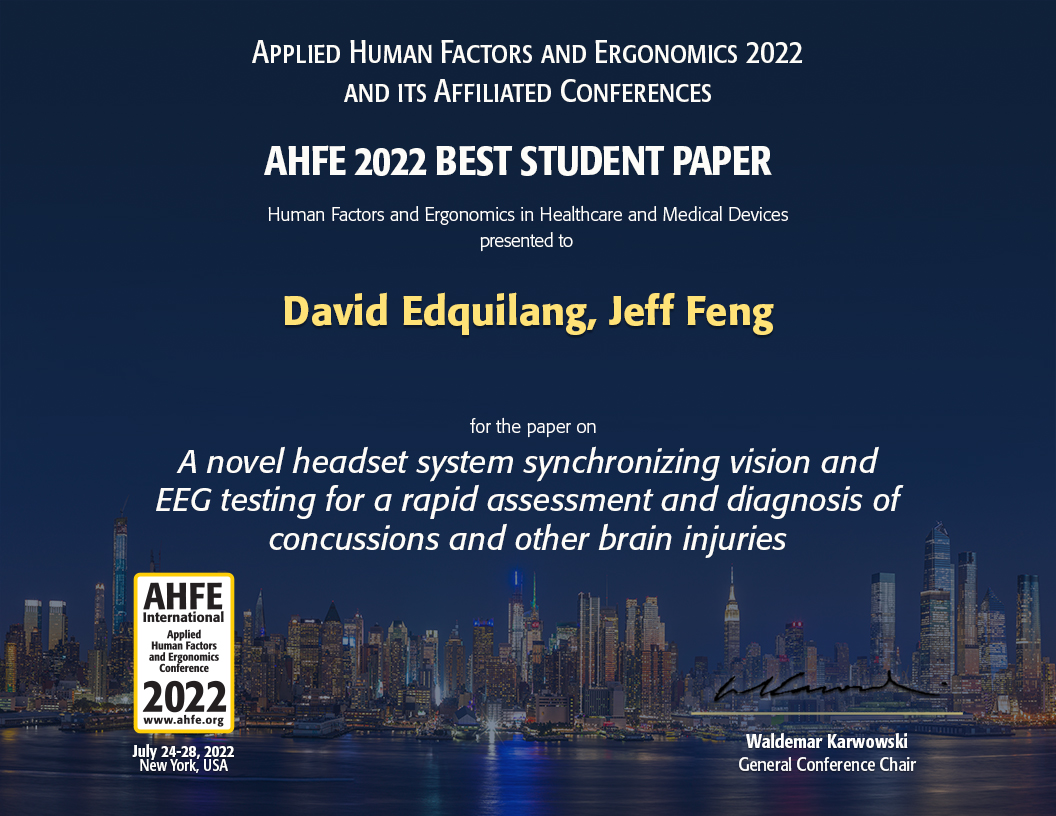
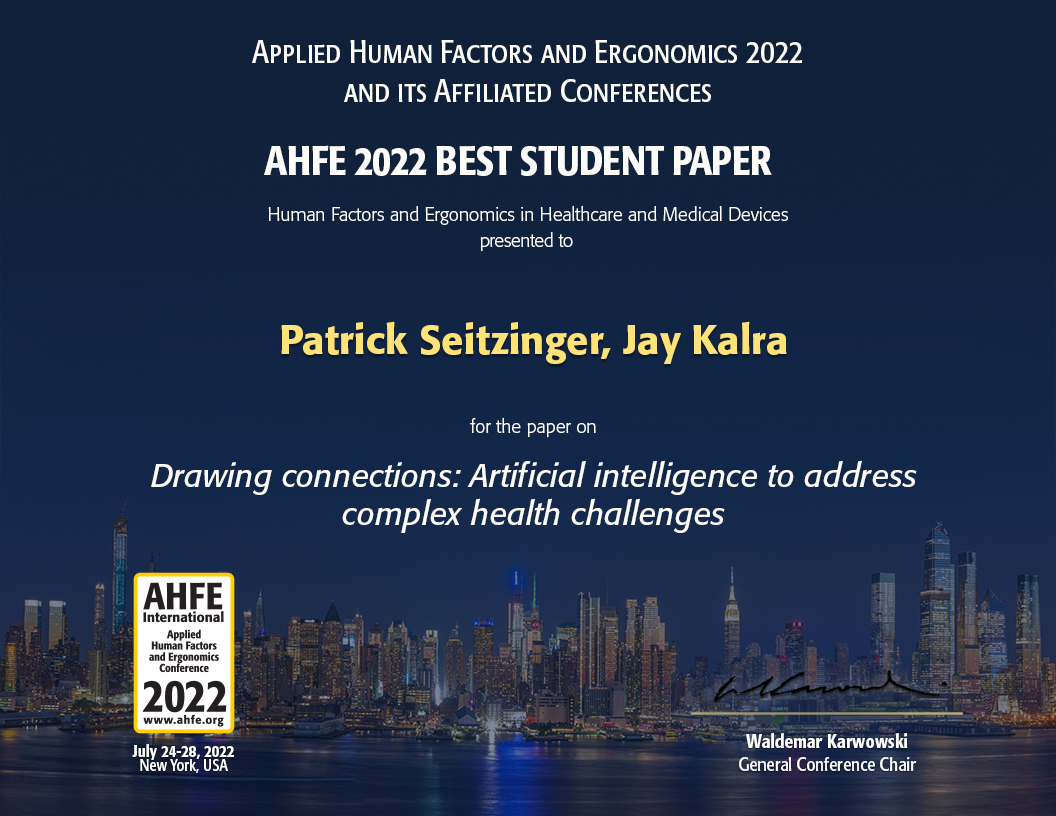
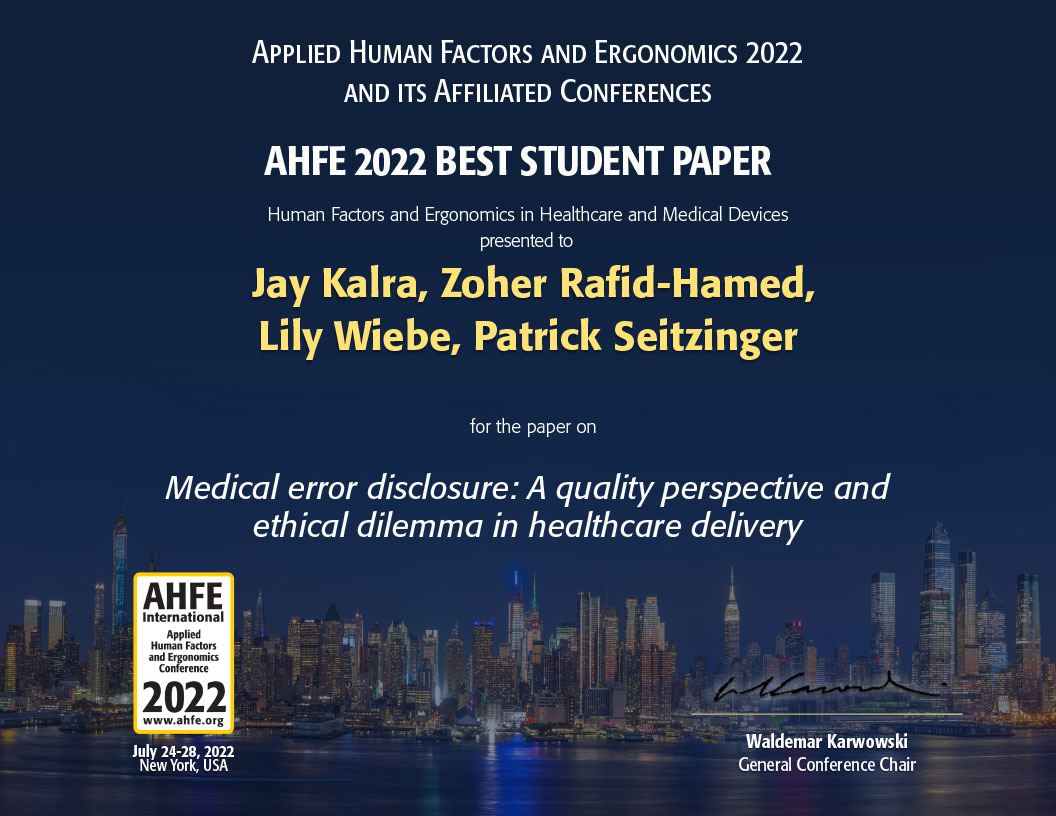
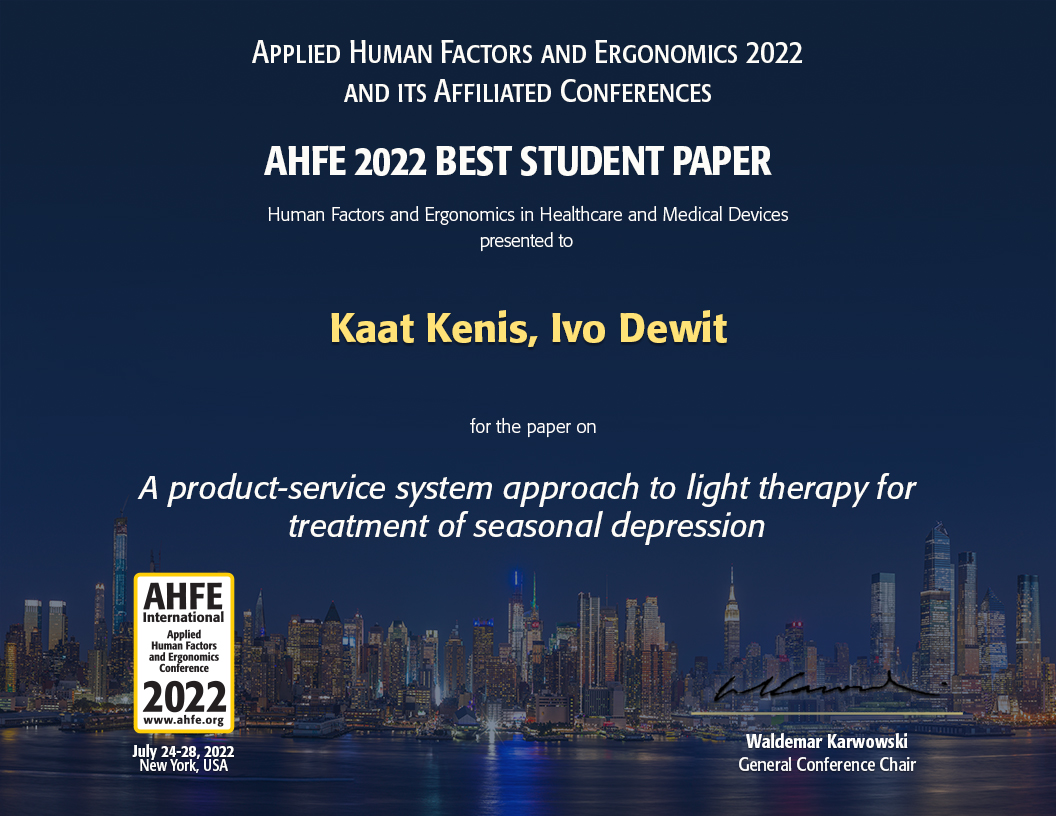
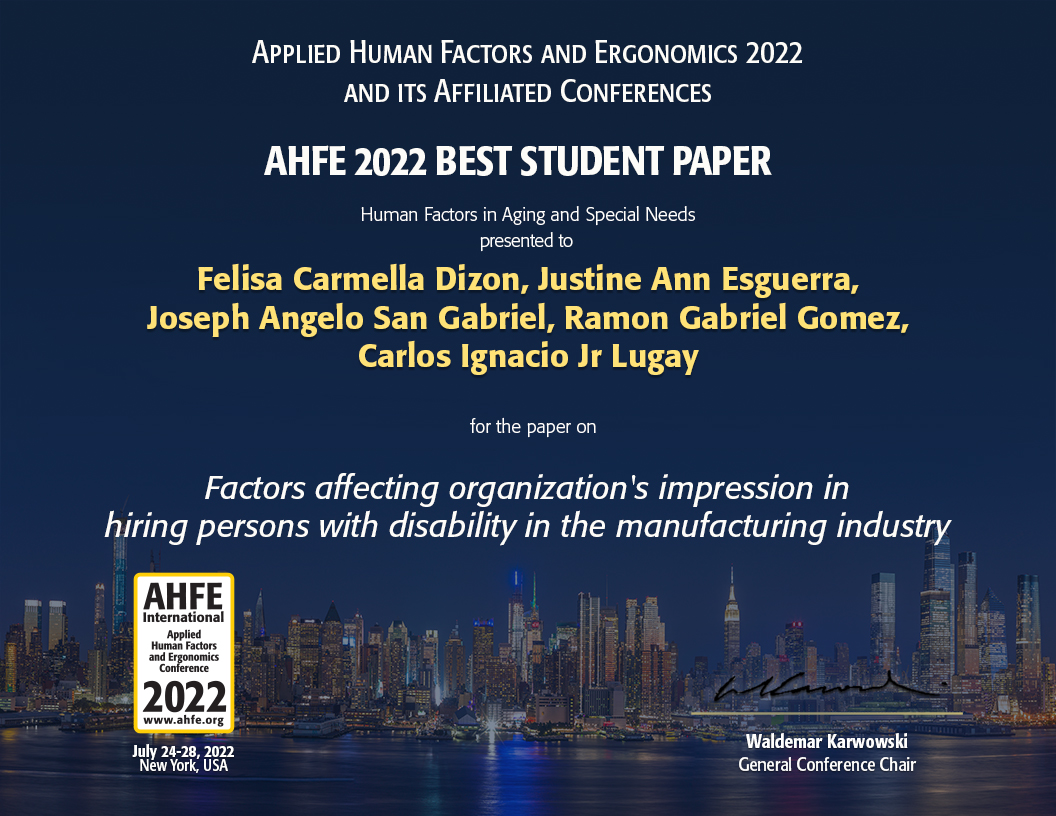
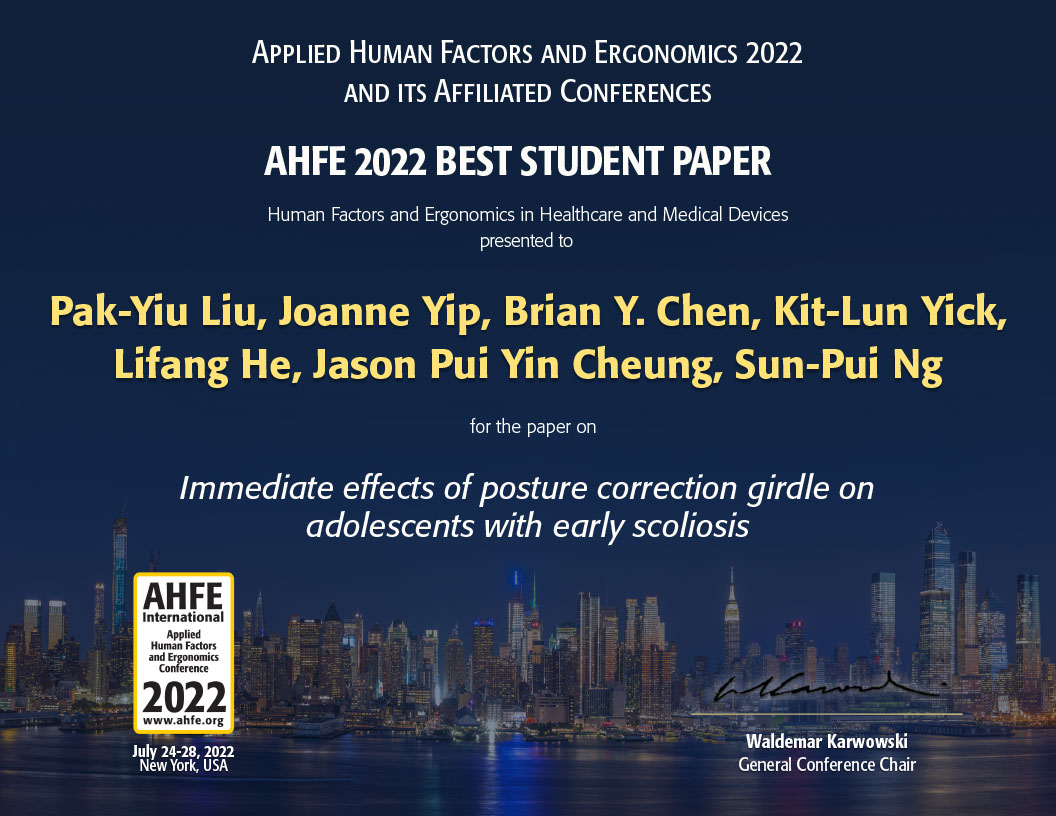
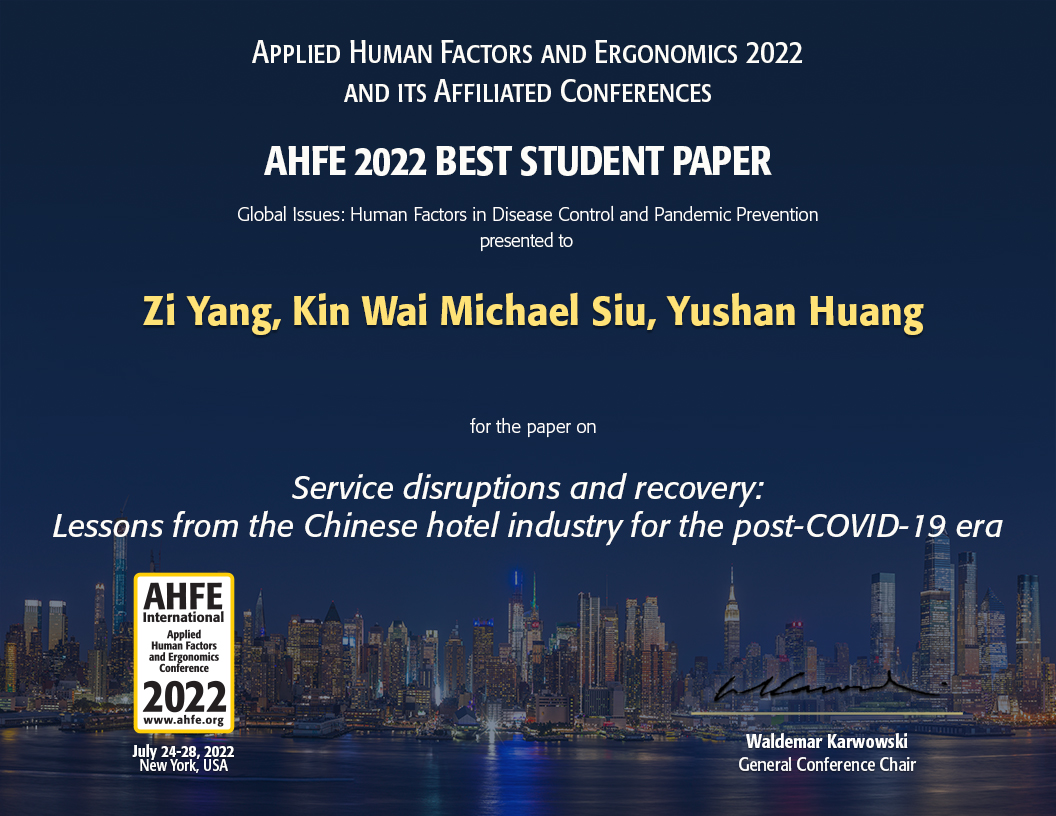
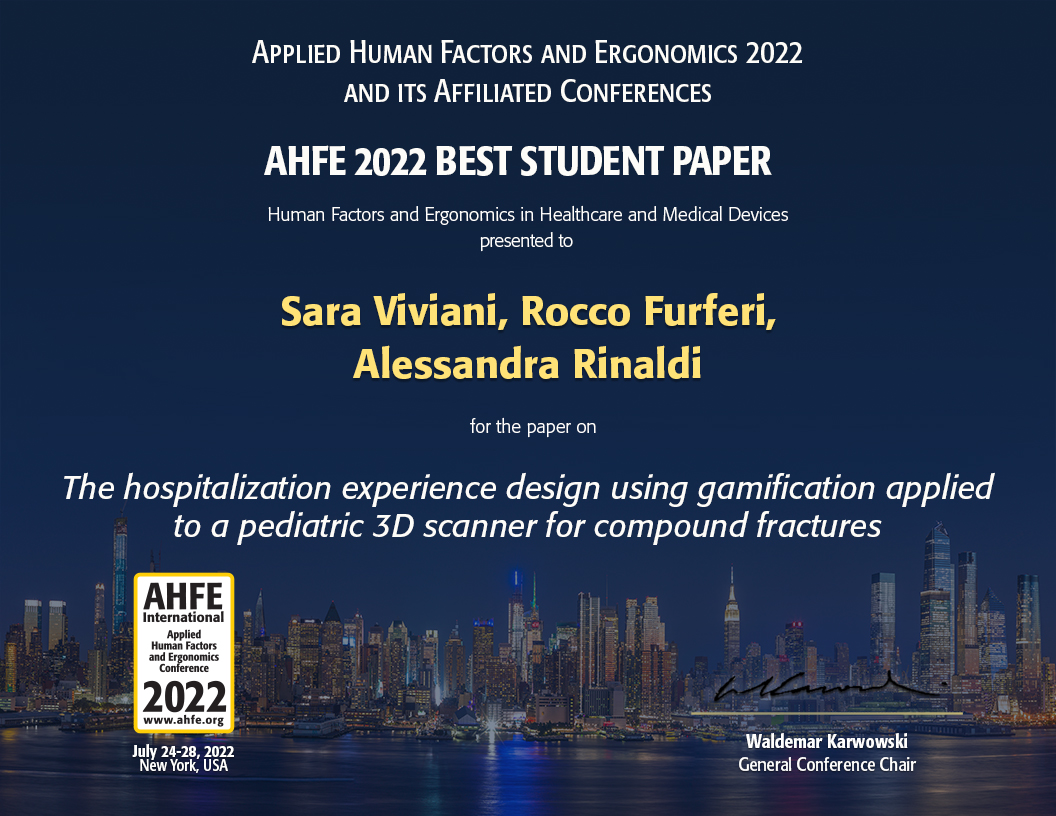
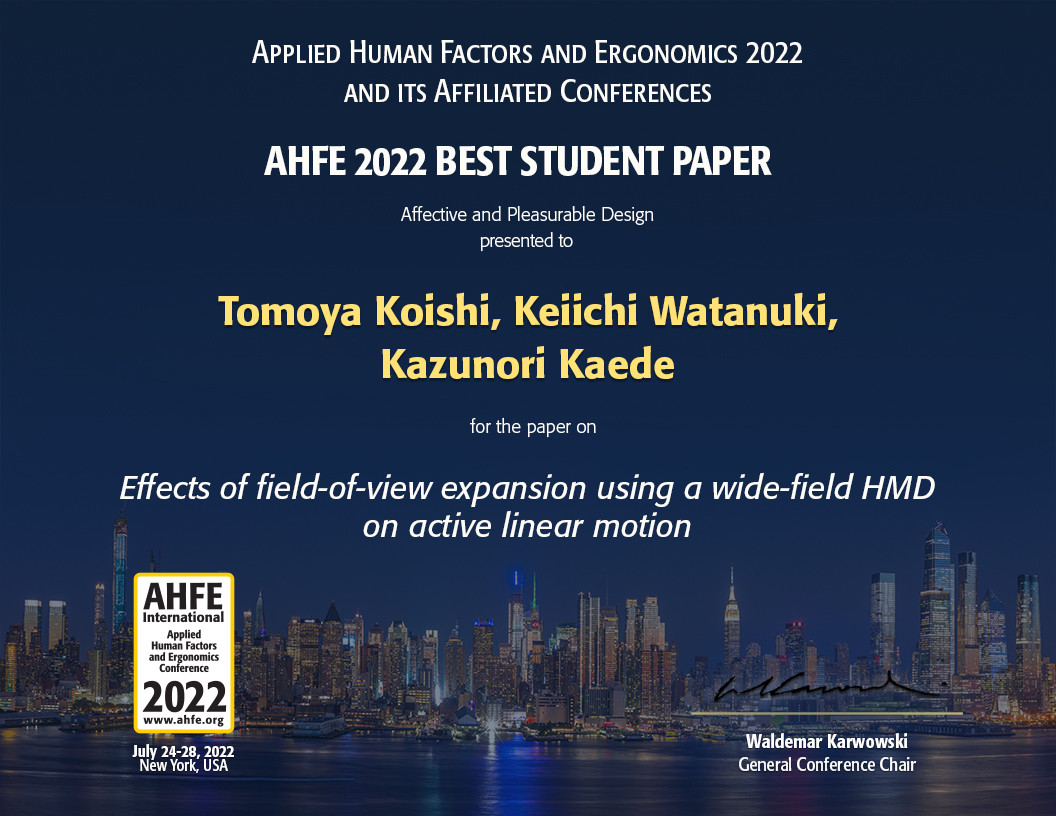
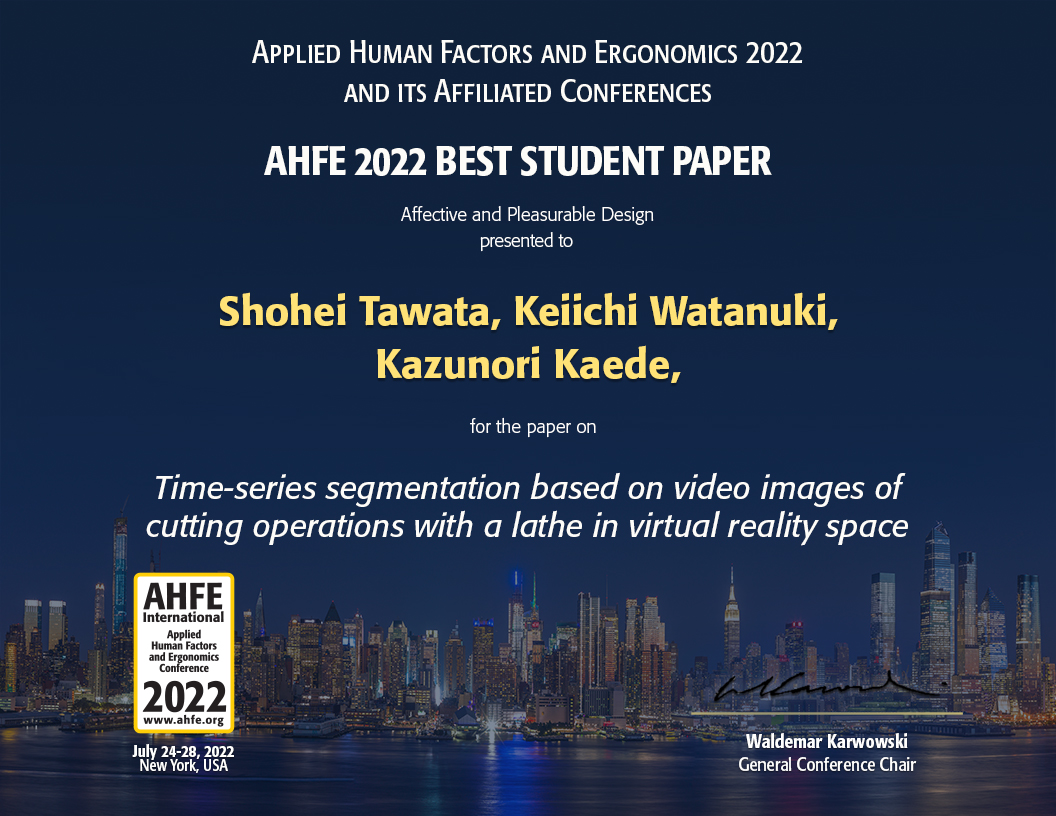
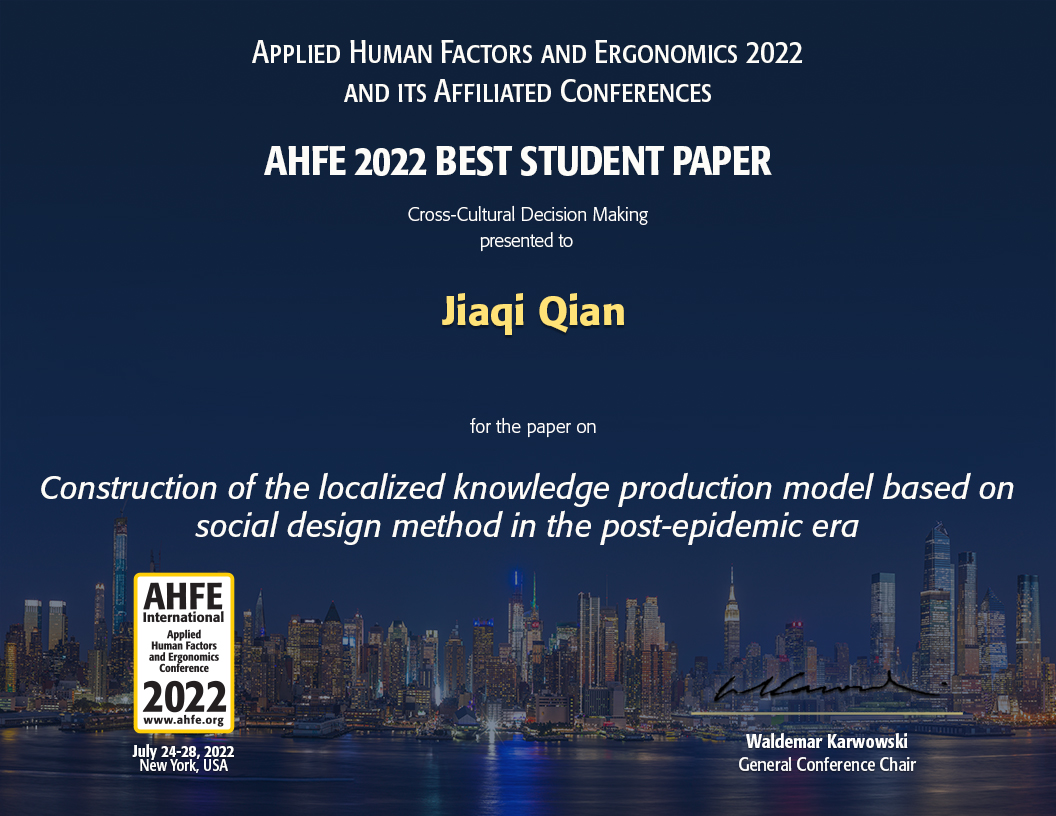
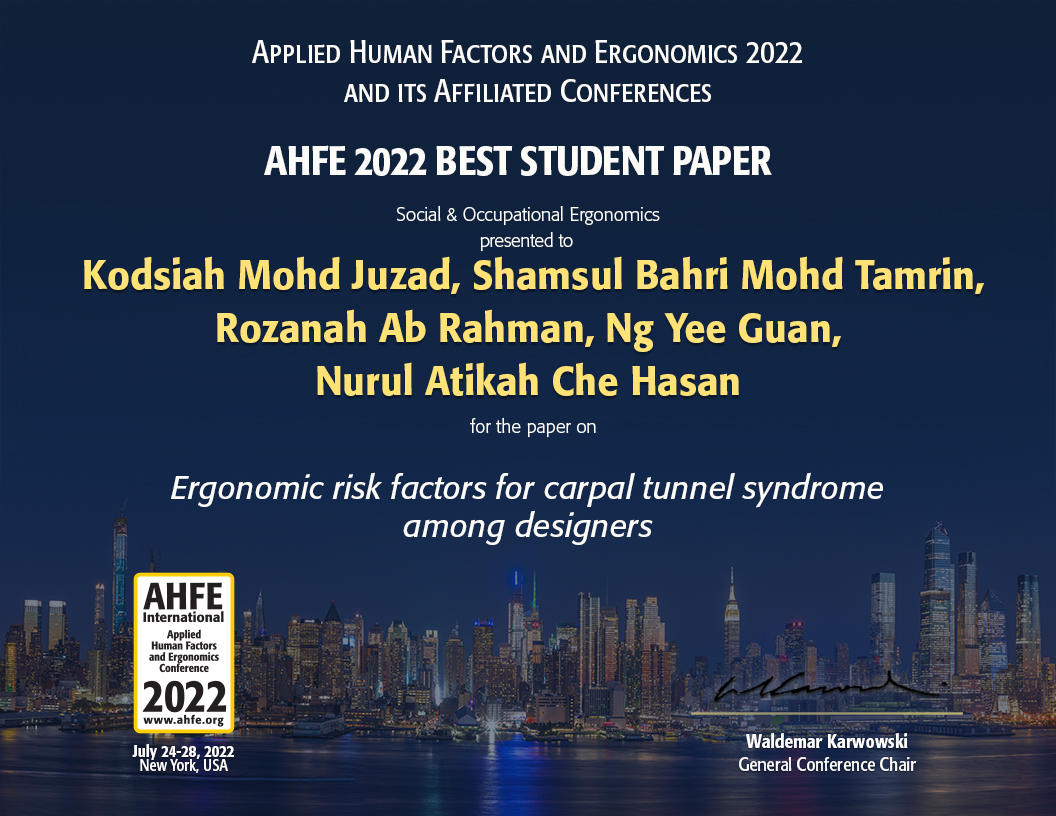
AHFE 2022 BEST STUDENT PAPER AWARDS


AHFE 2022 Best Paper Awards

🏆 Best Paper Awards


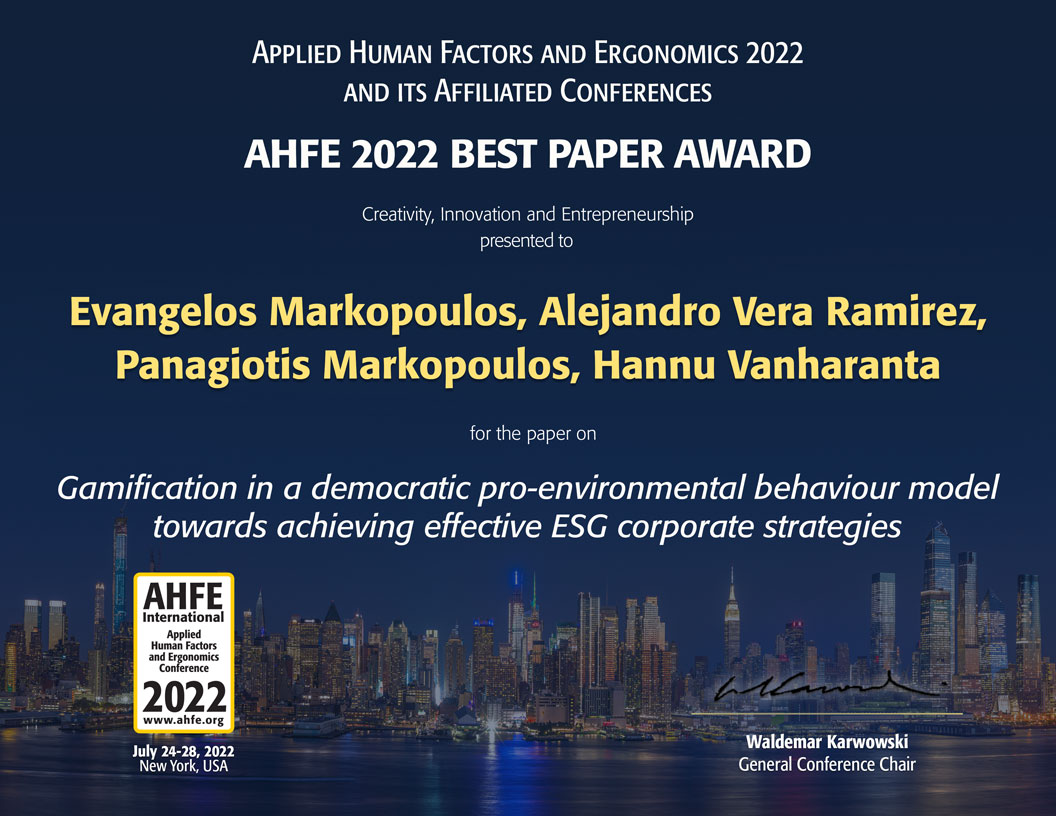
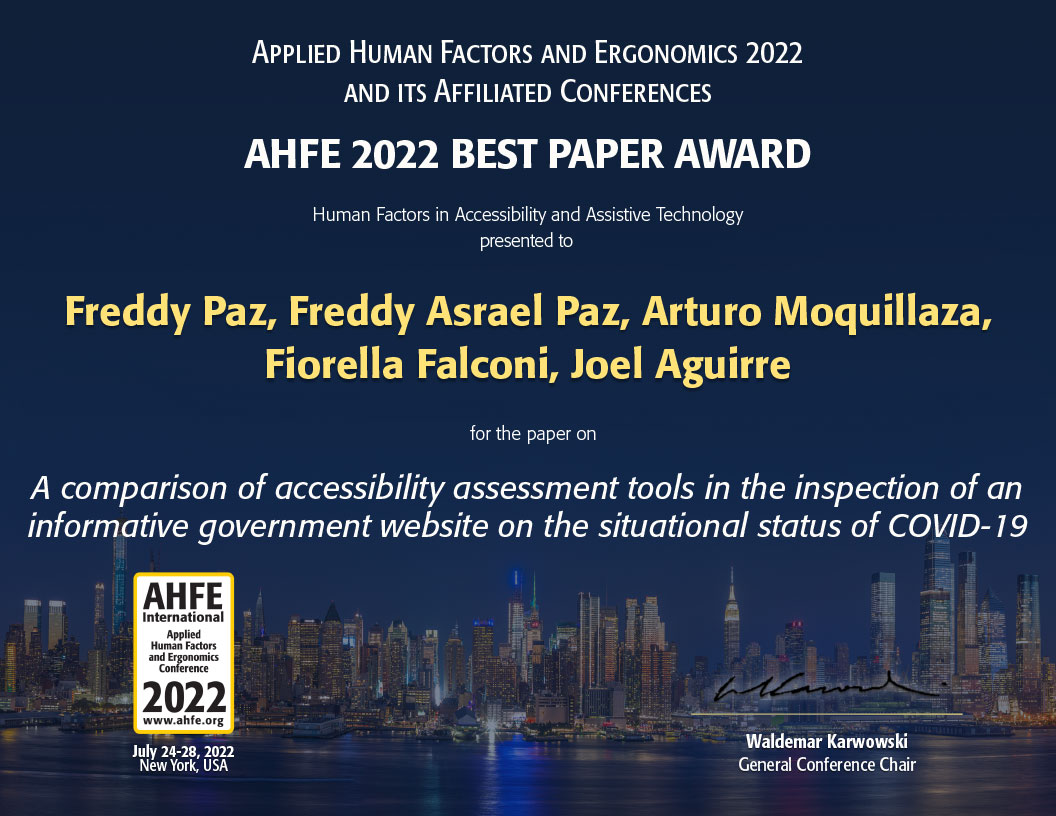
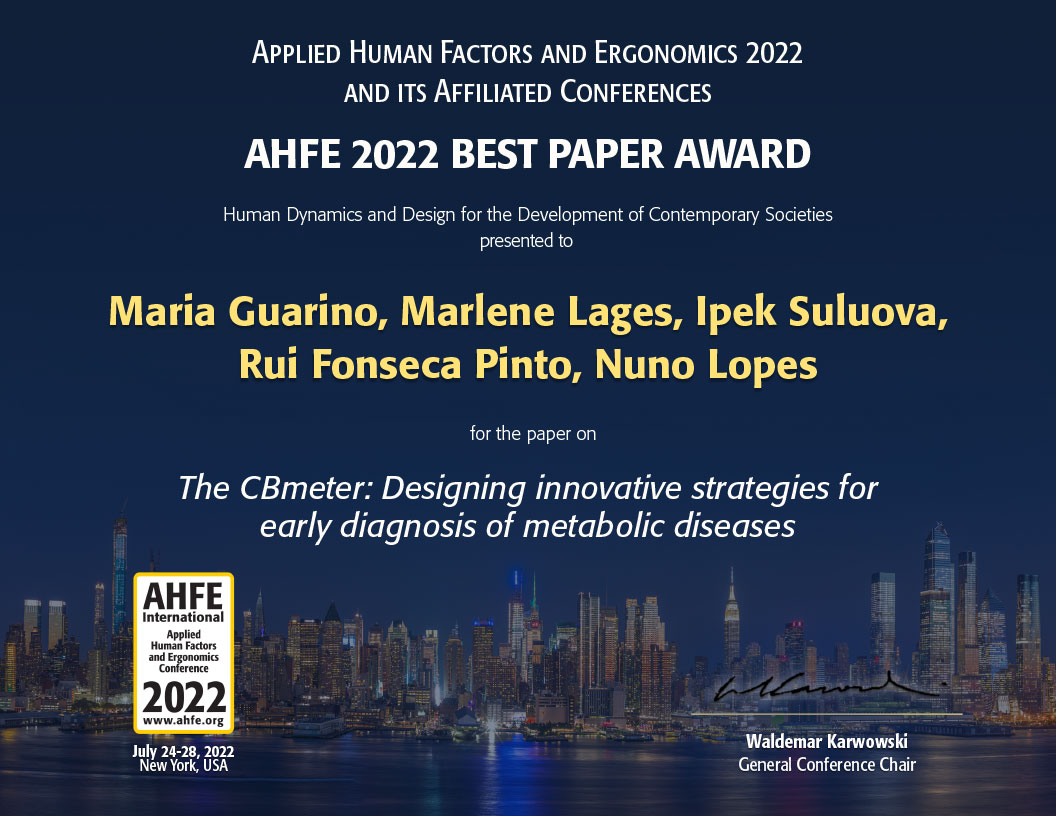
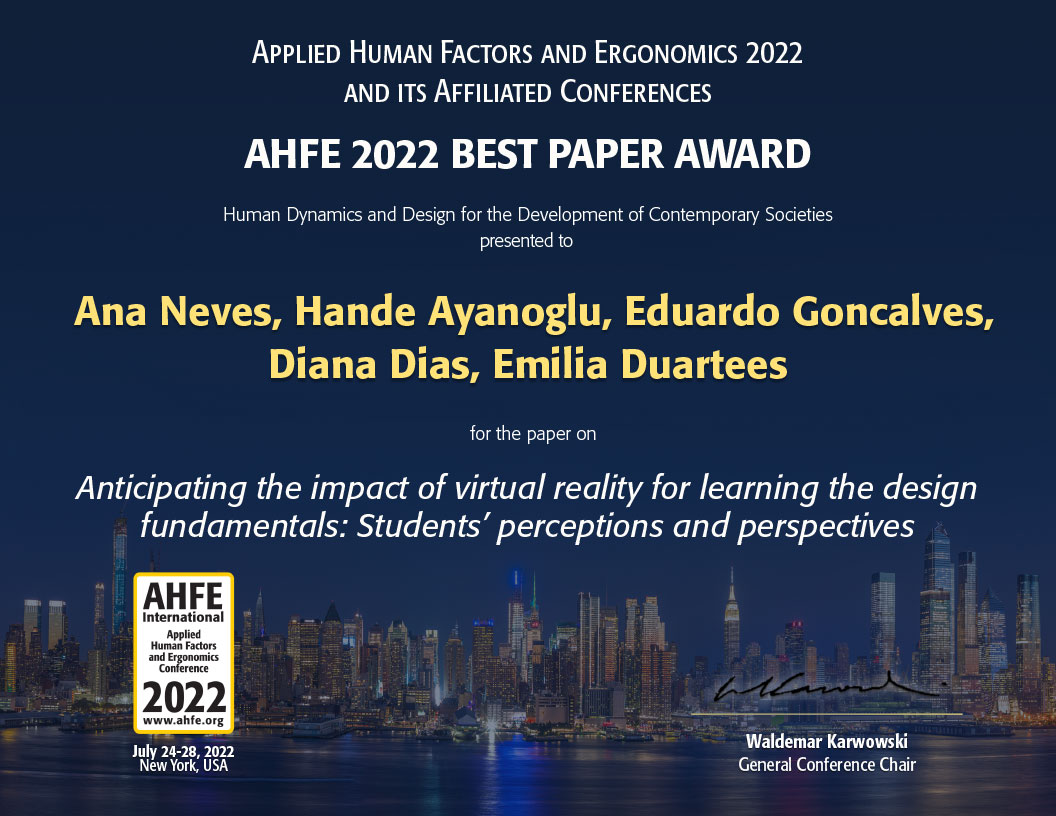
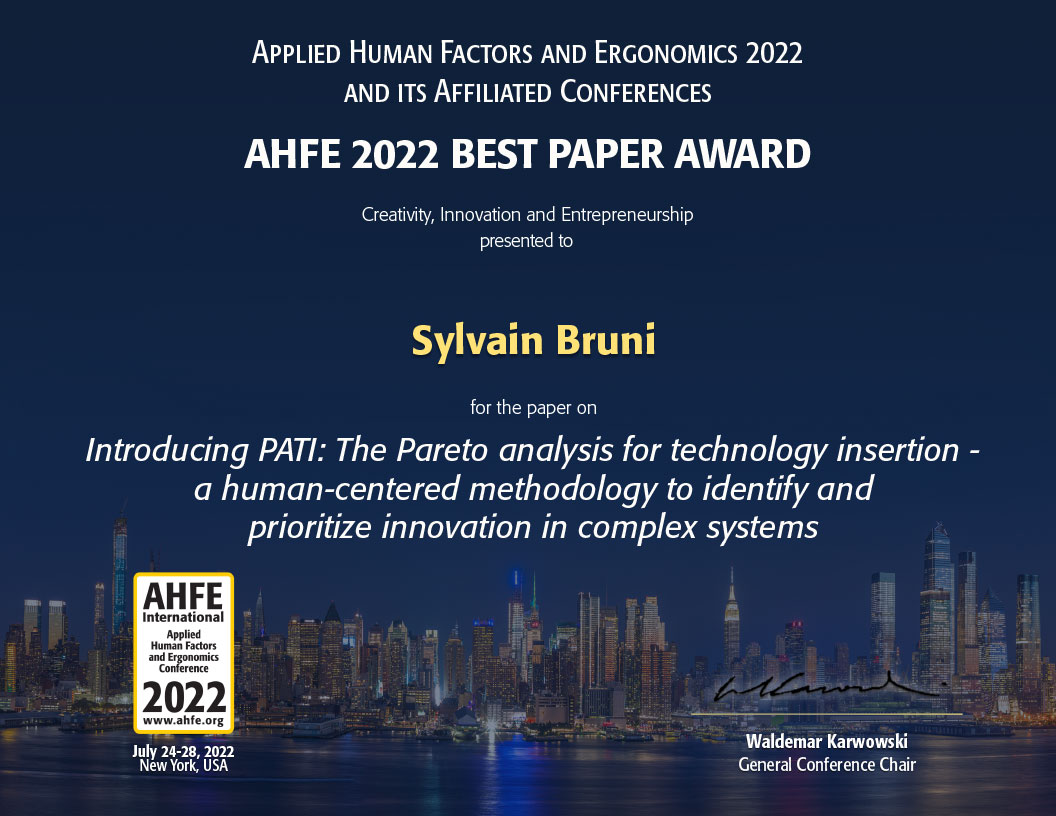
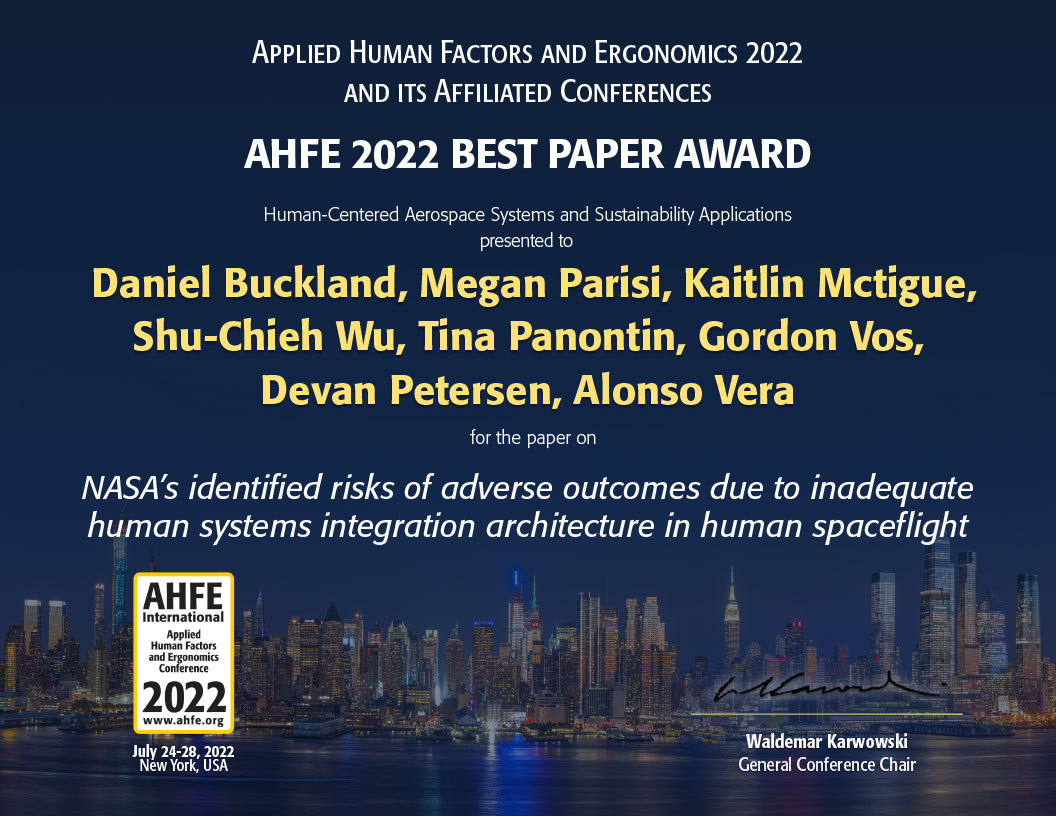
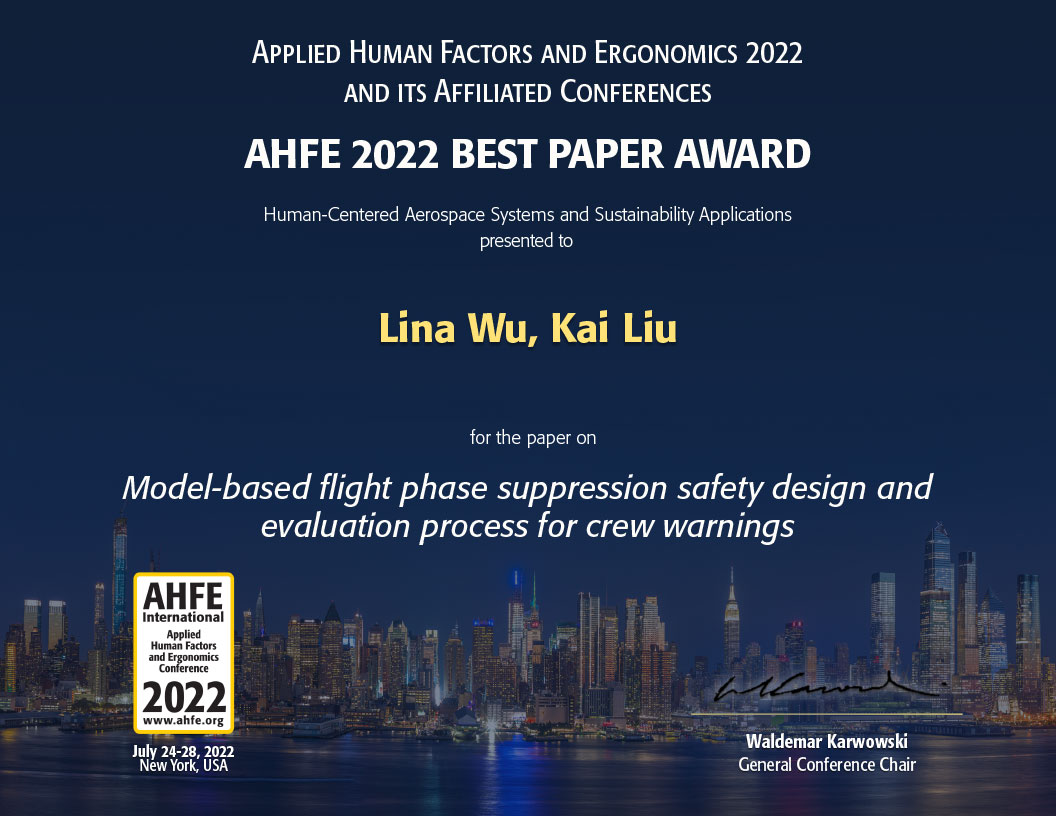
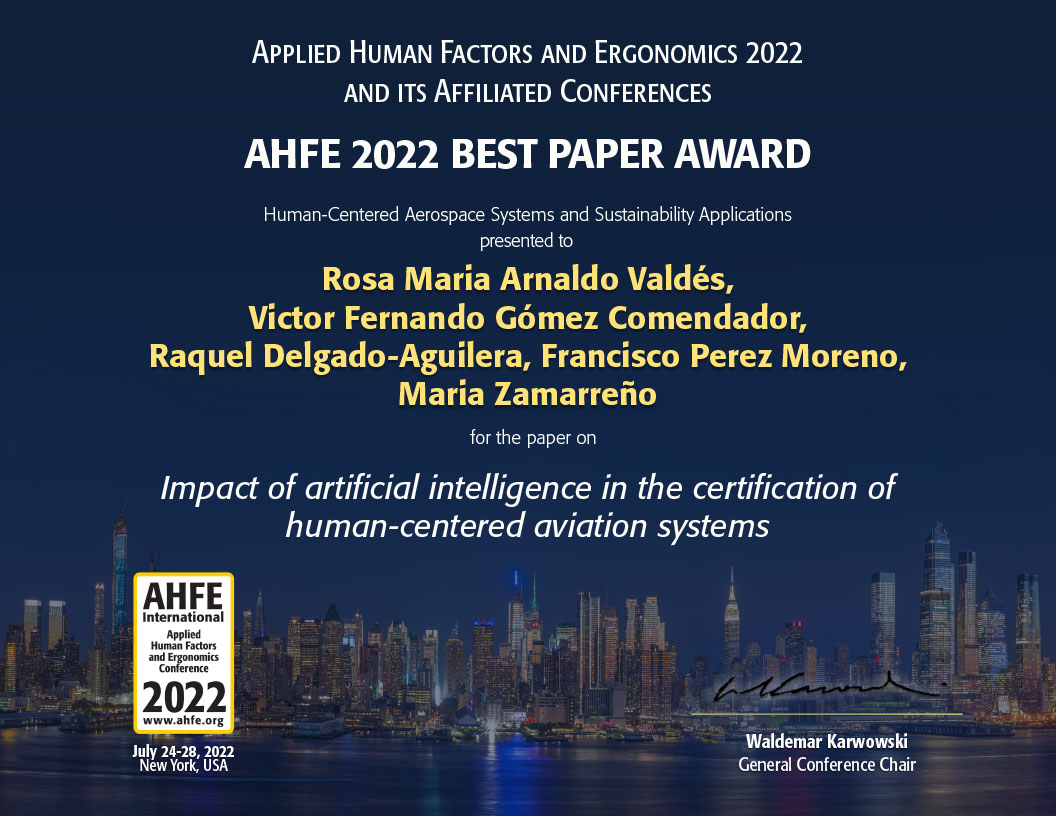
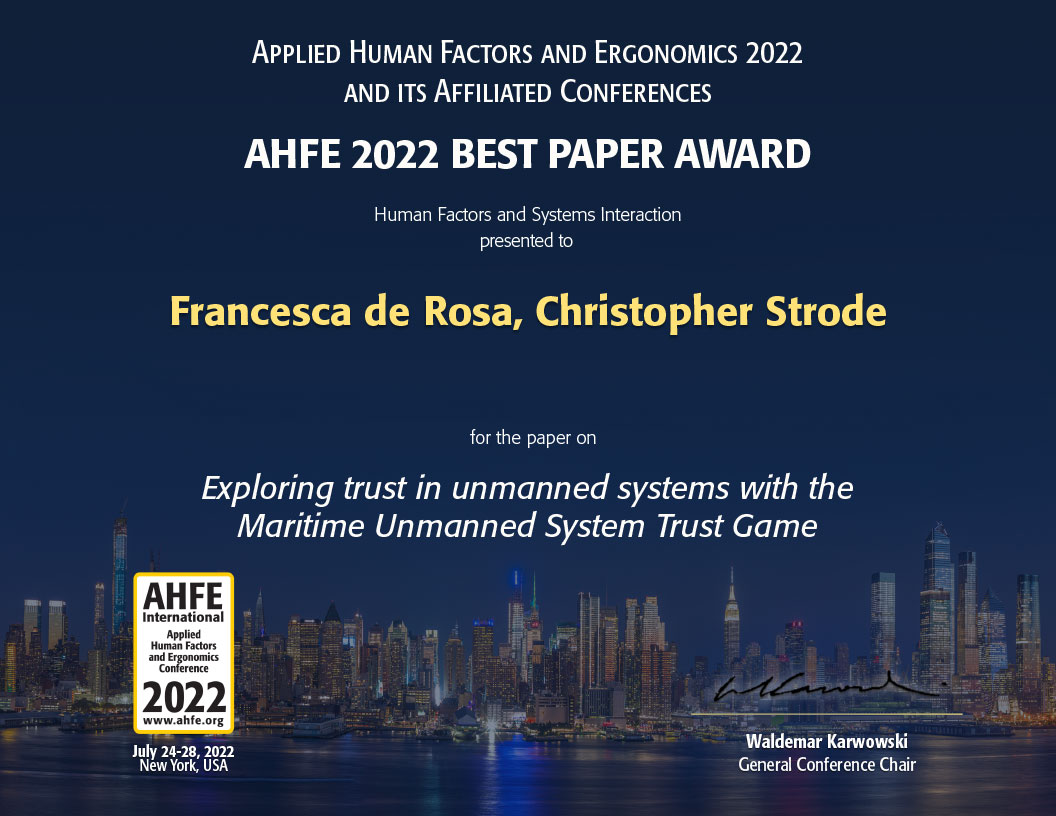
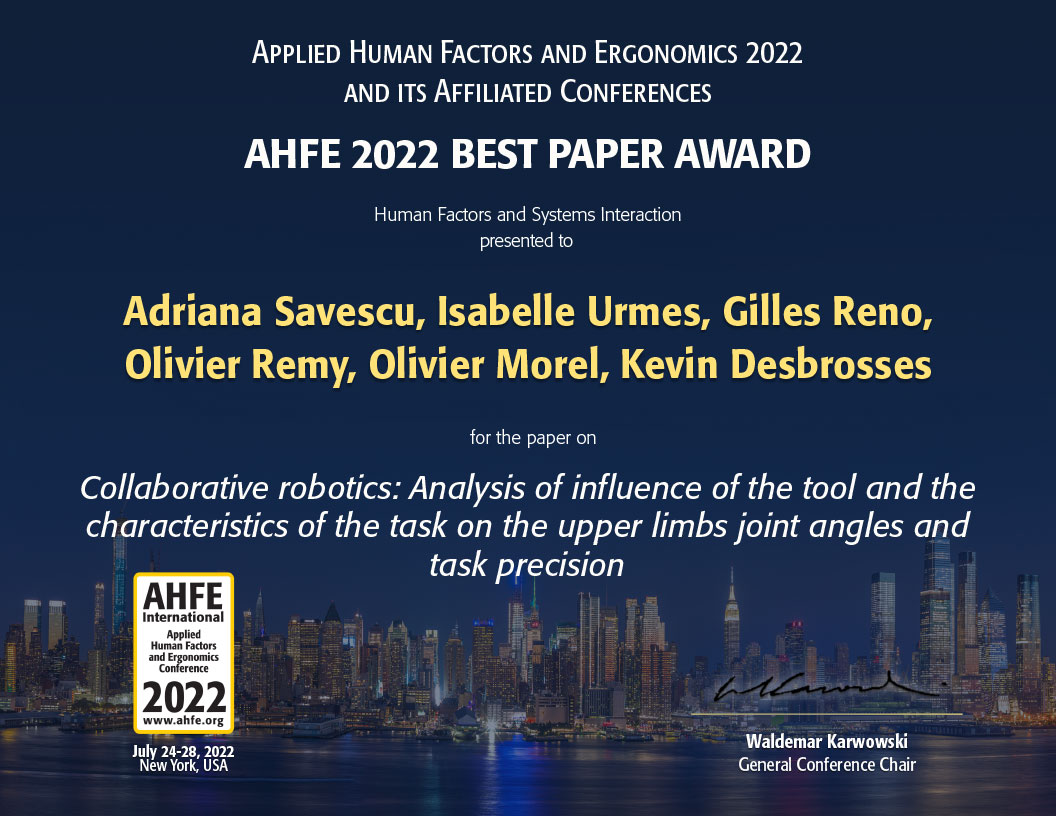
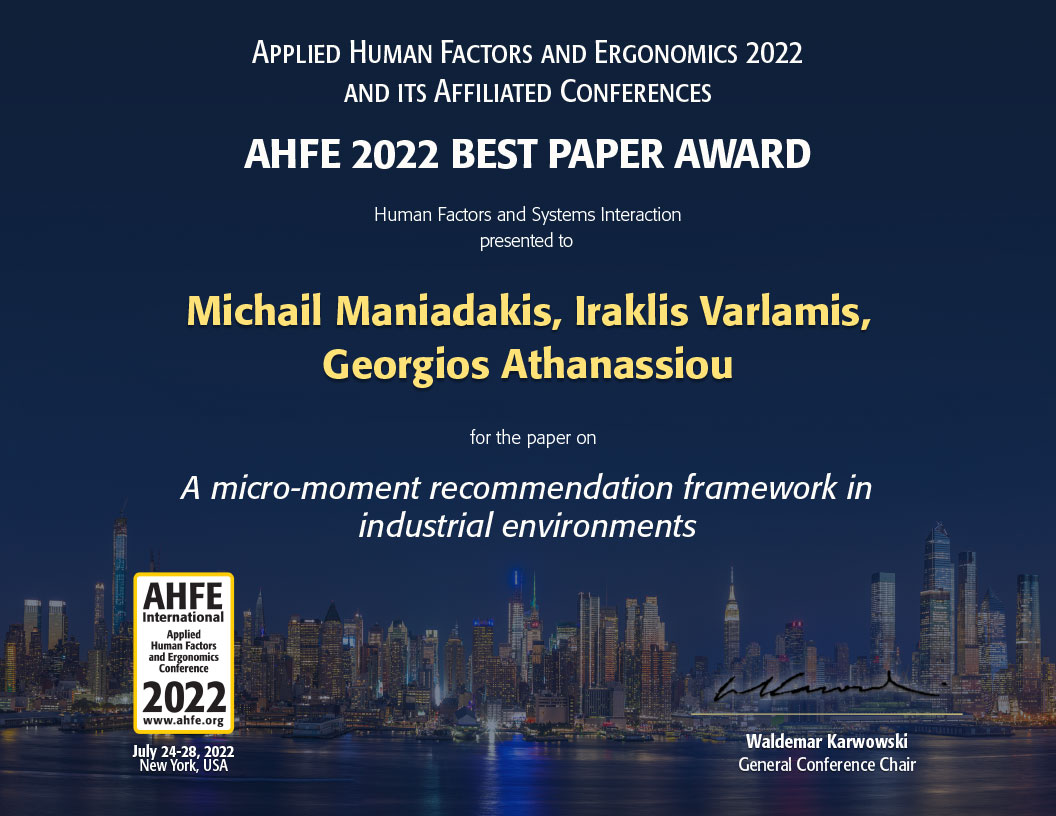
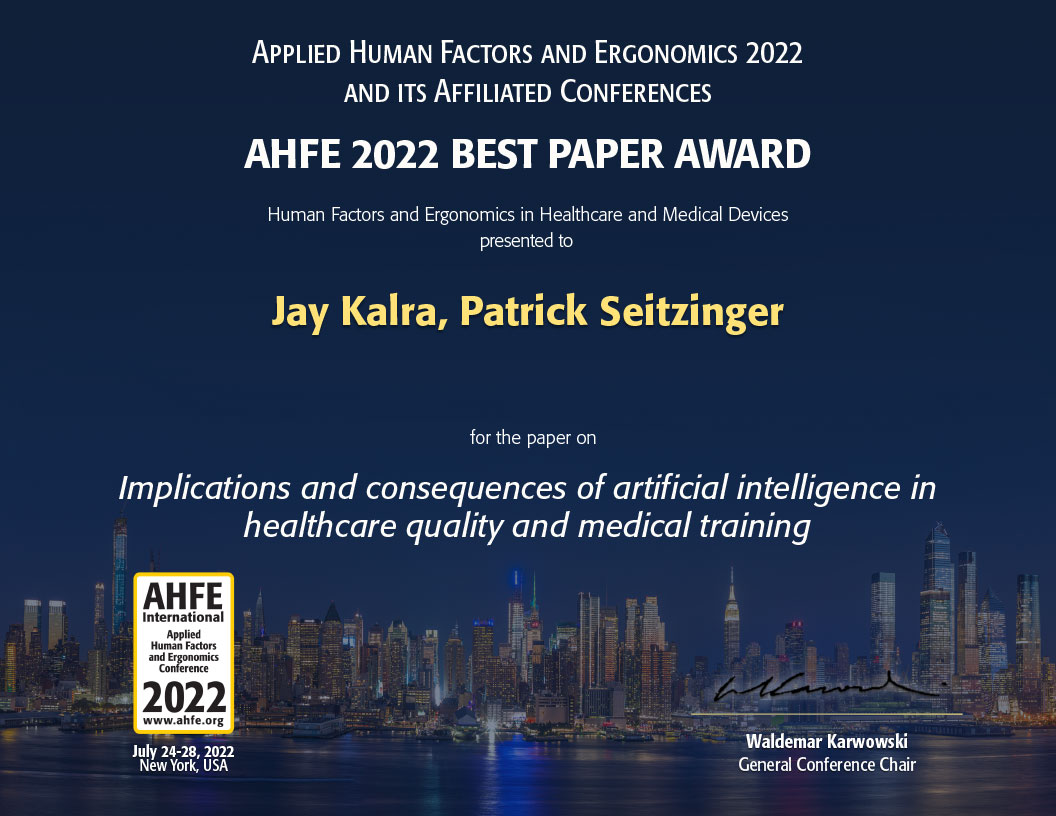
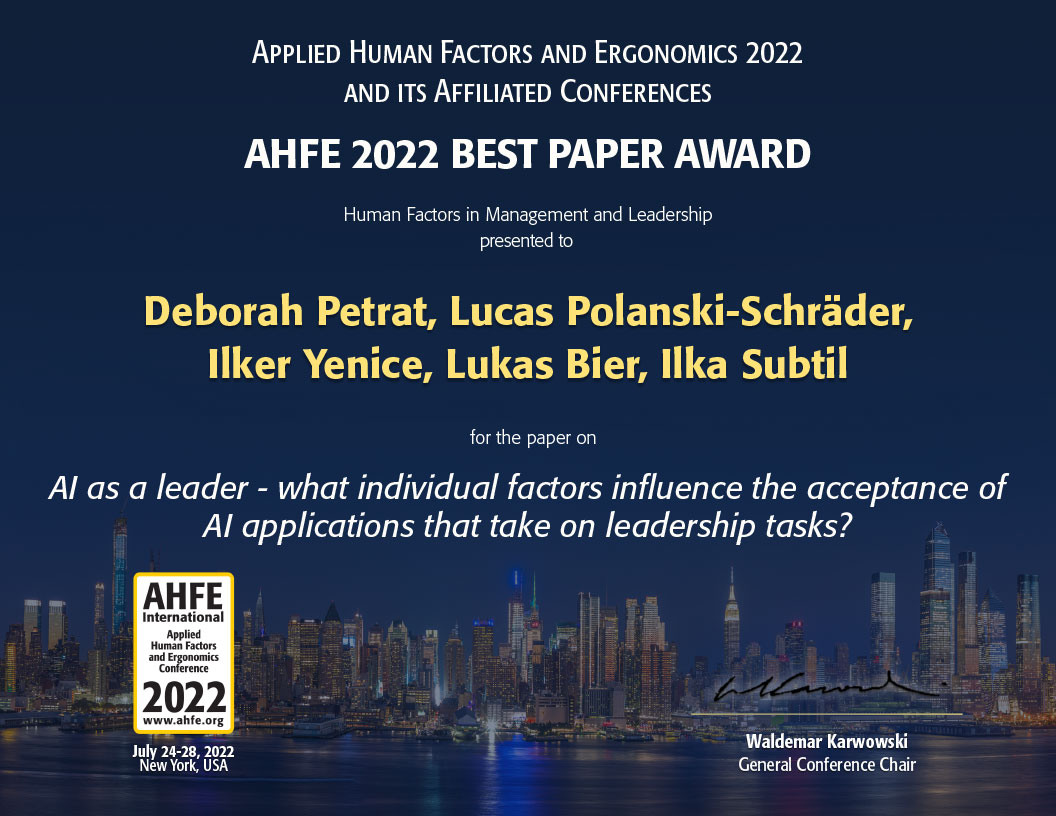
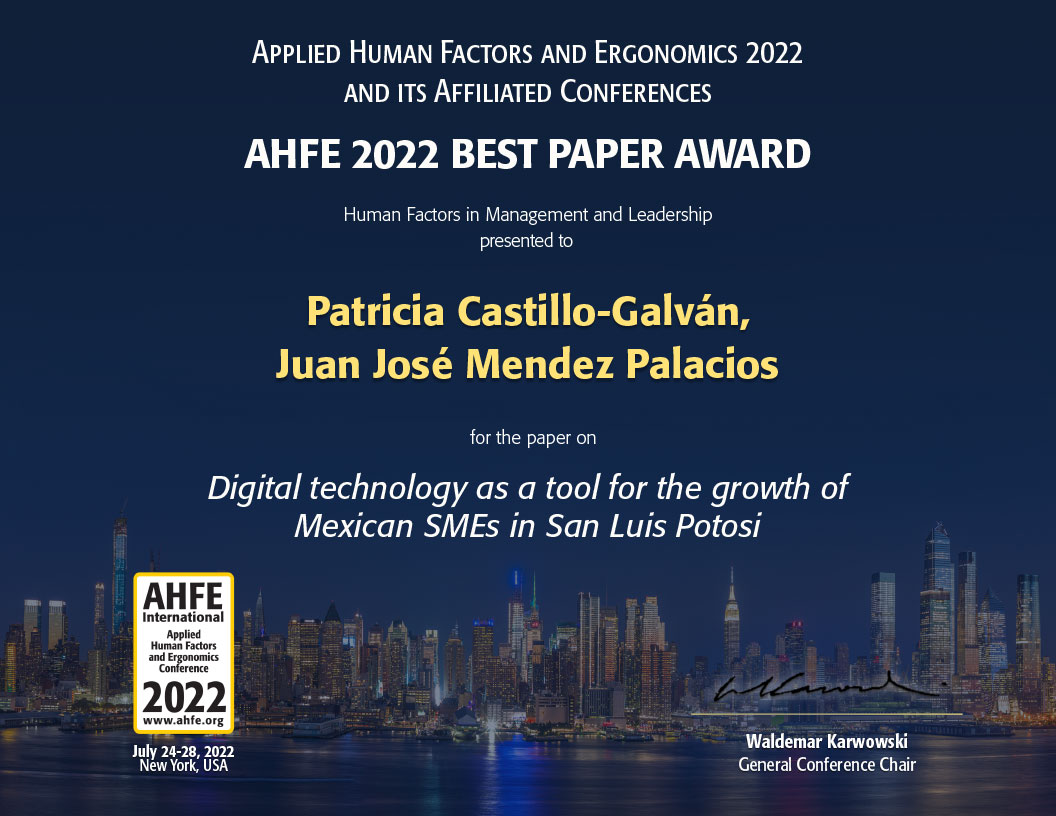
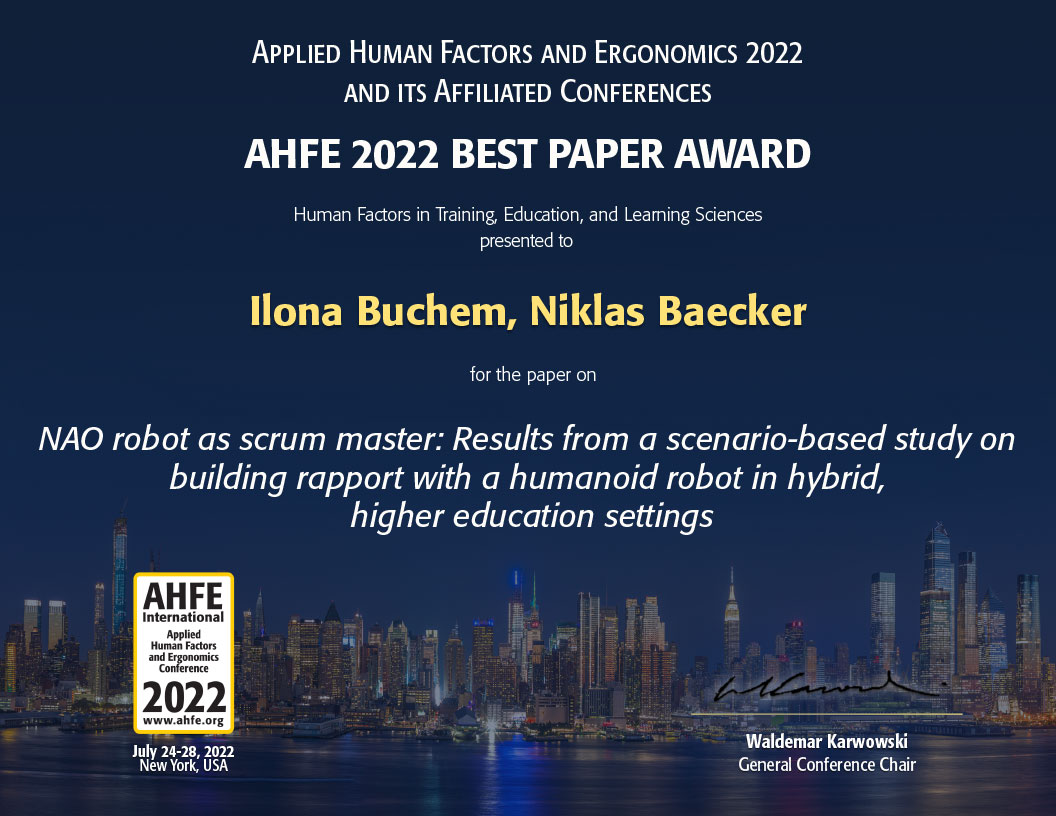
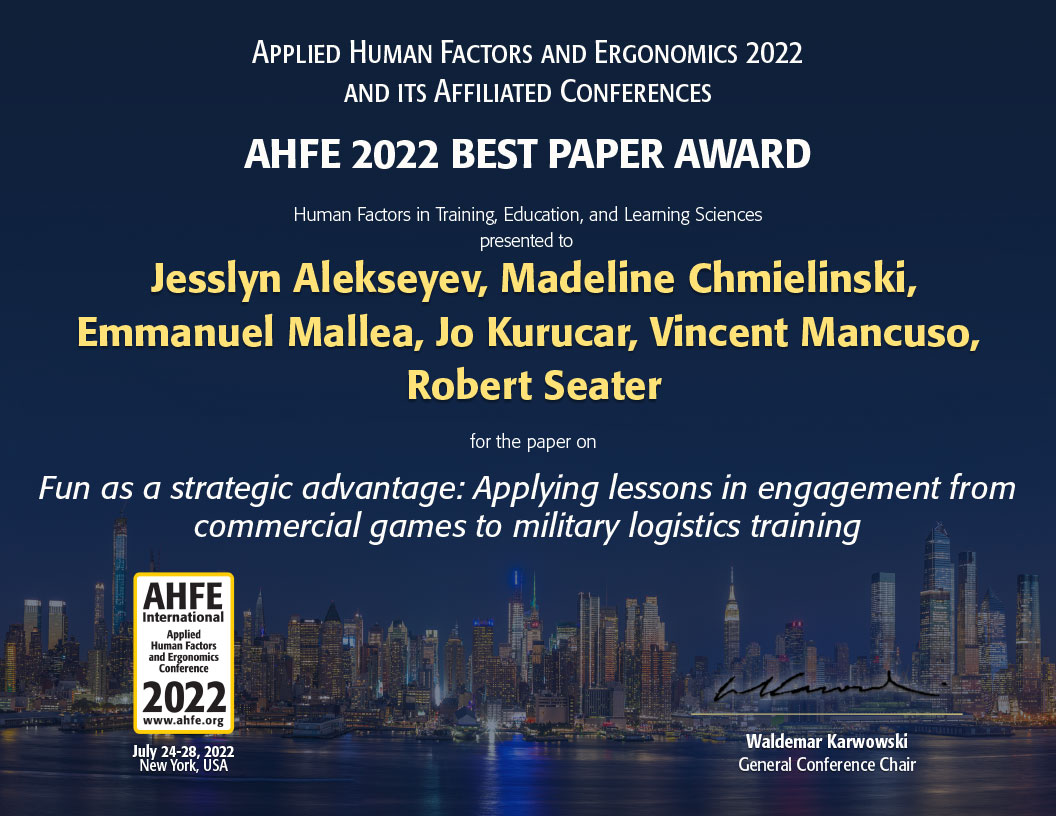
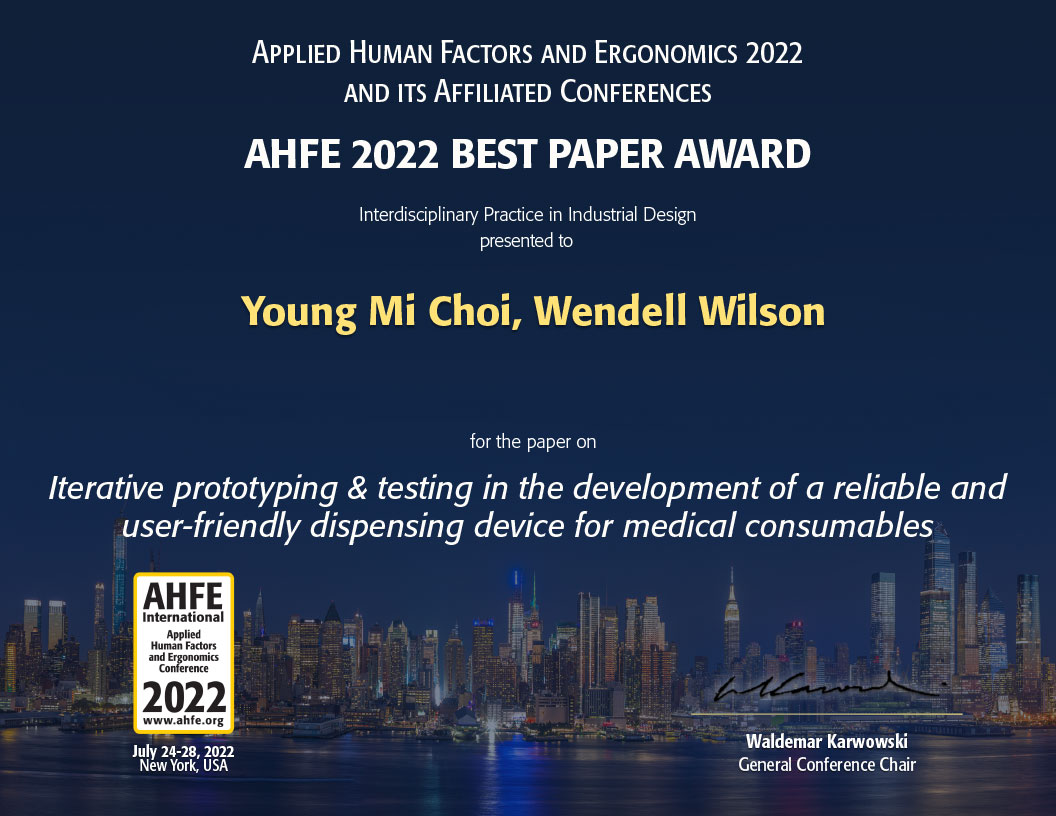
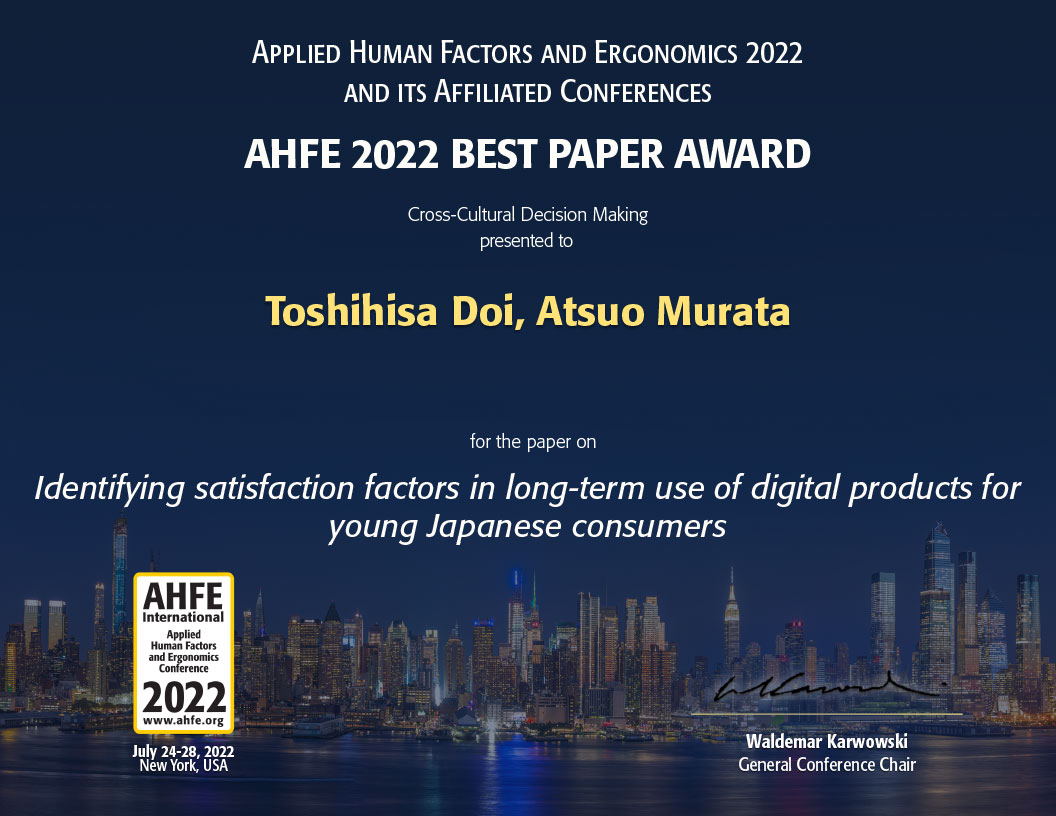
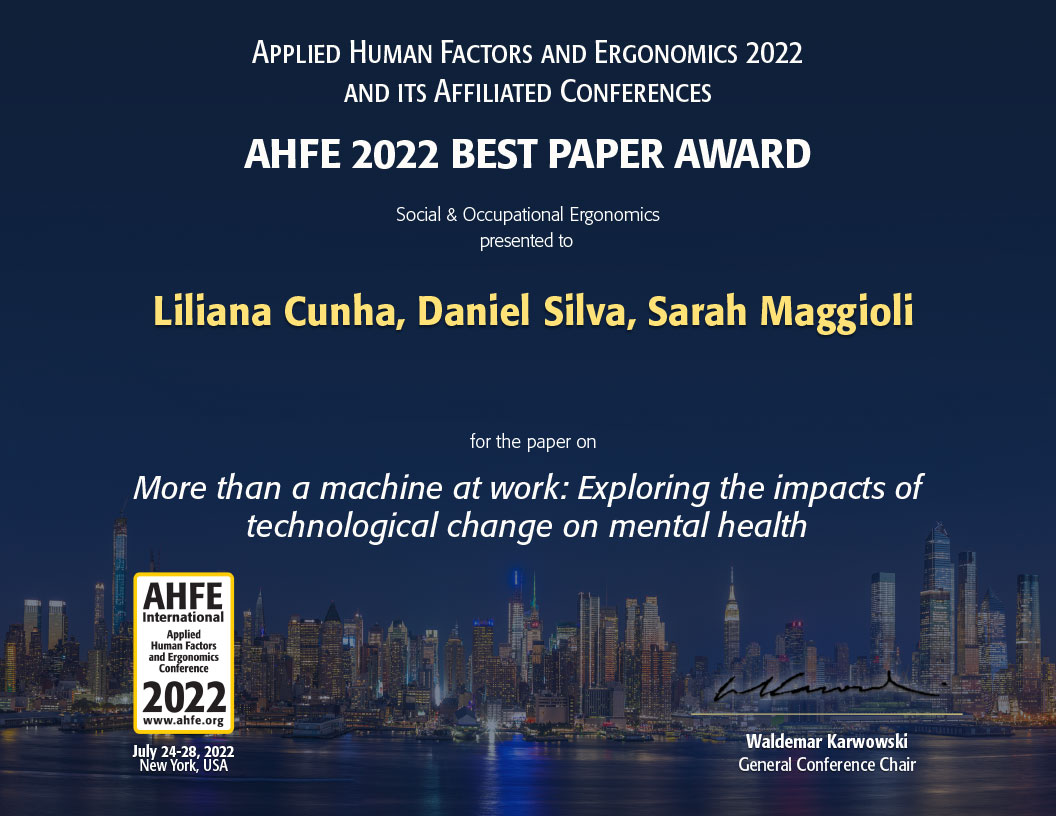
AHFE 2022 BEST PAPER AWARDS


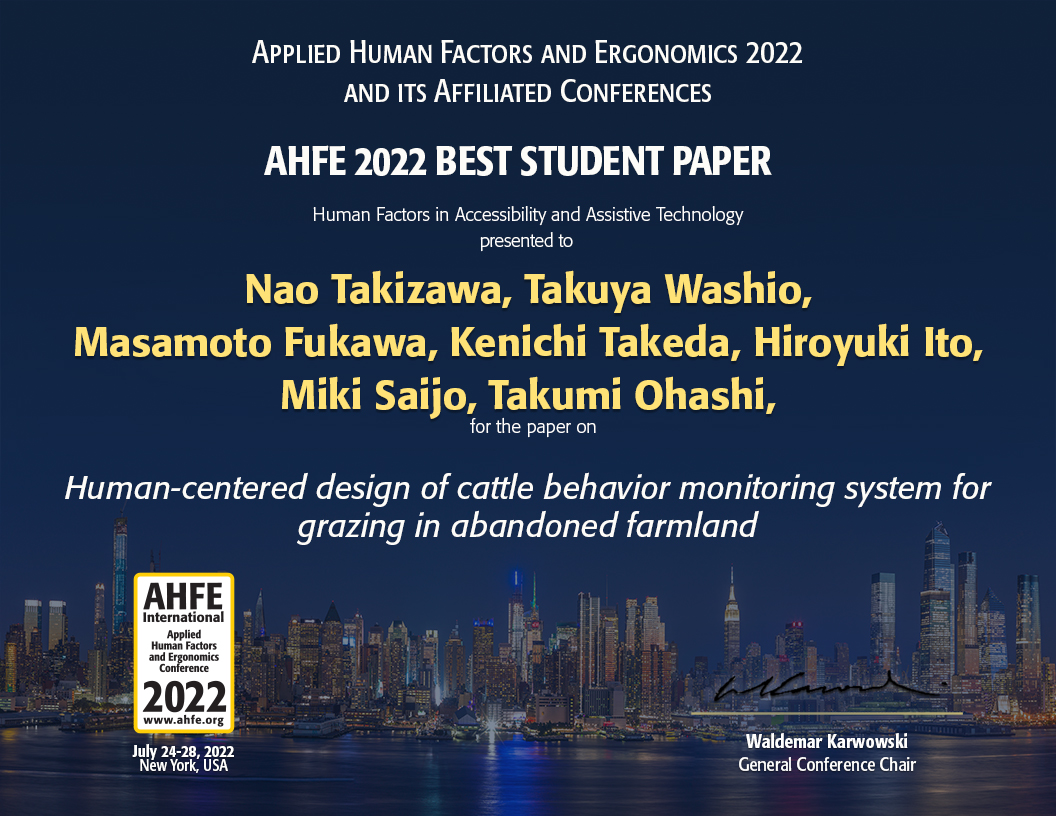
AHFE 2022 BEST STUDENT PAPER AWARDS


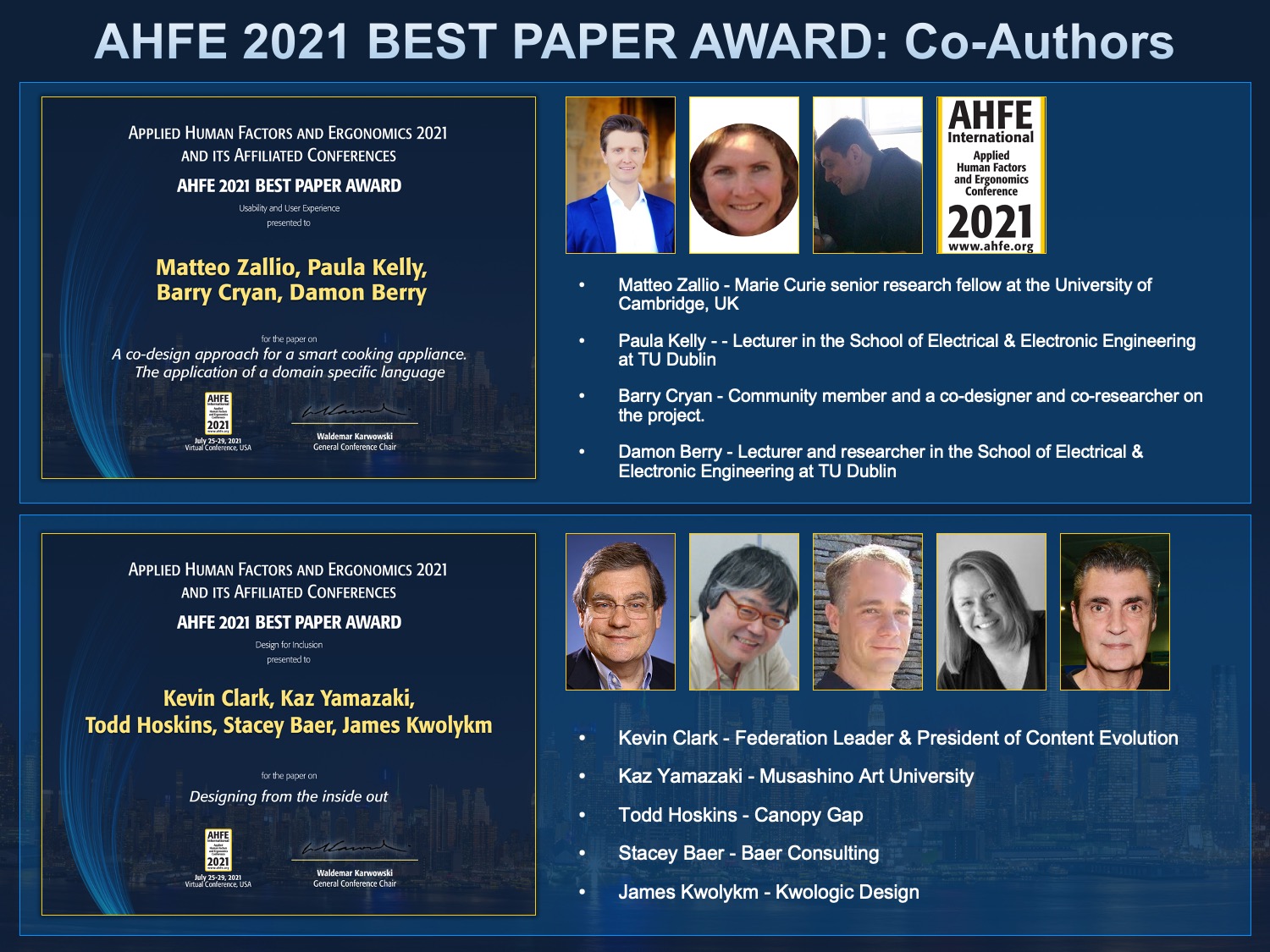
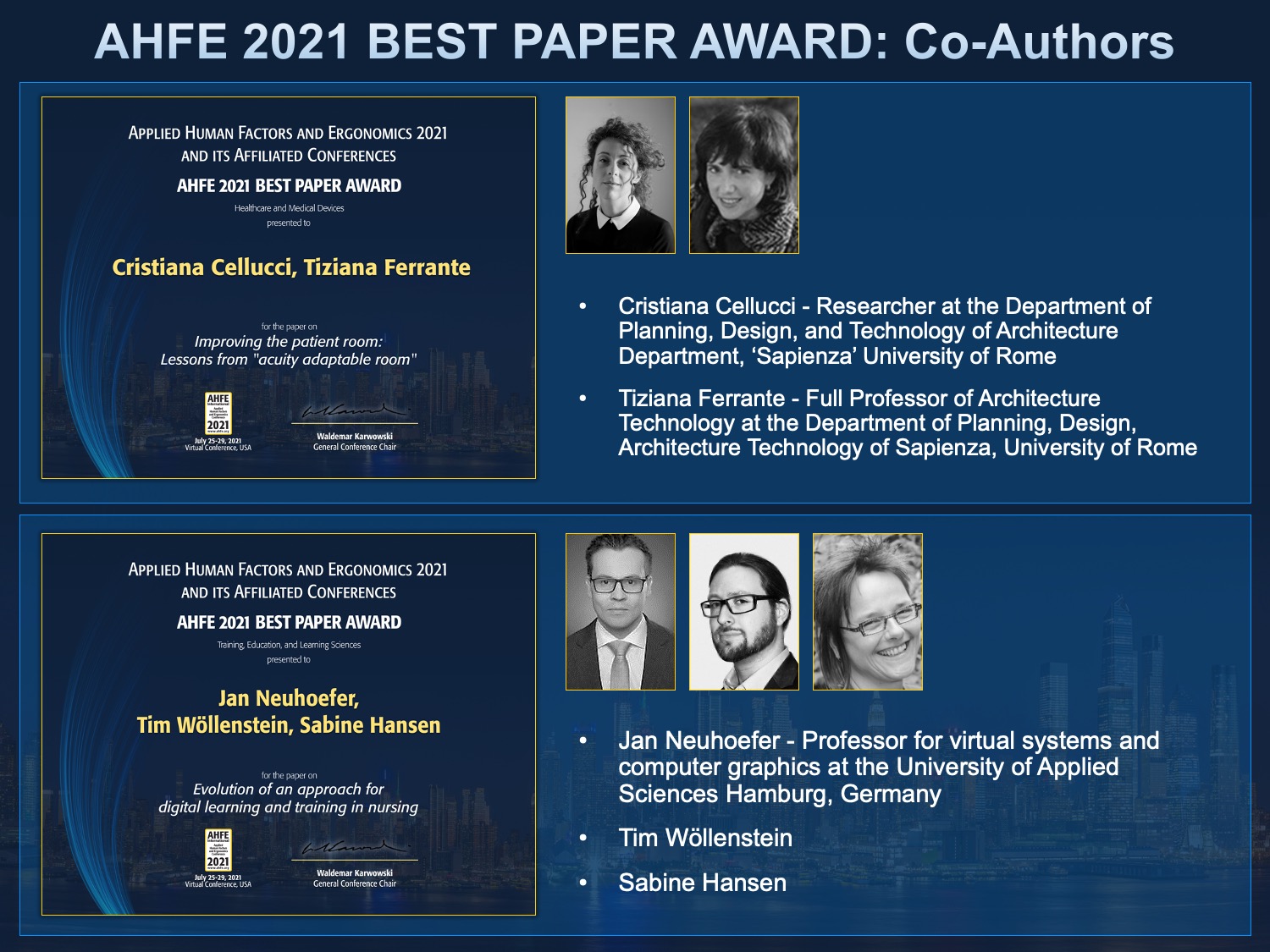
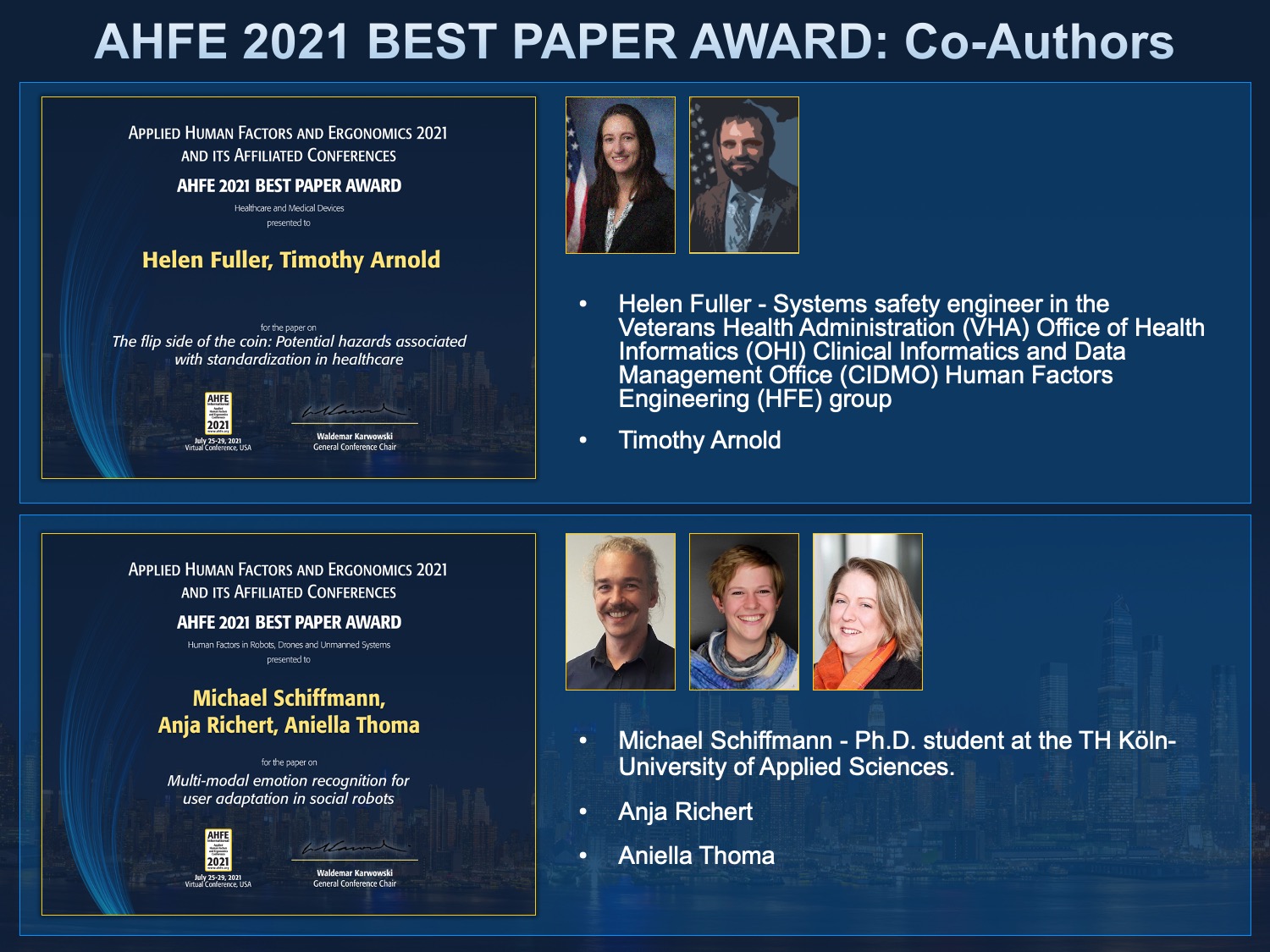
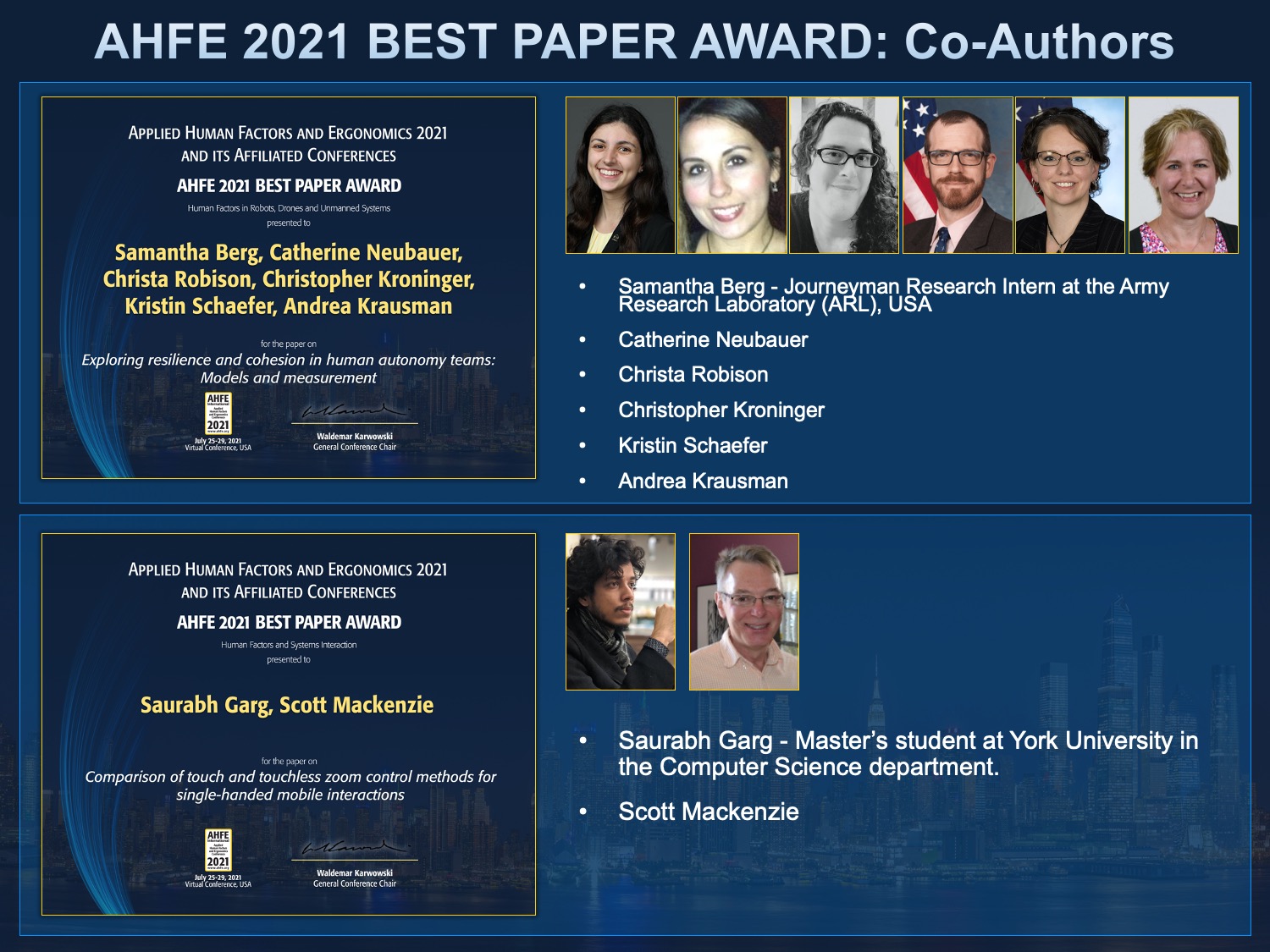
AHFE 2021 Best Paper Awards

🏆 Best Paper Awards


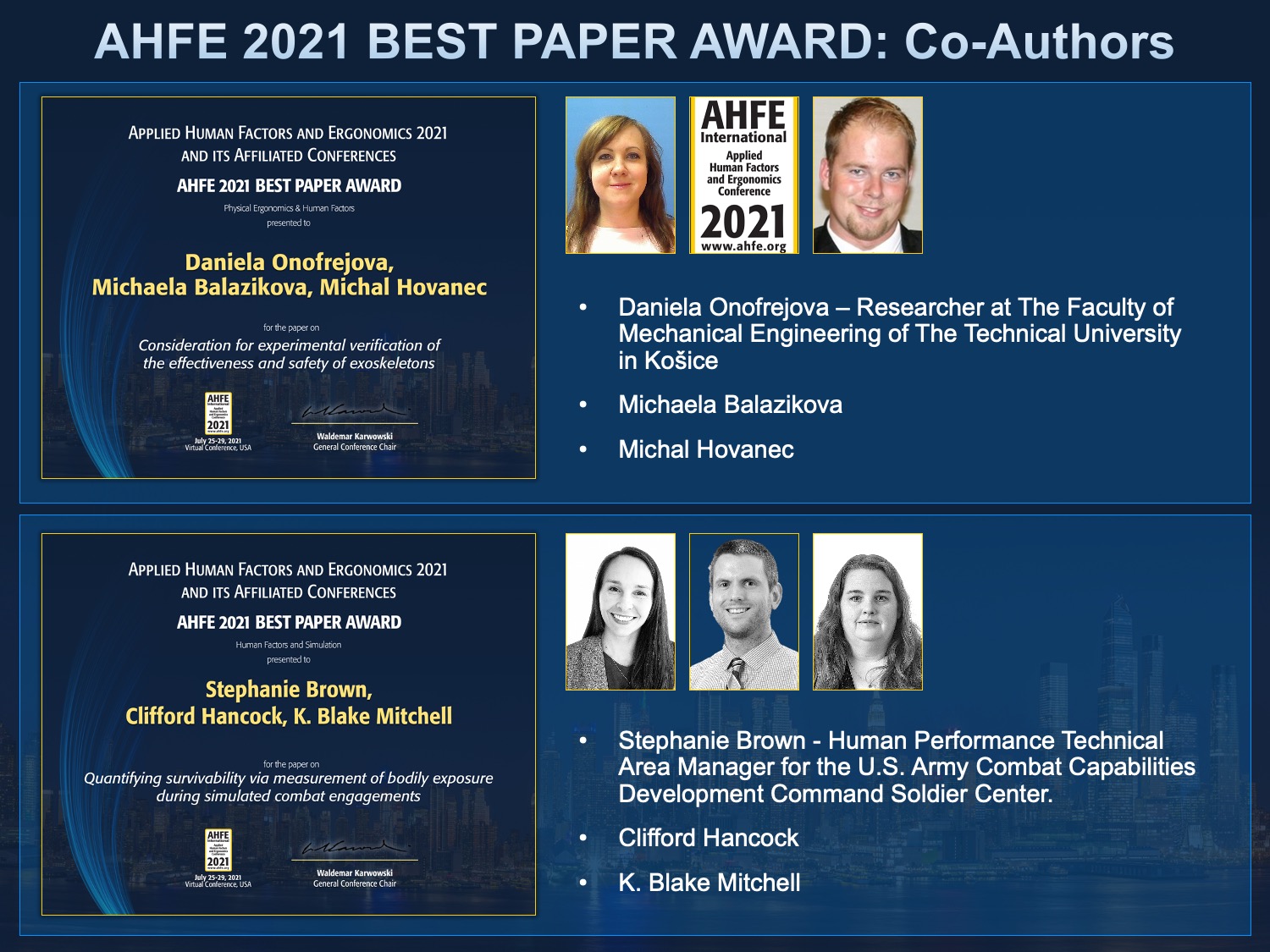
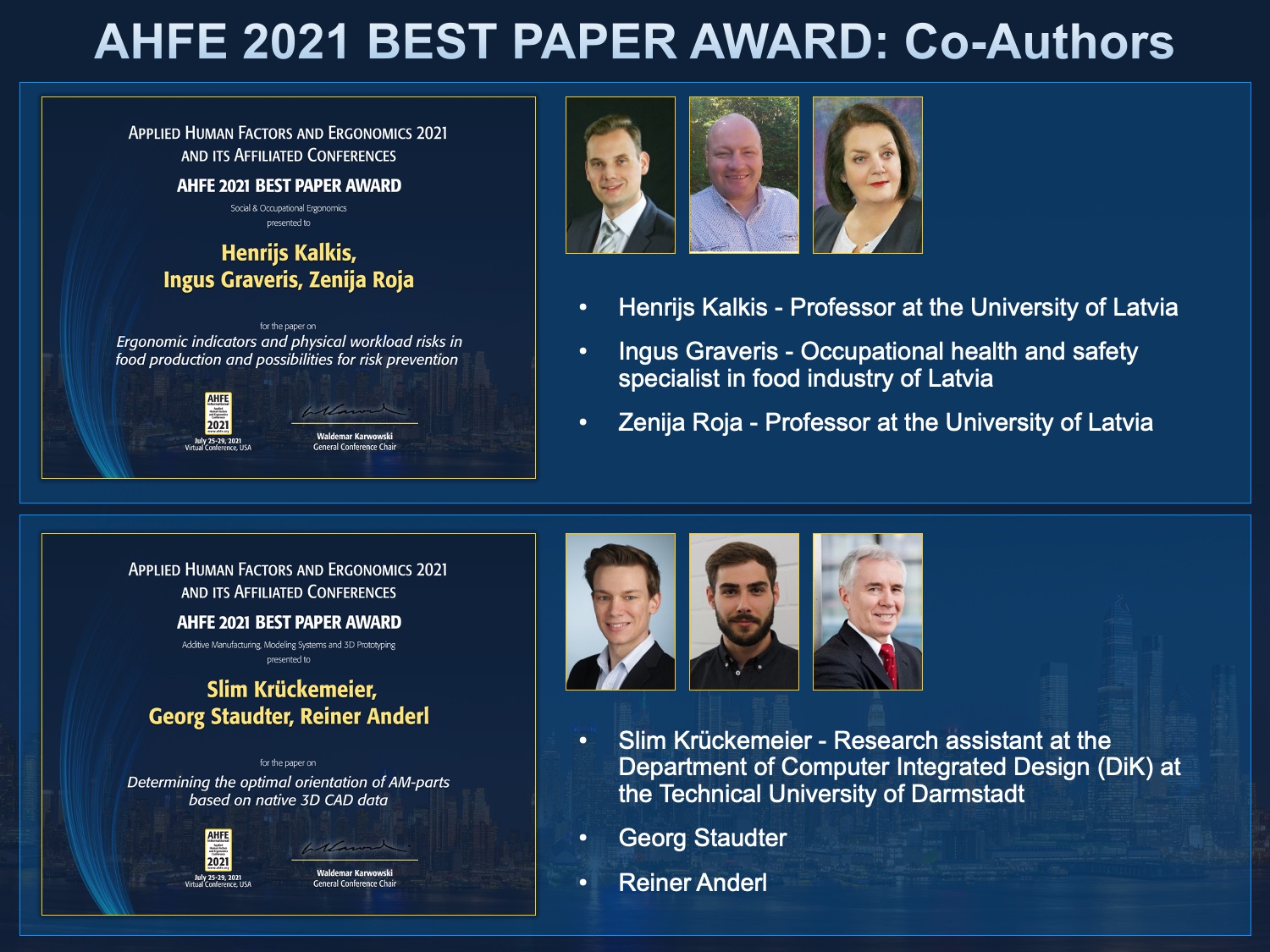
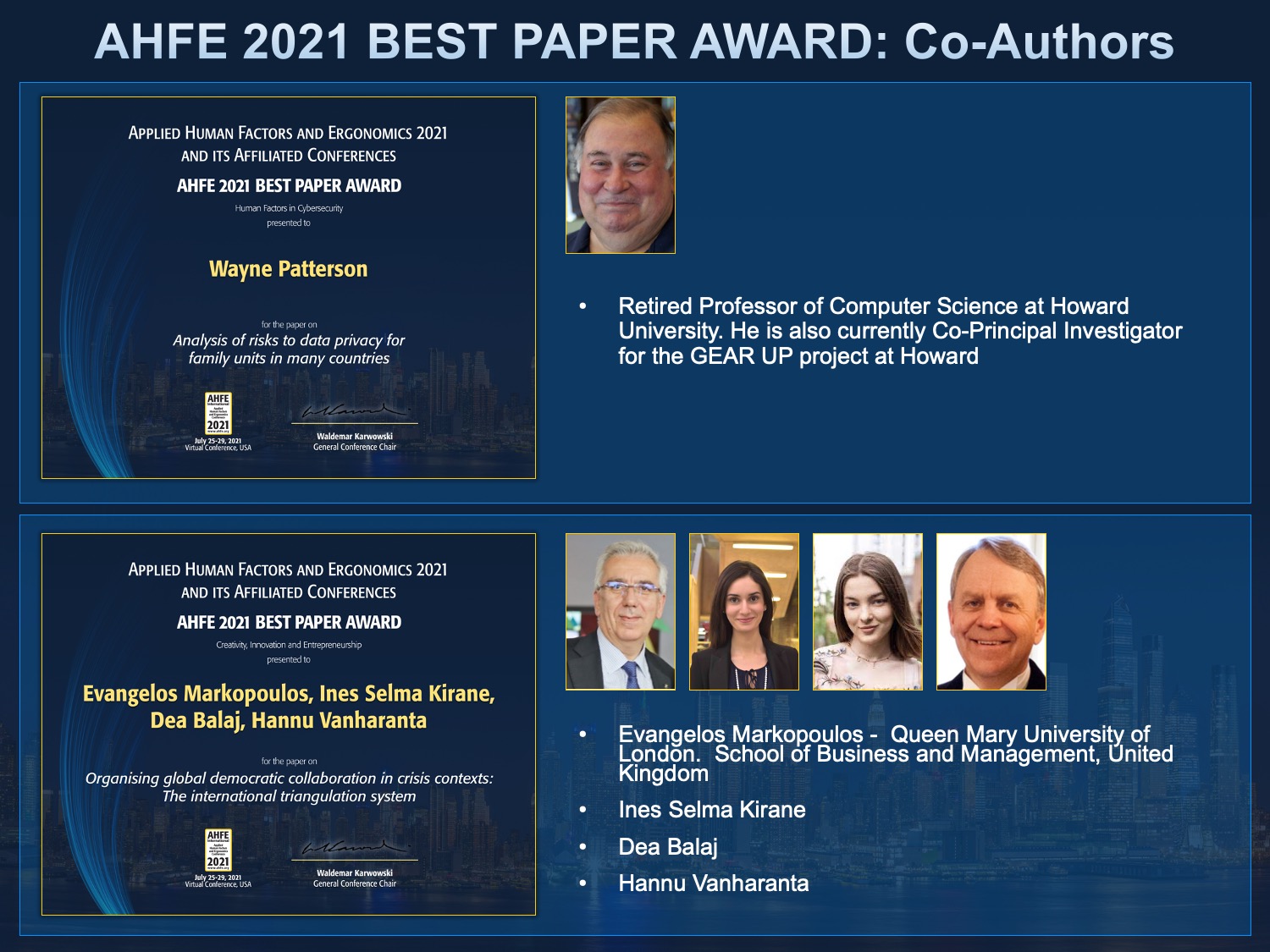
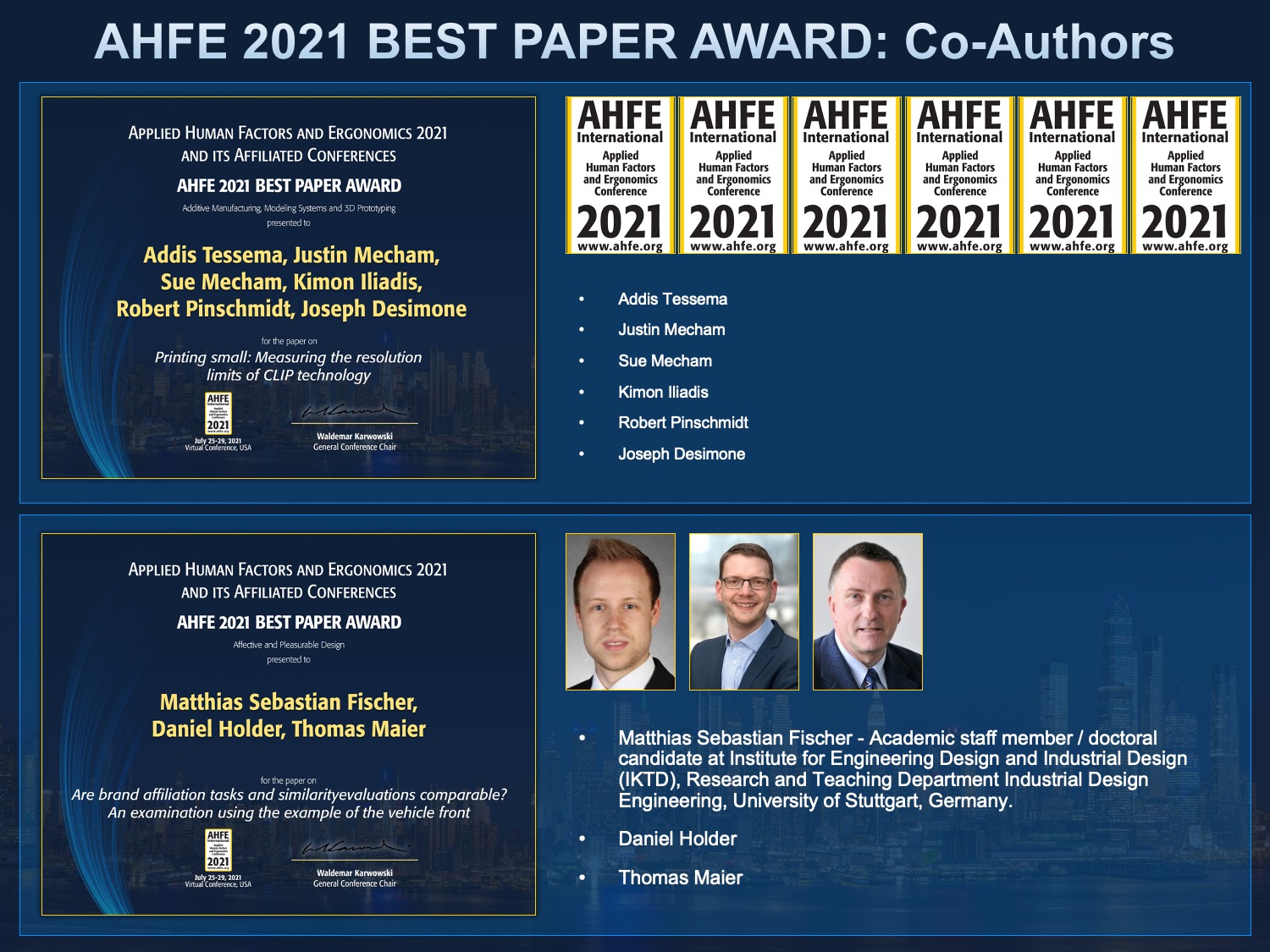
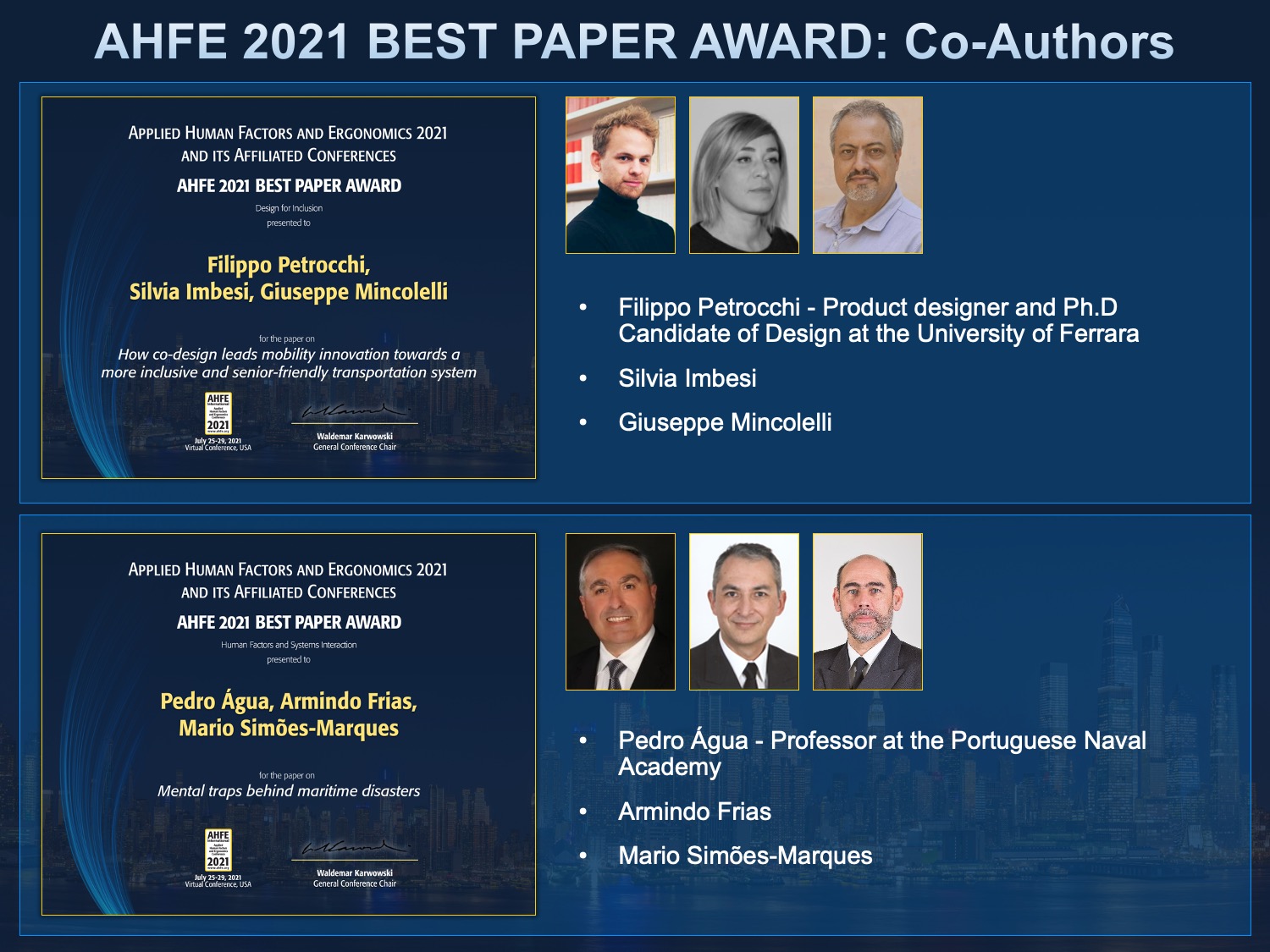
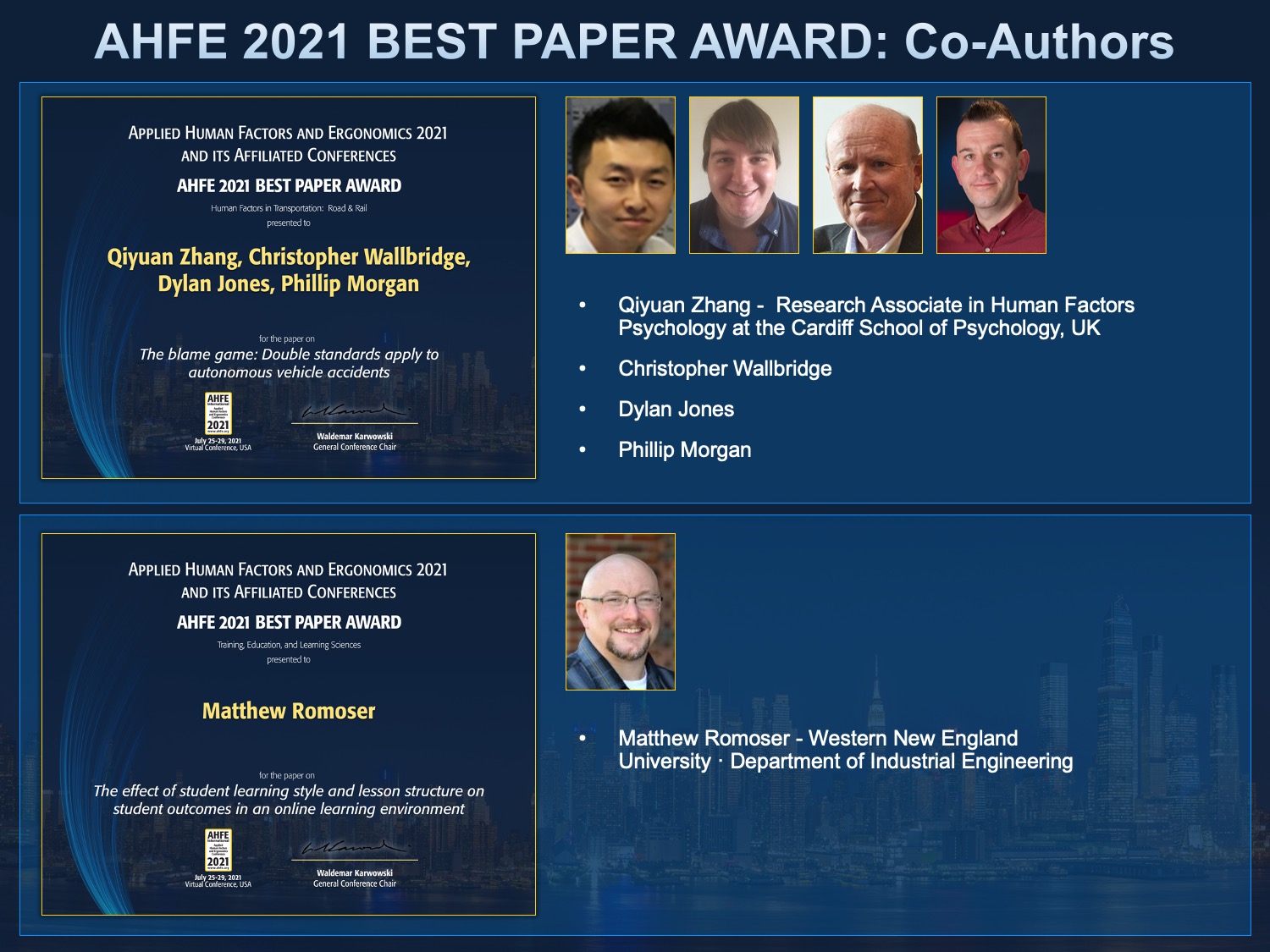
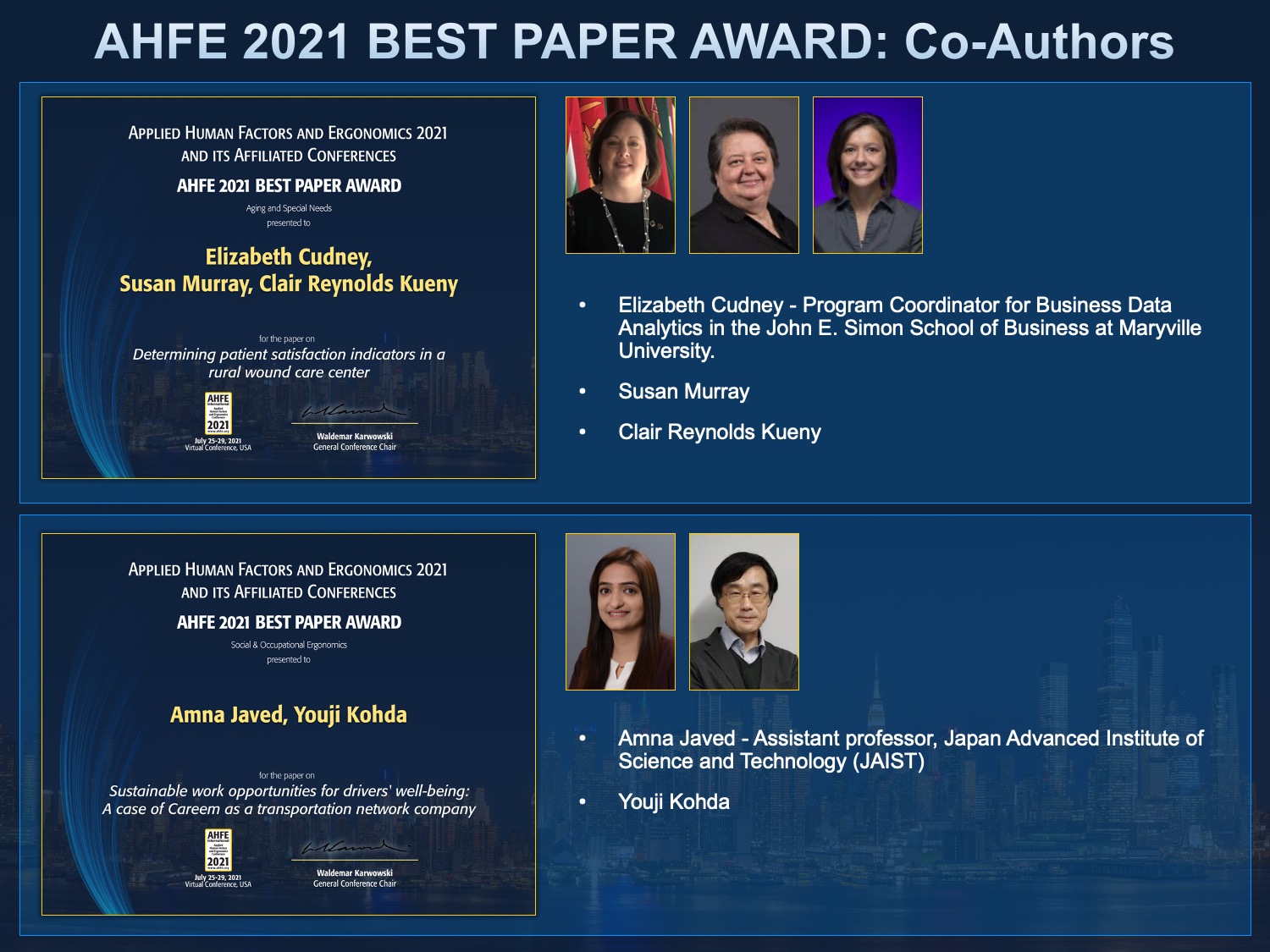
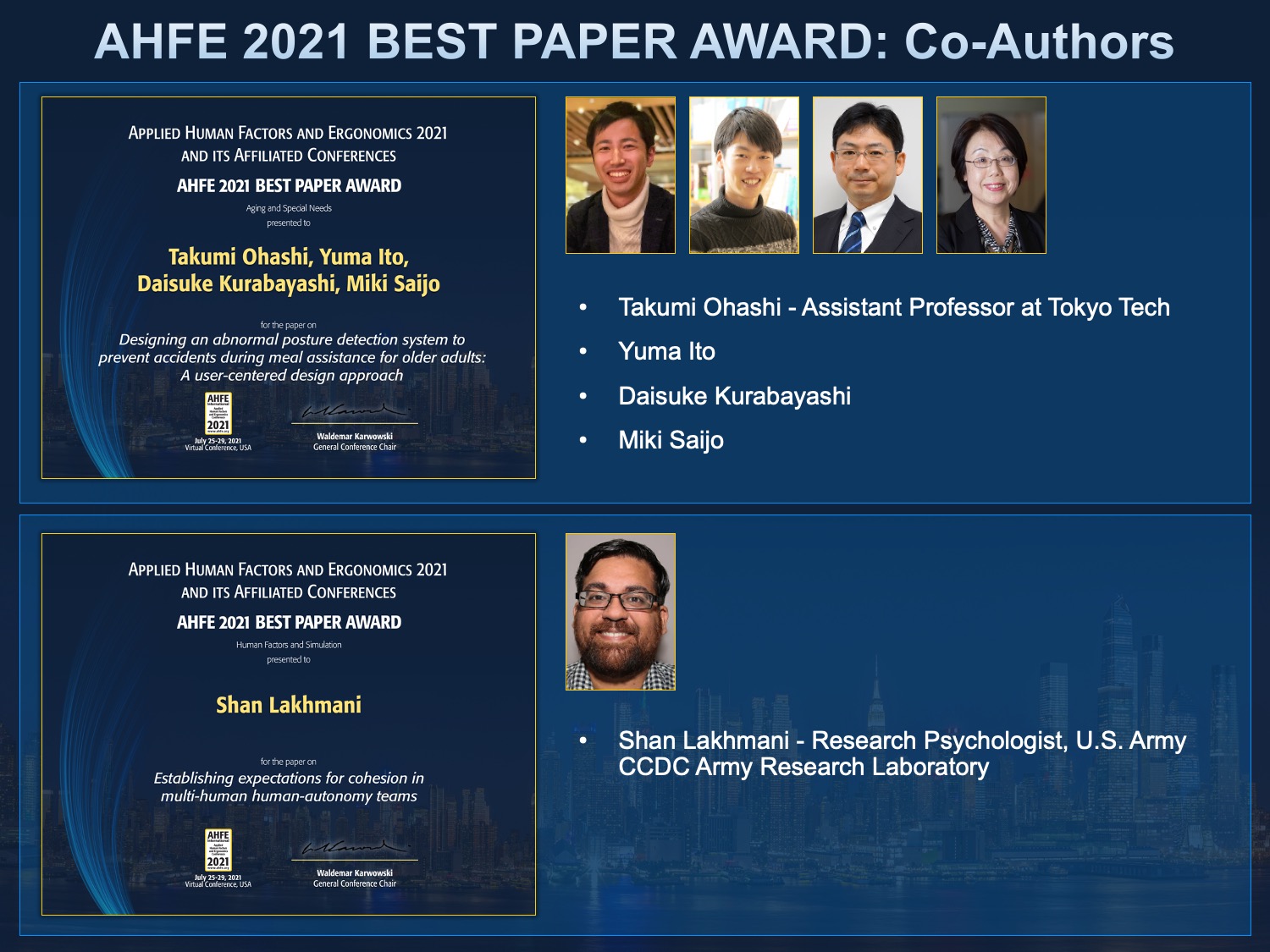
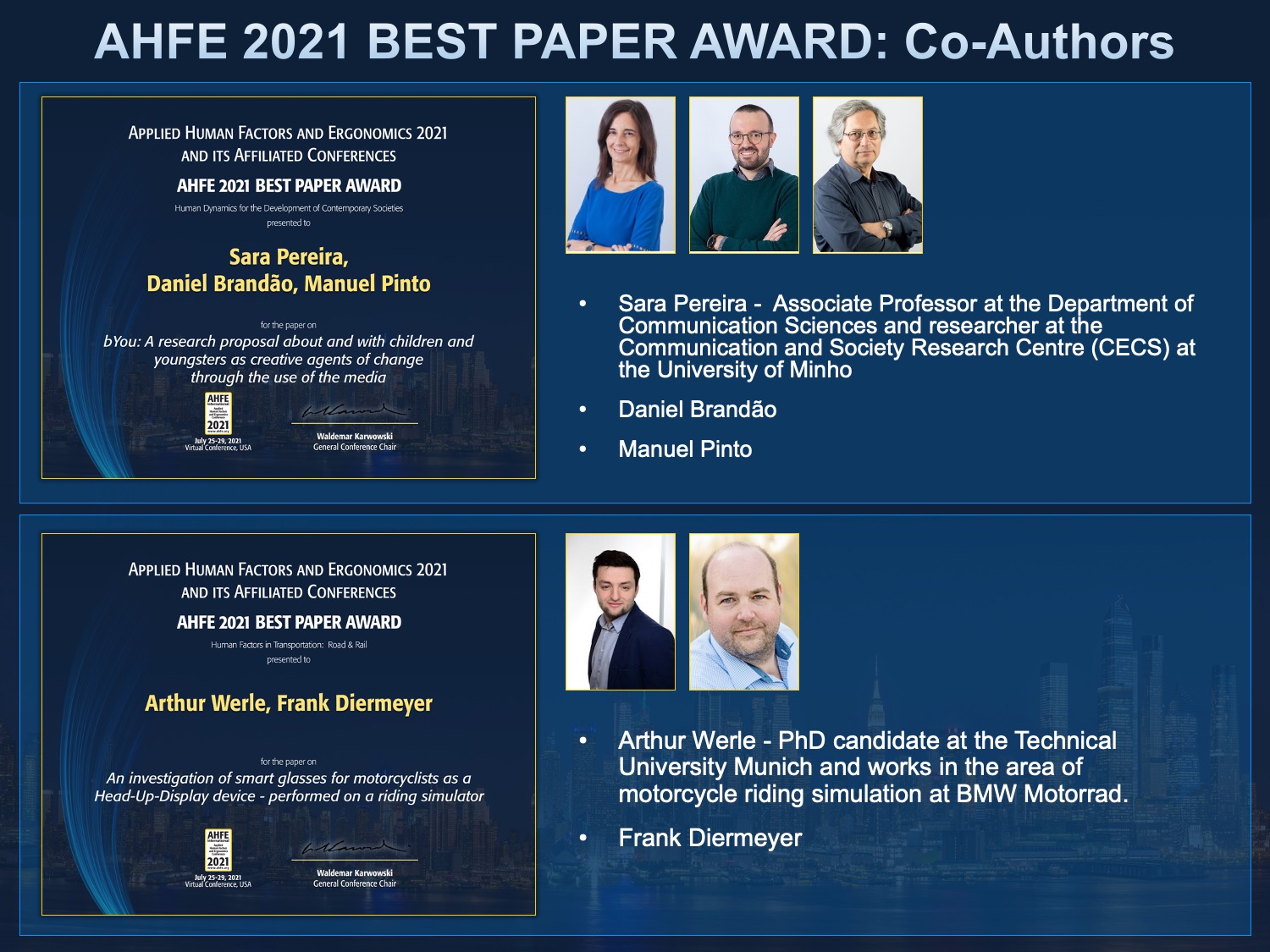
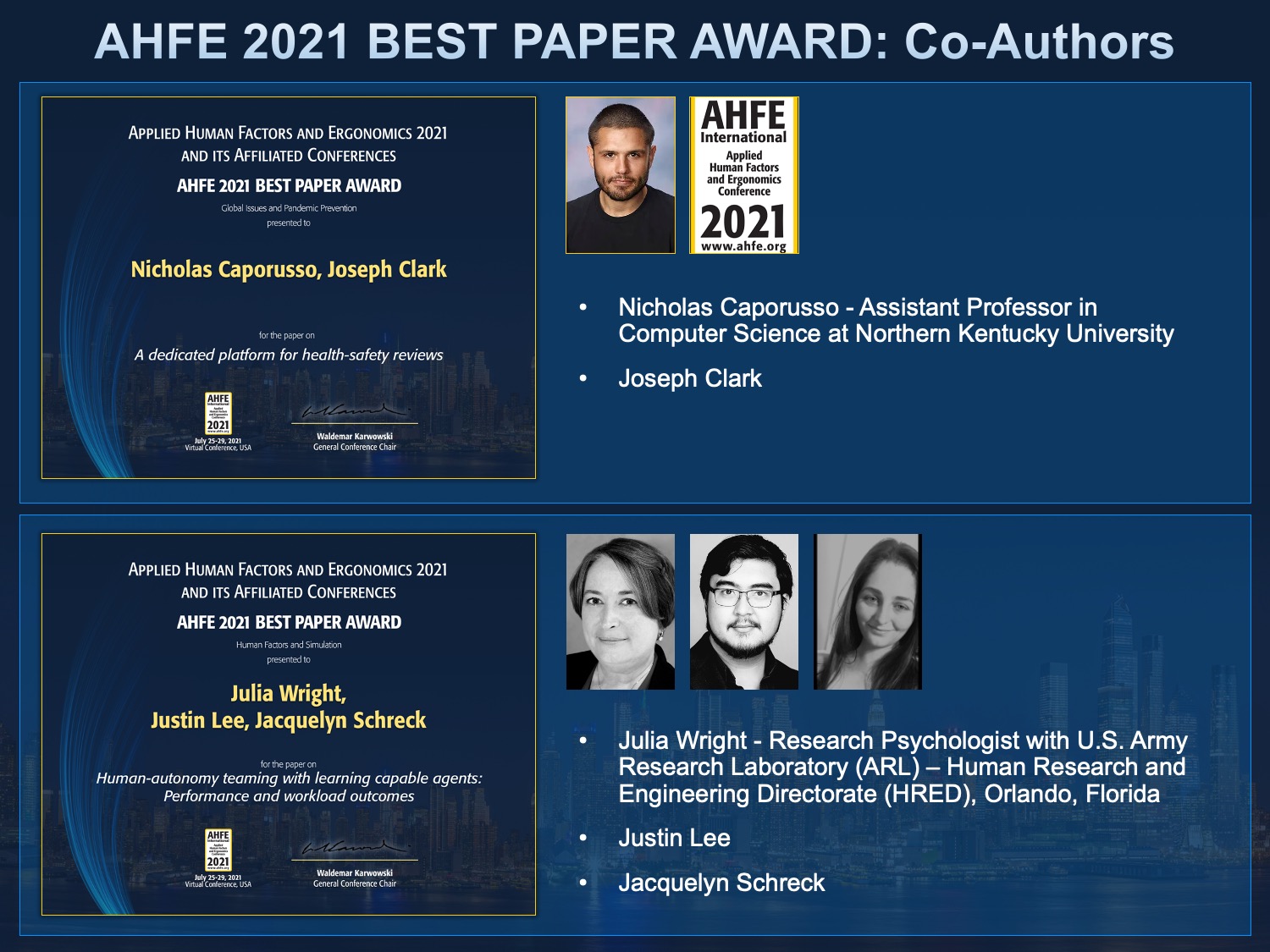
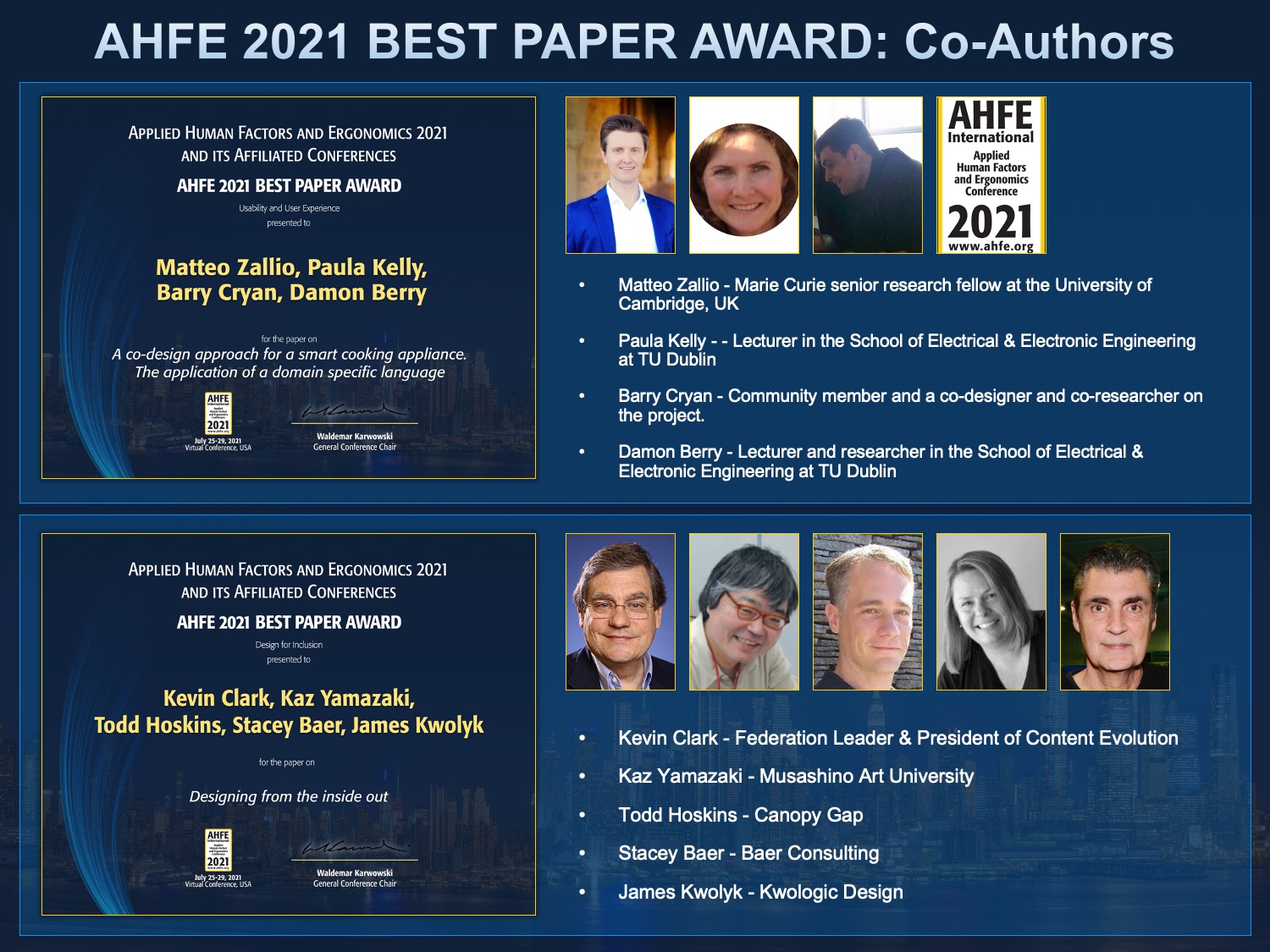
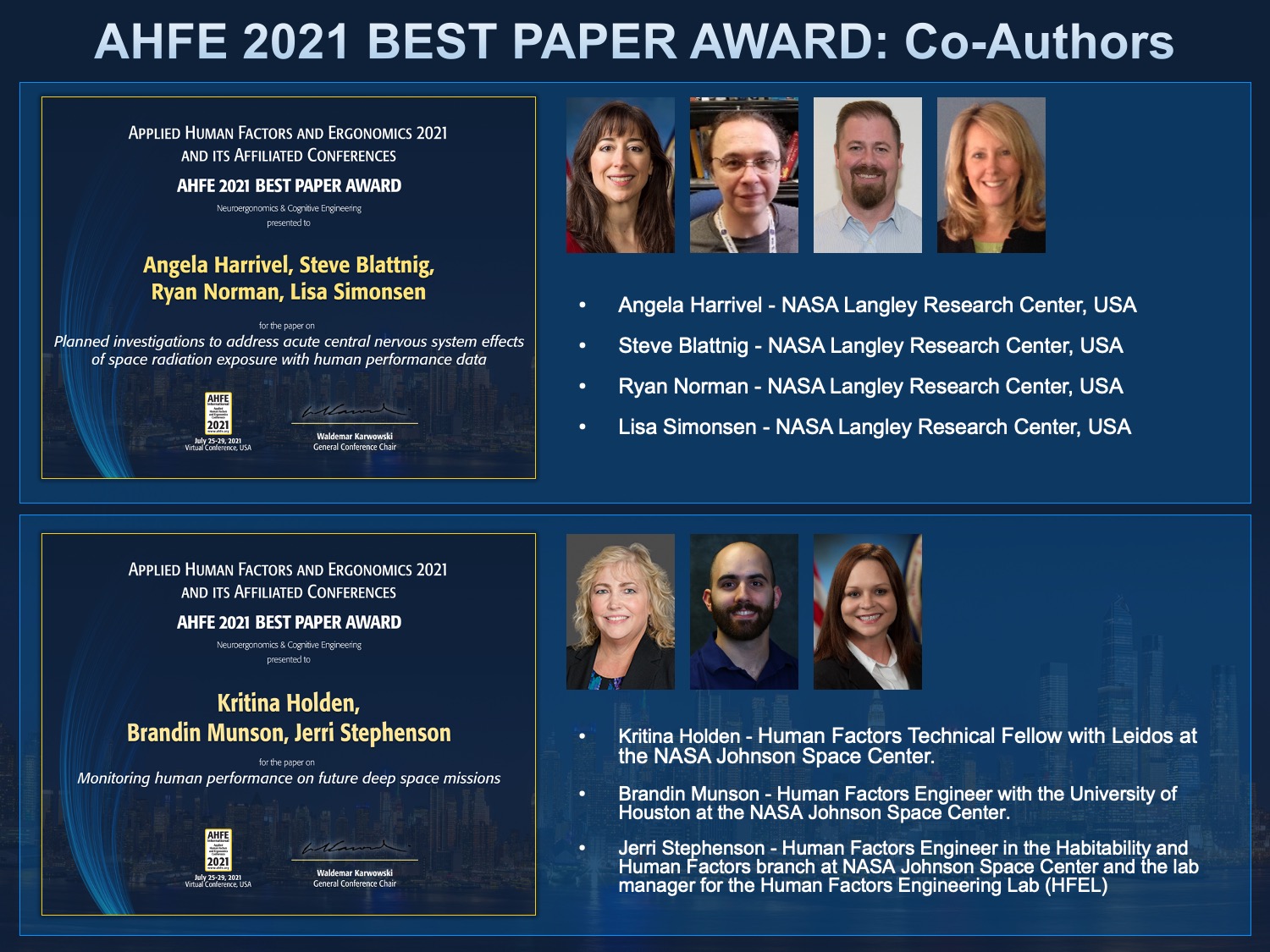
AHFE 2021 BEST PAPER AWARDS


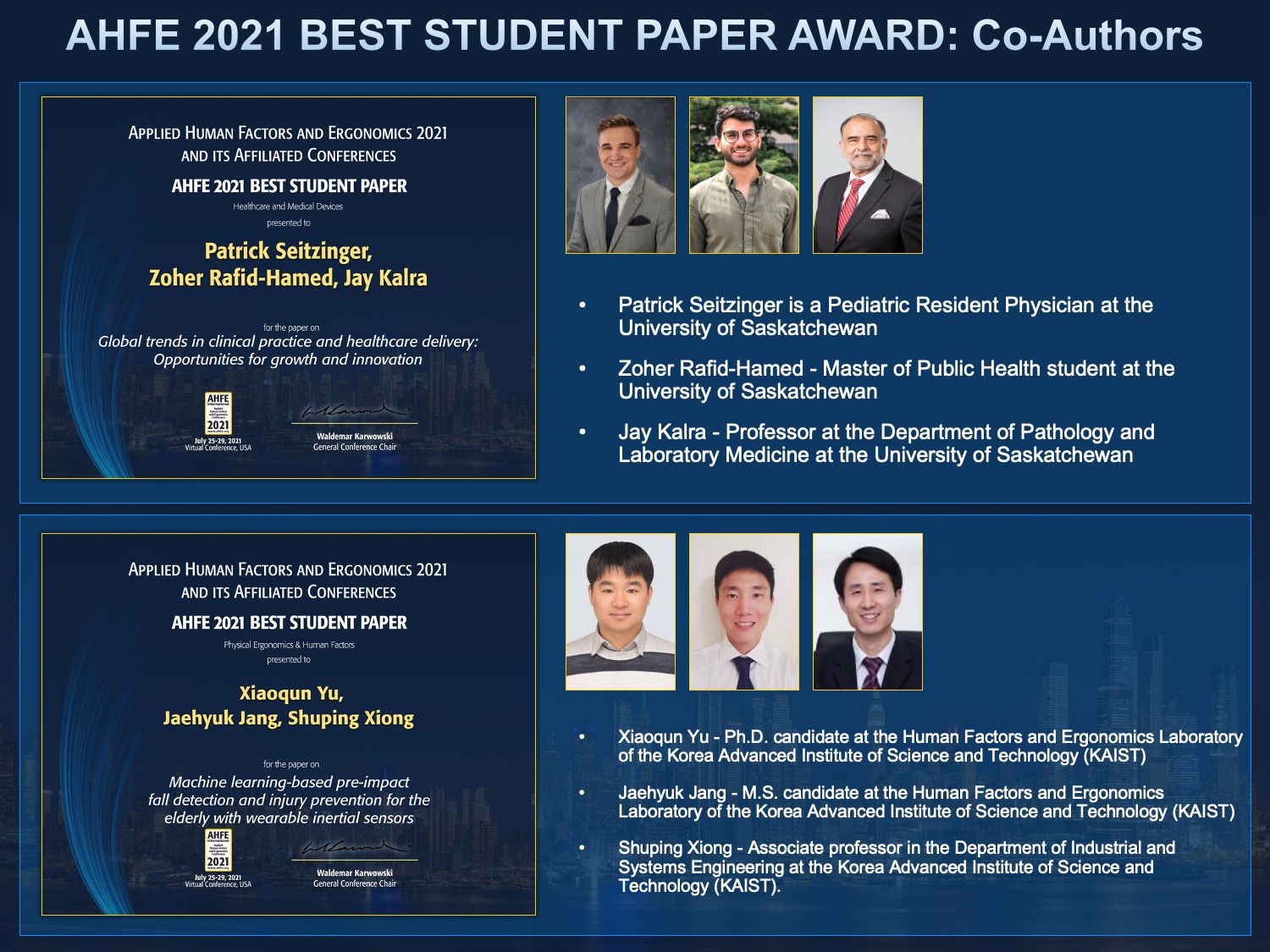
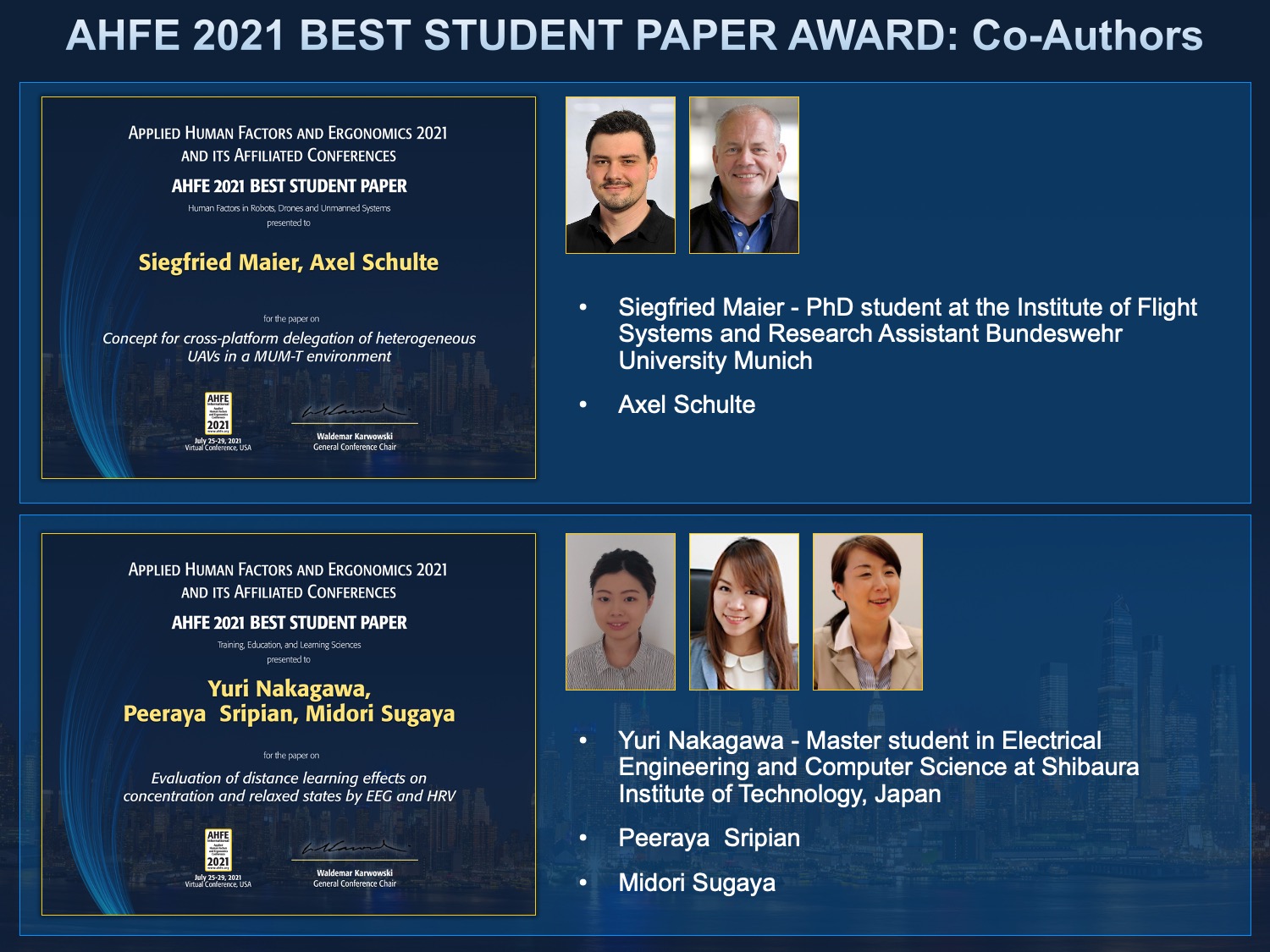
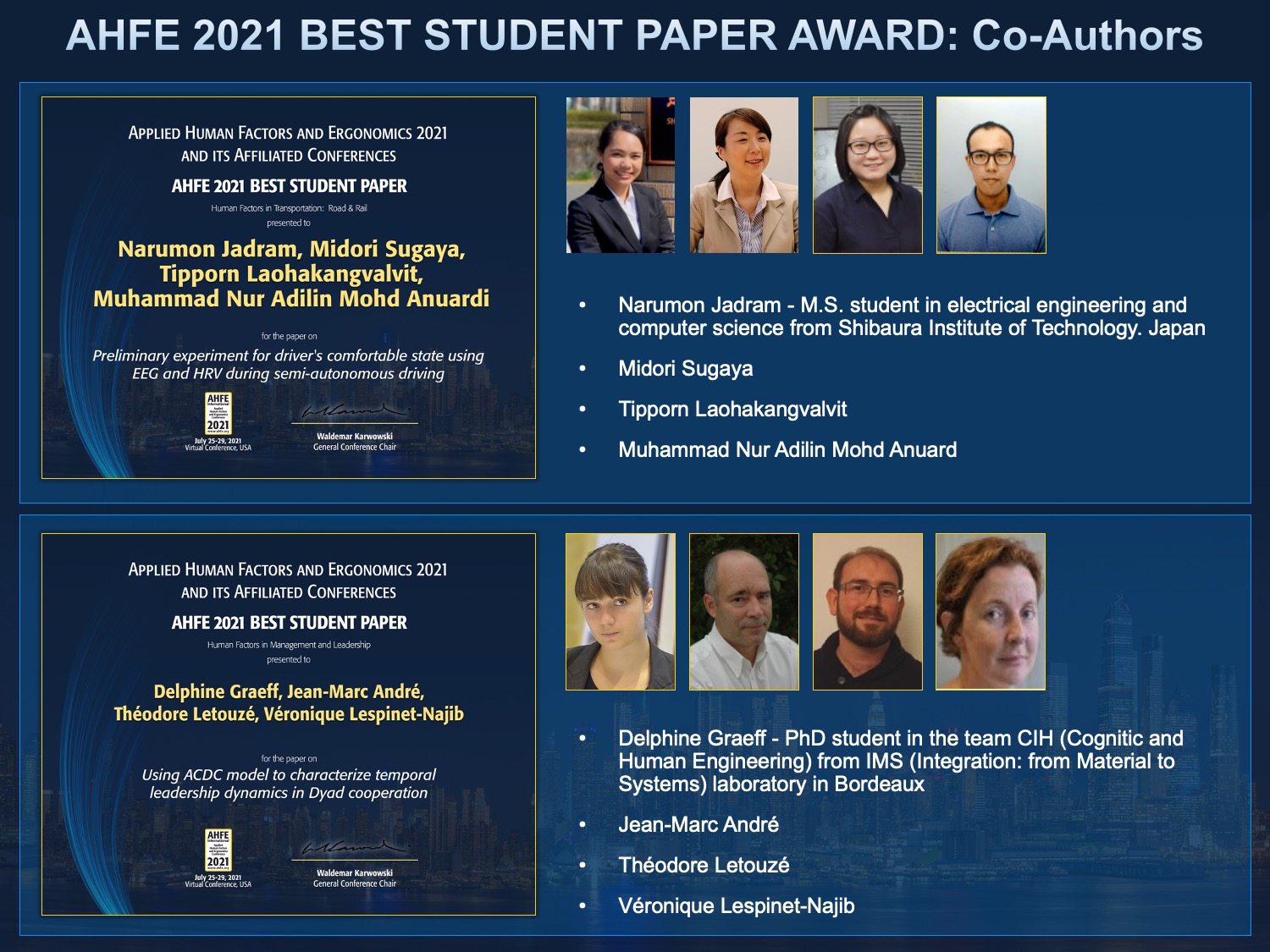
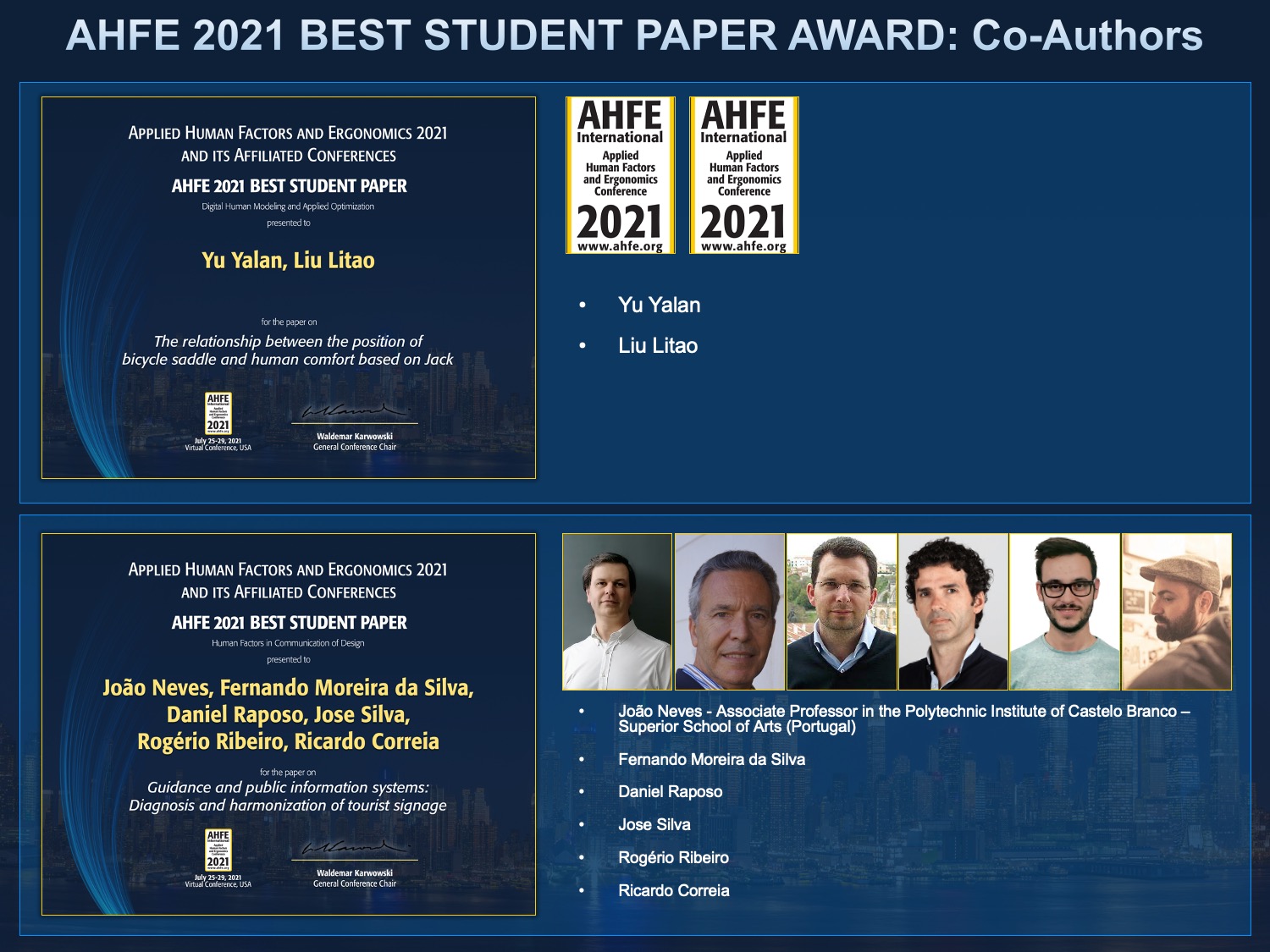
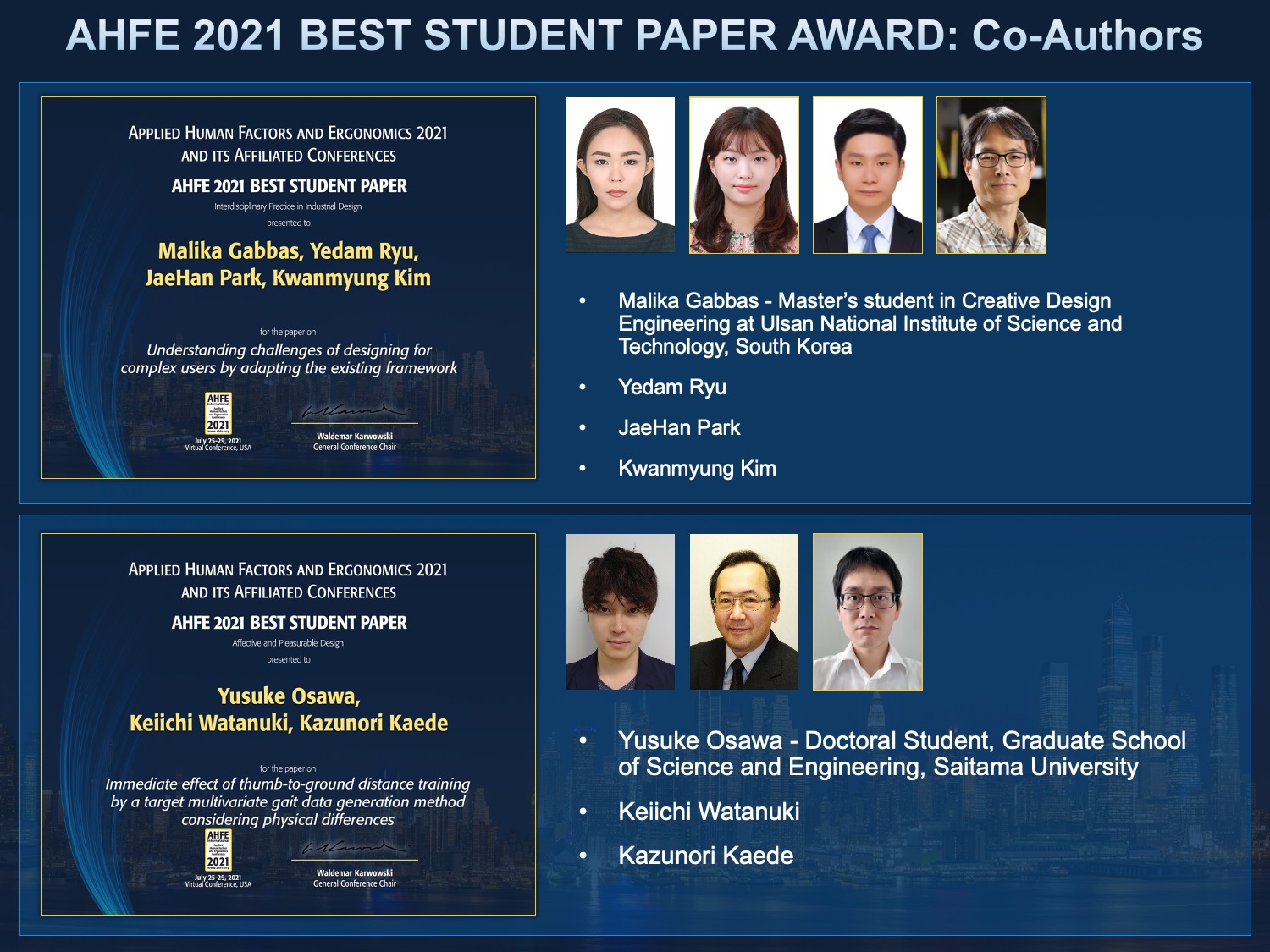
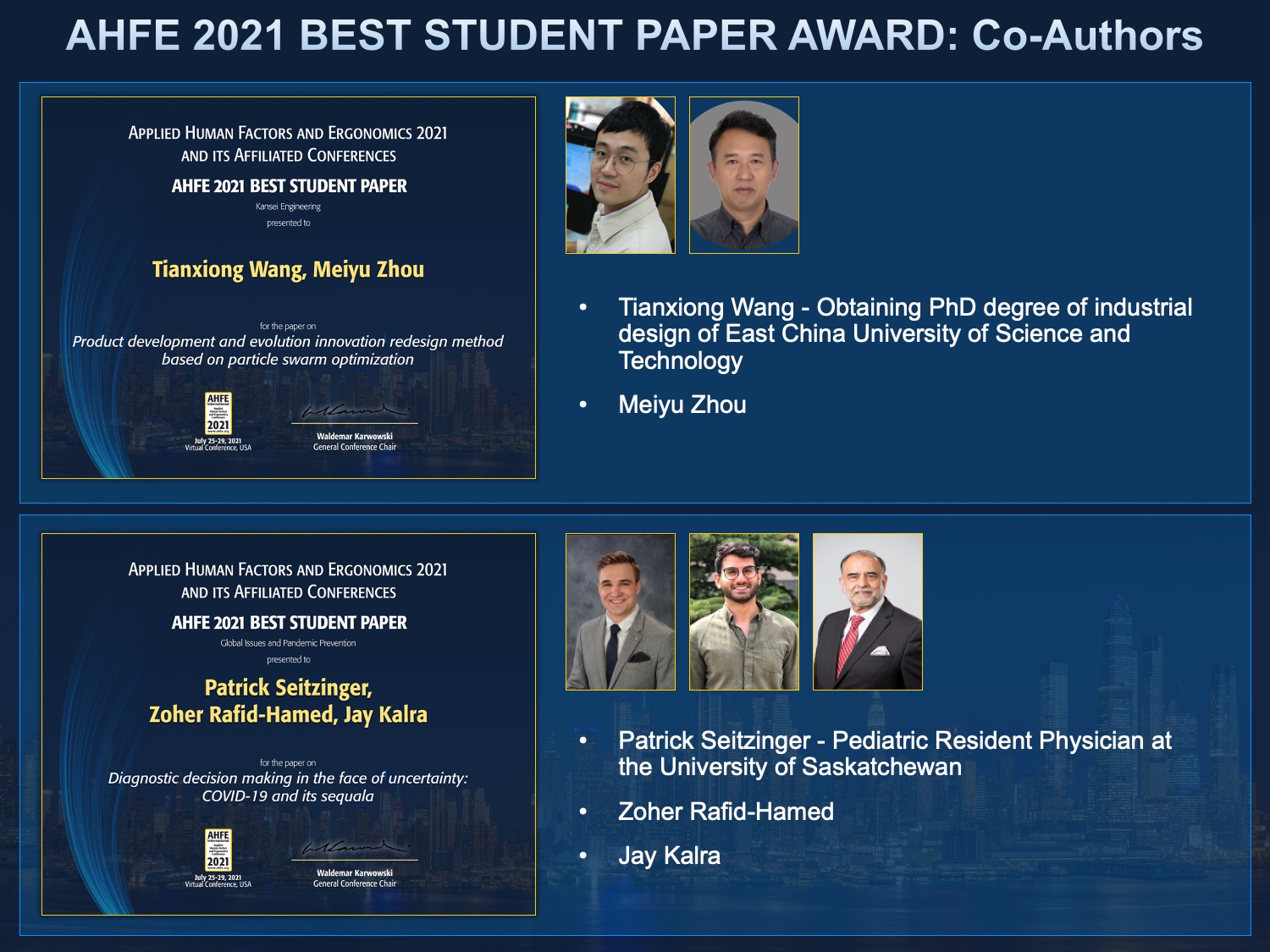
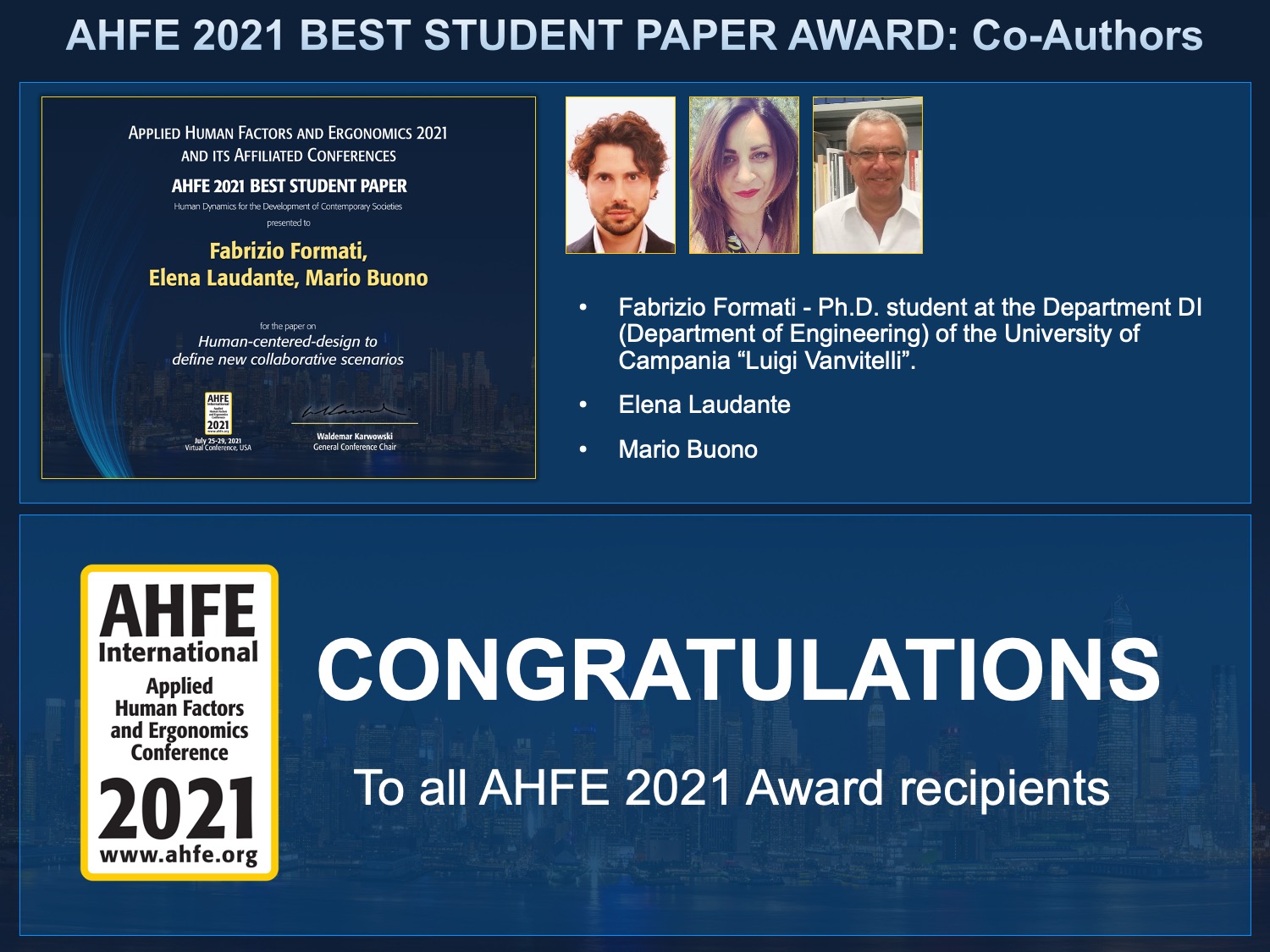
AHFE 2021 BEST STUDENT PAPER AWARDS


AHFE 2020 Best Paper Awards

🏆 Best Paper Awards


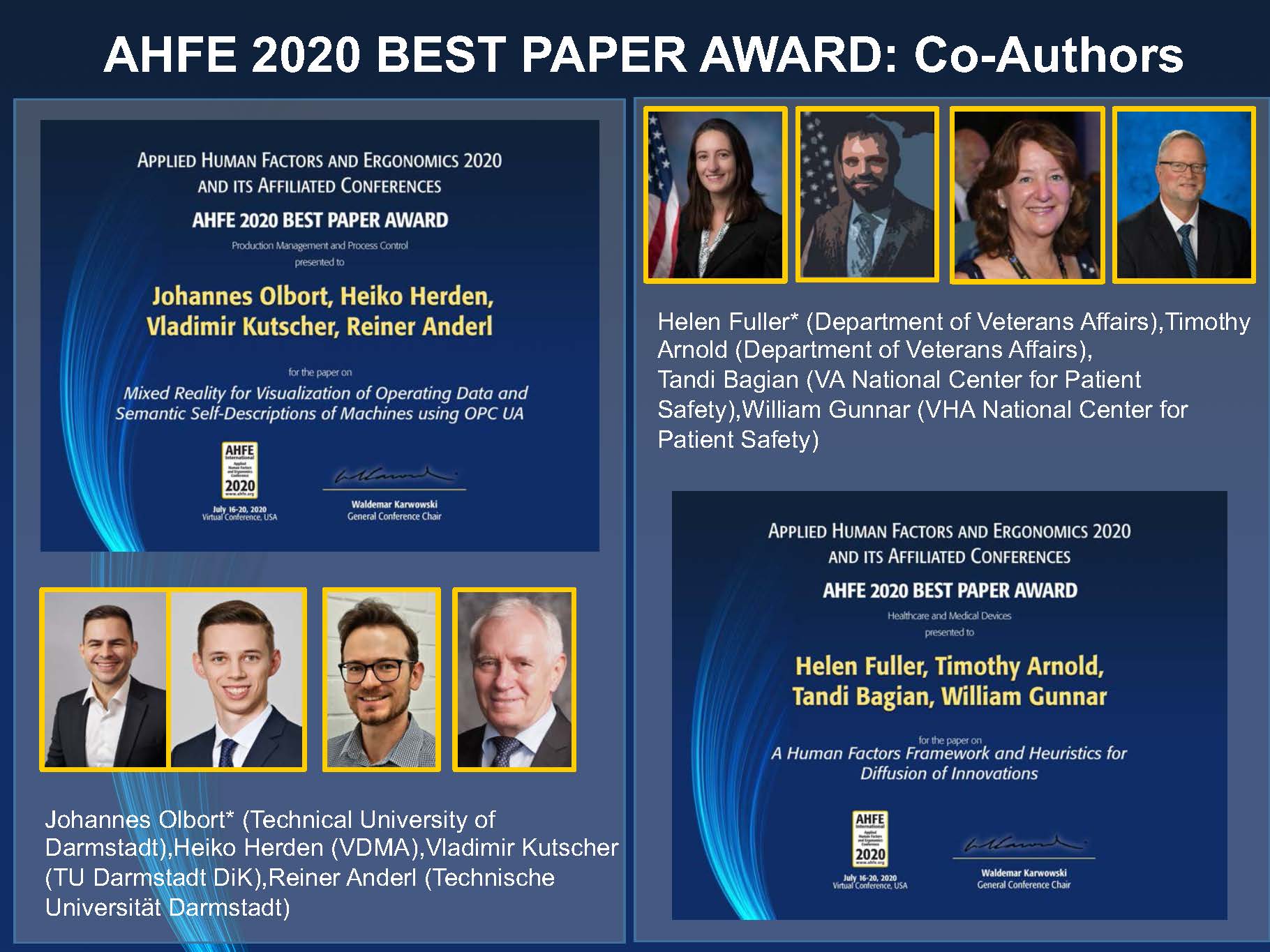
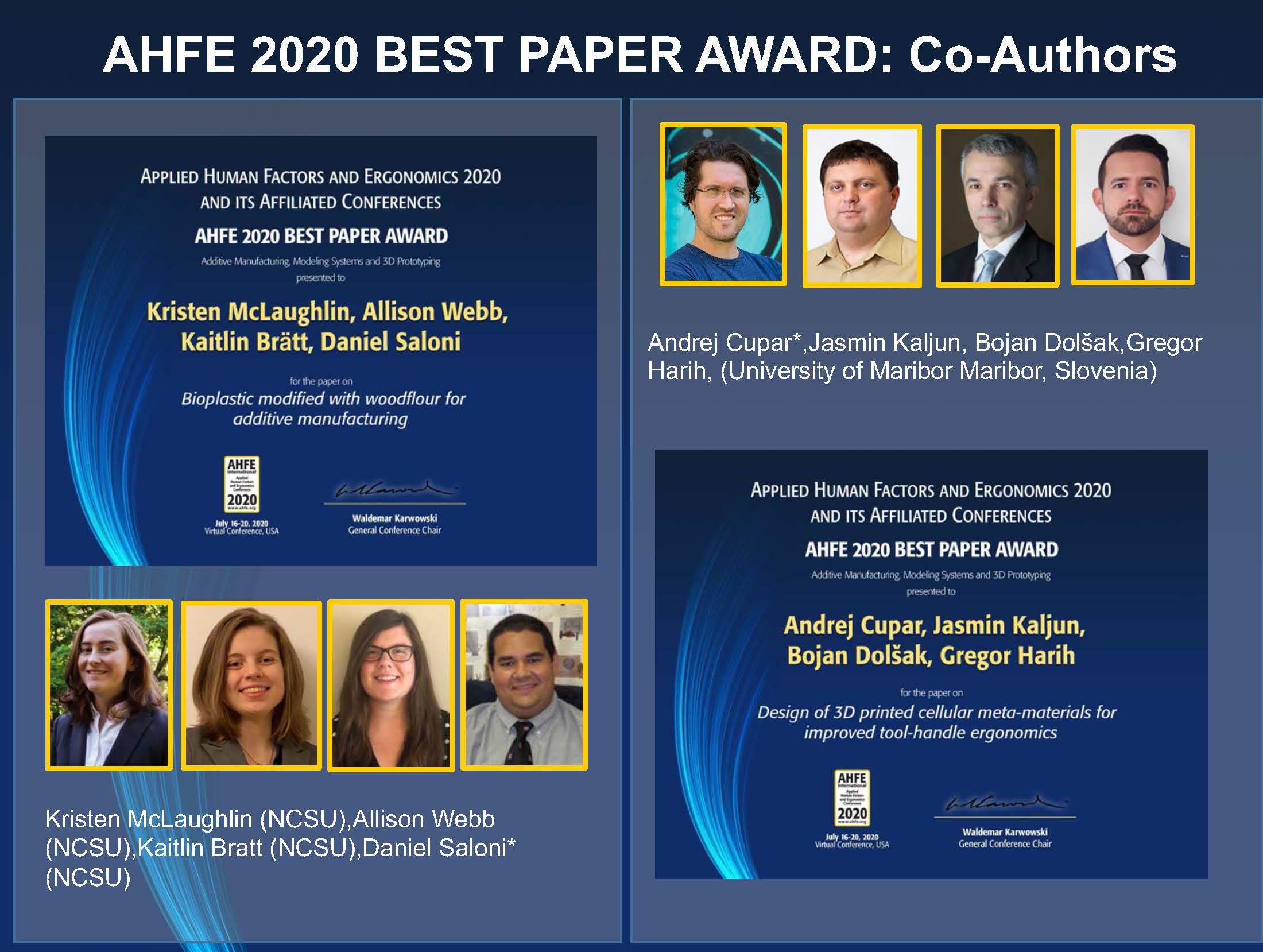
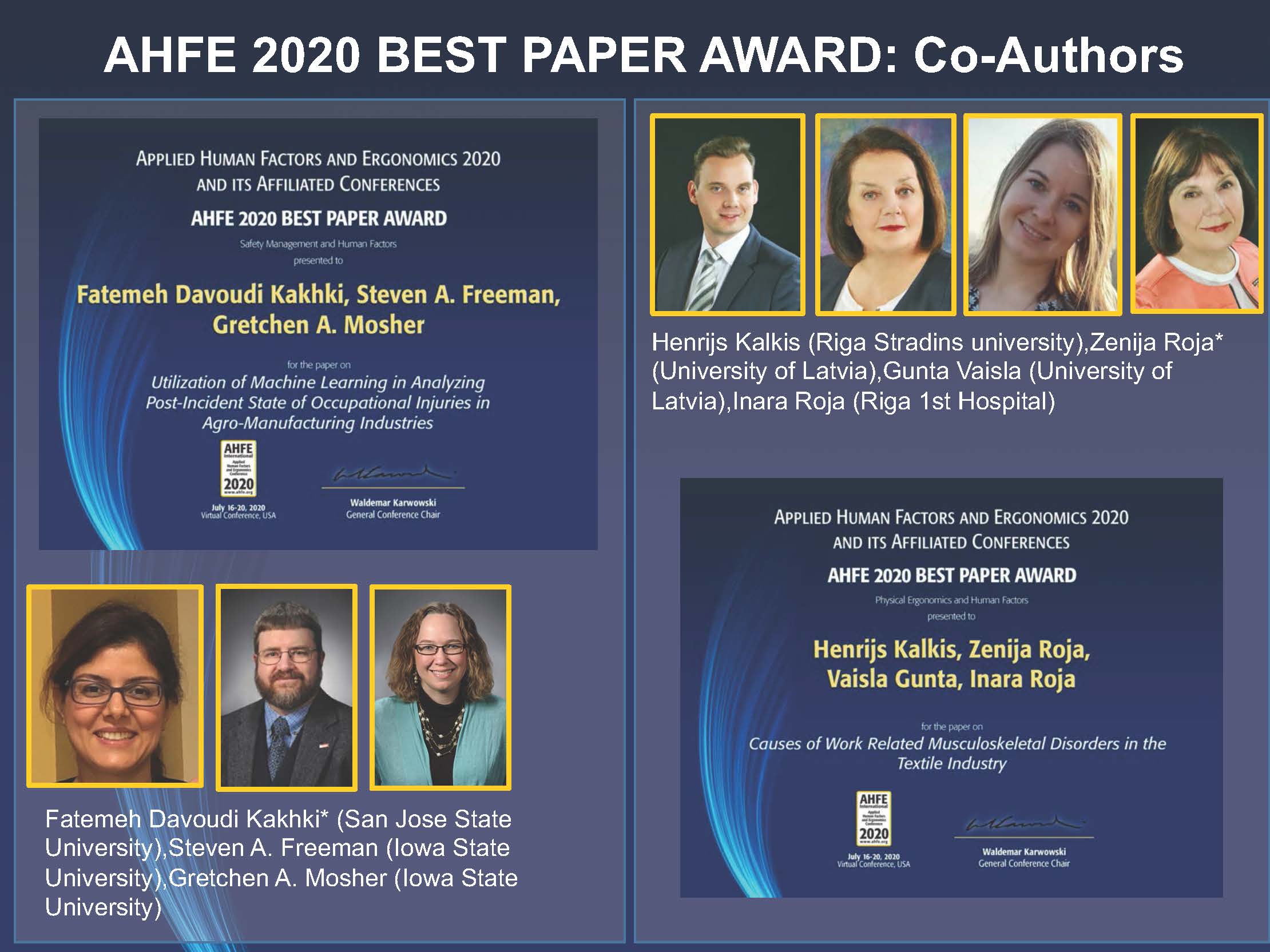
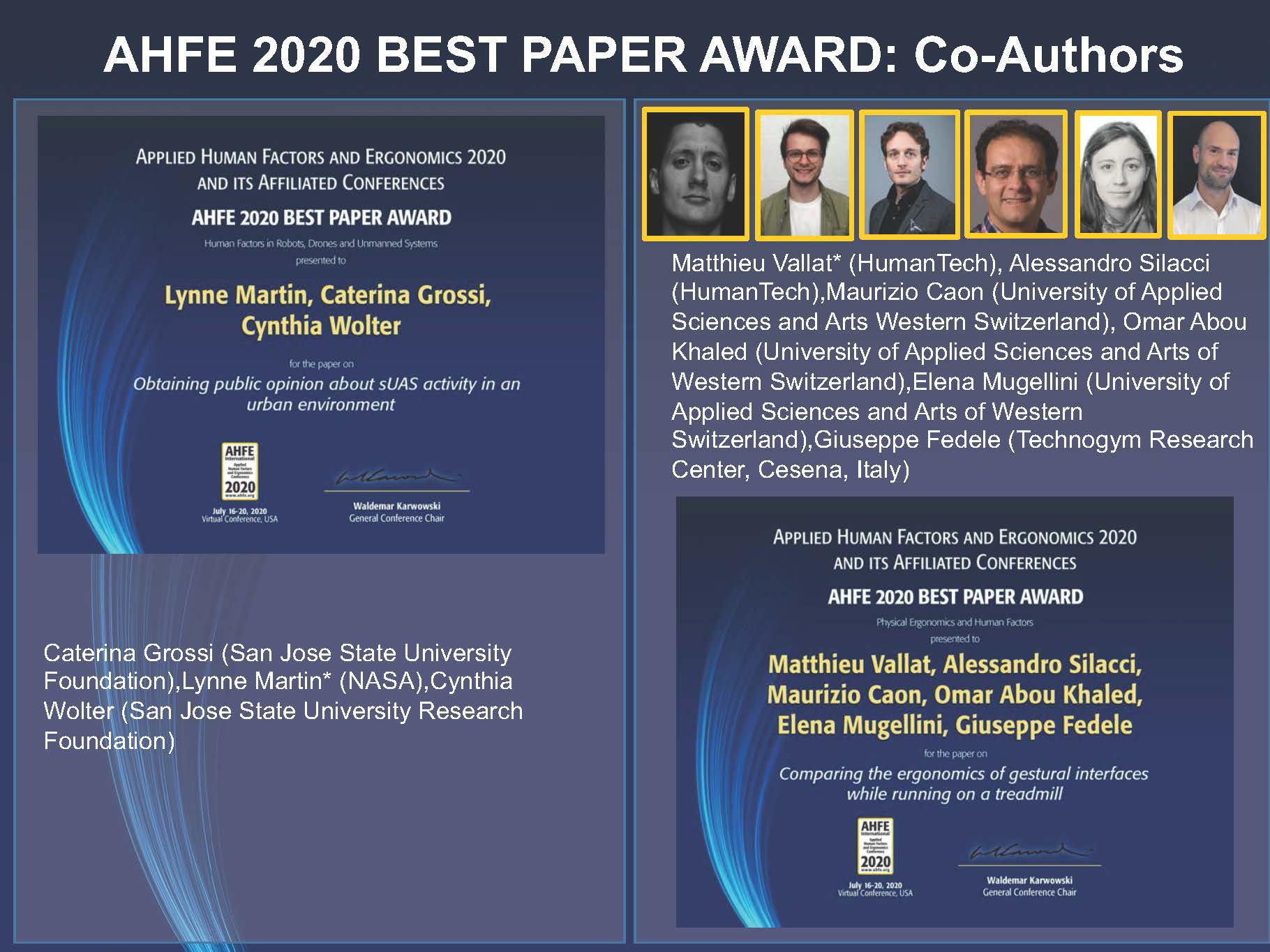
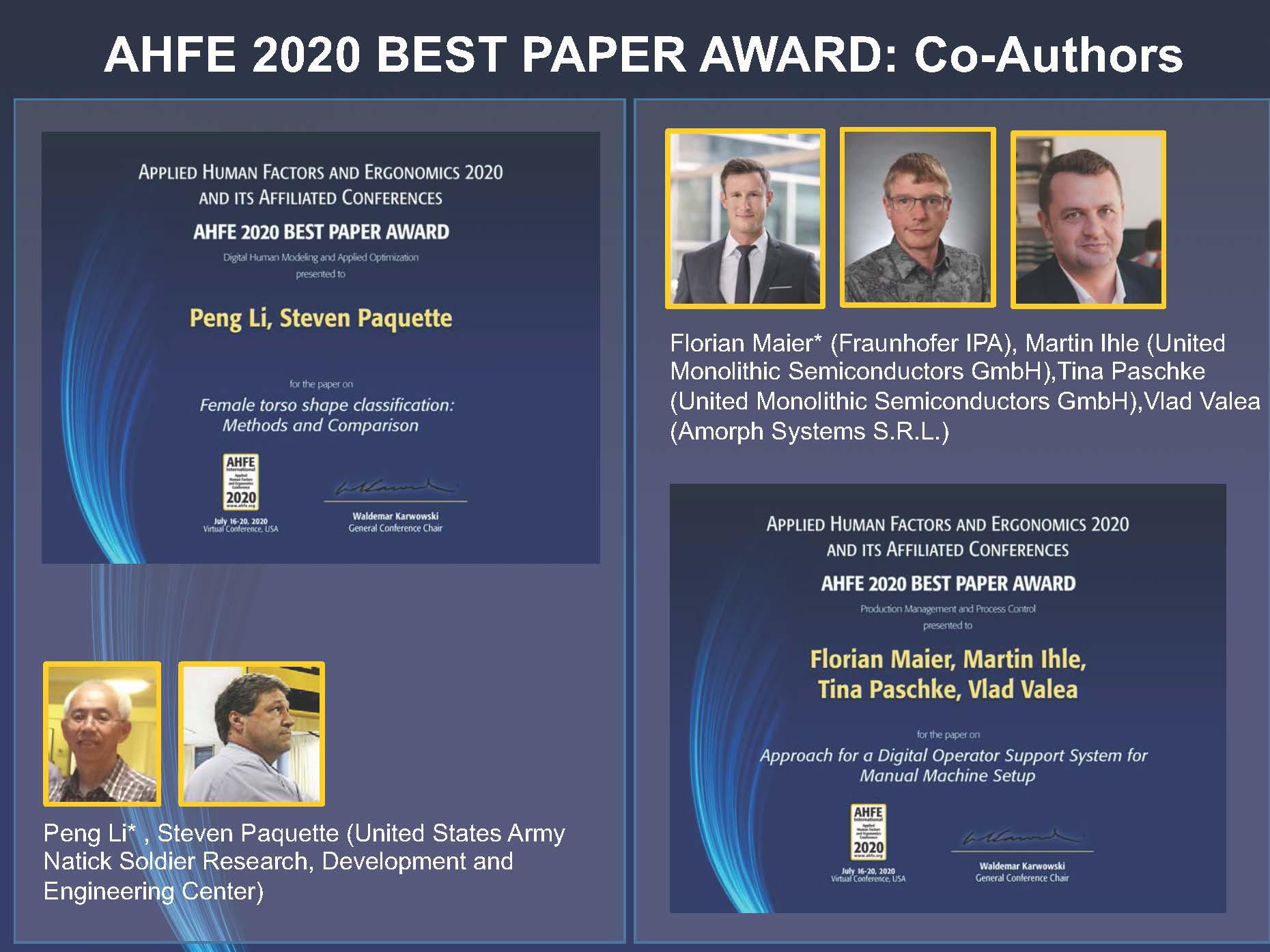
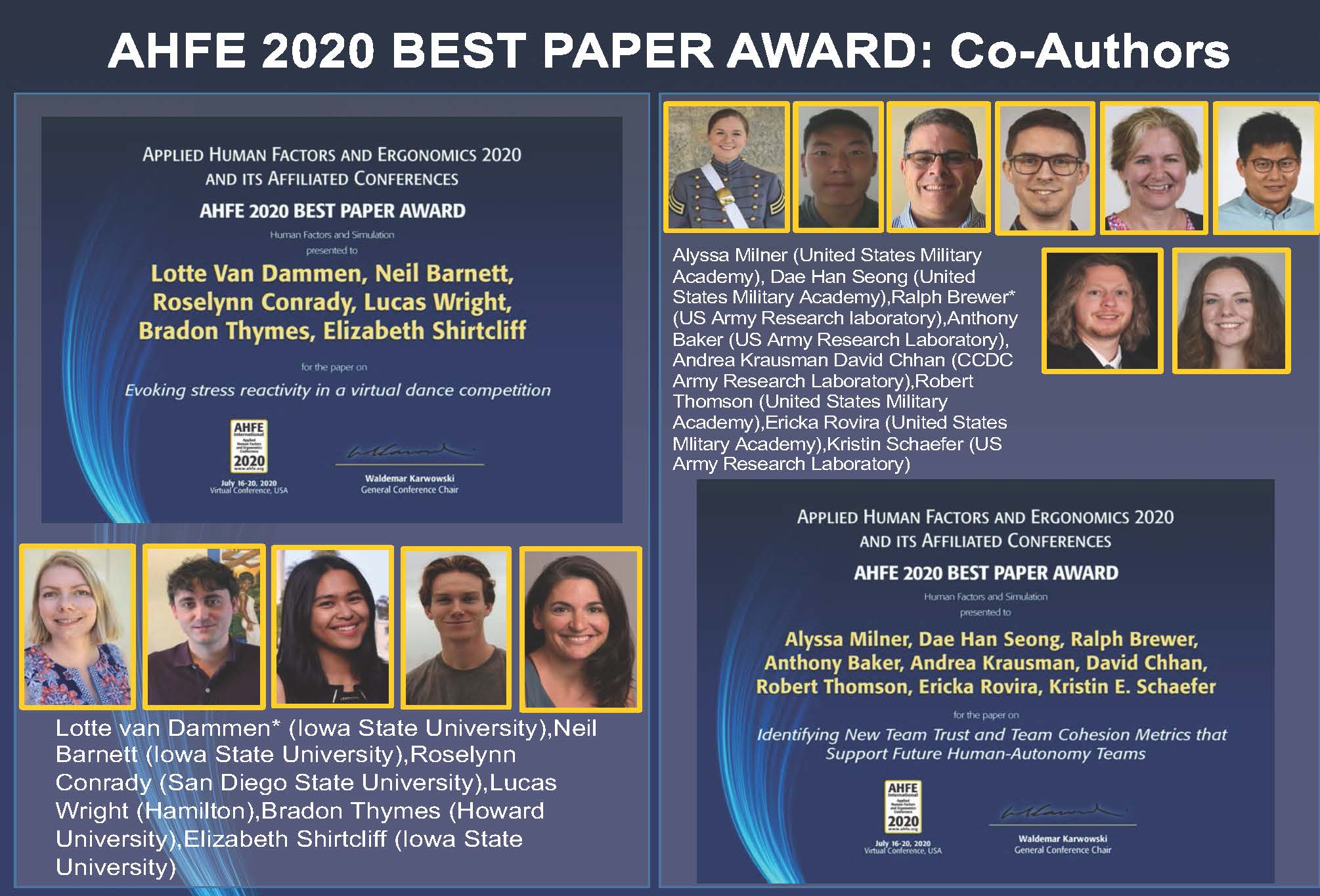
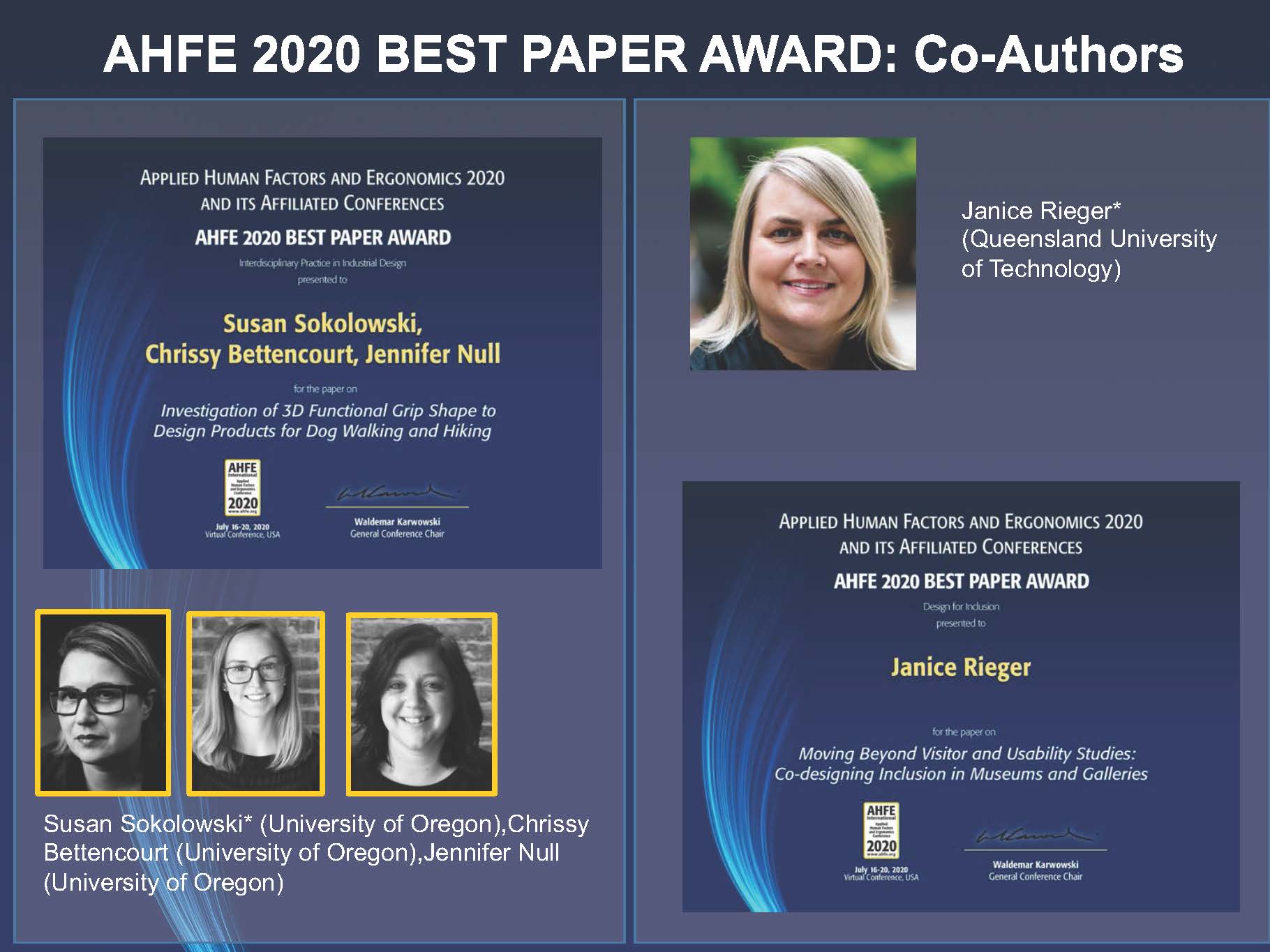
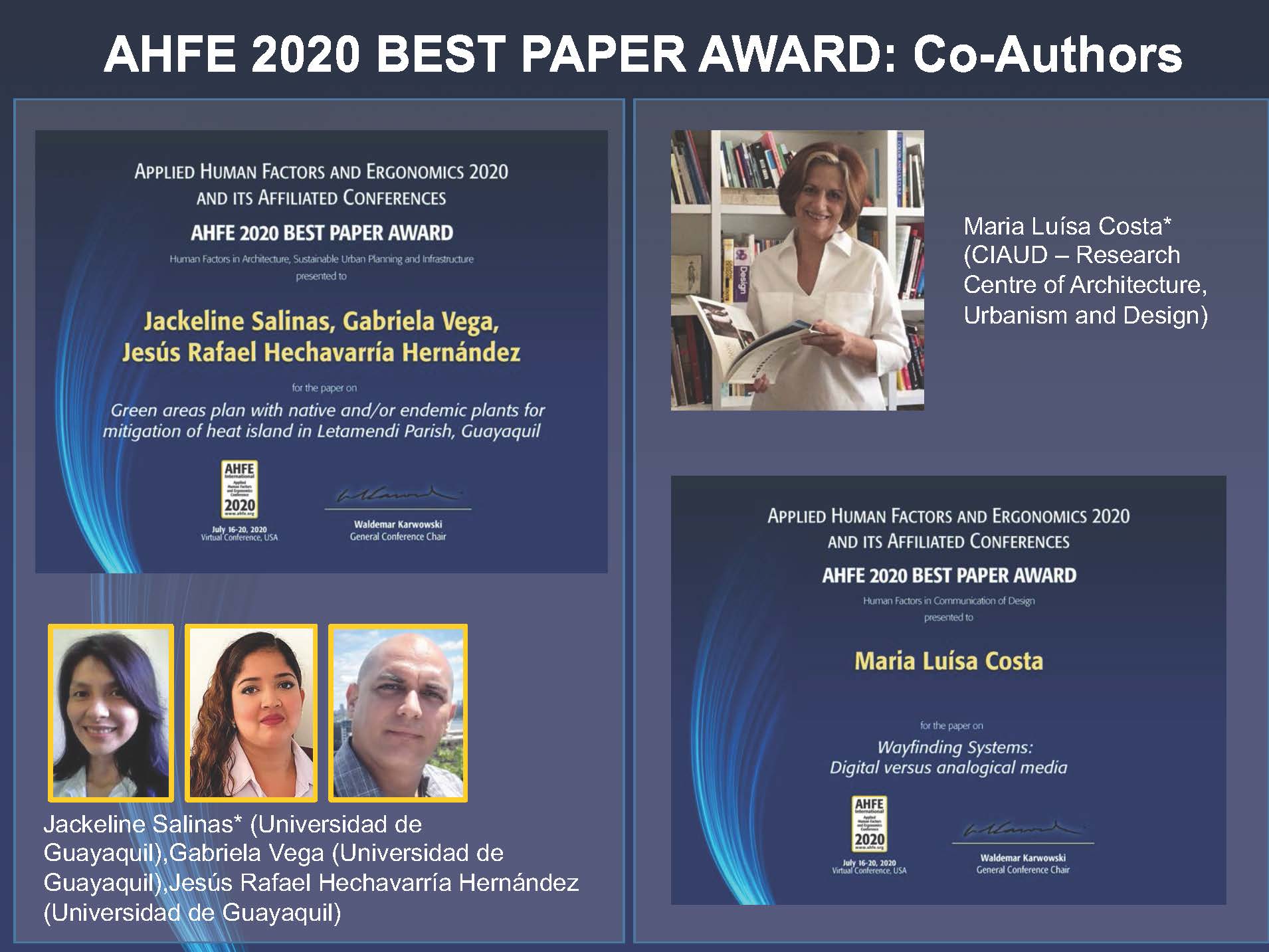
AHFE 2020 BEST PAPER AWARDS


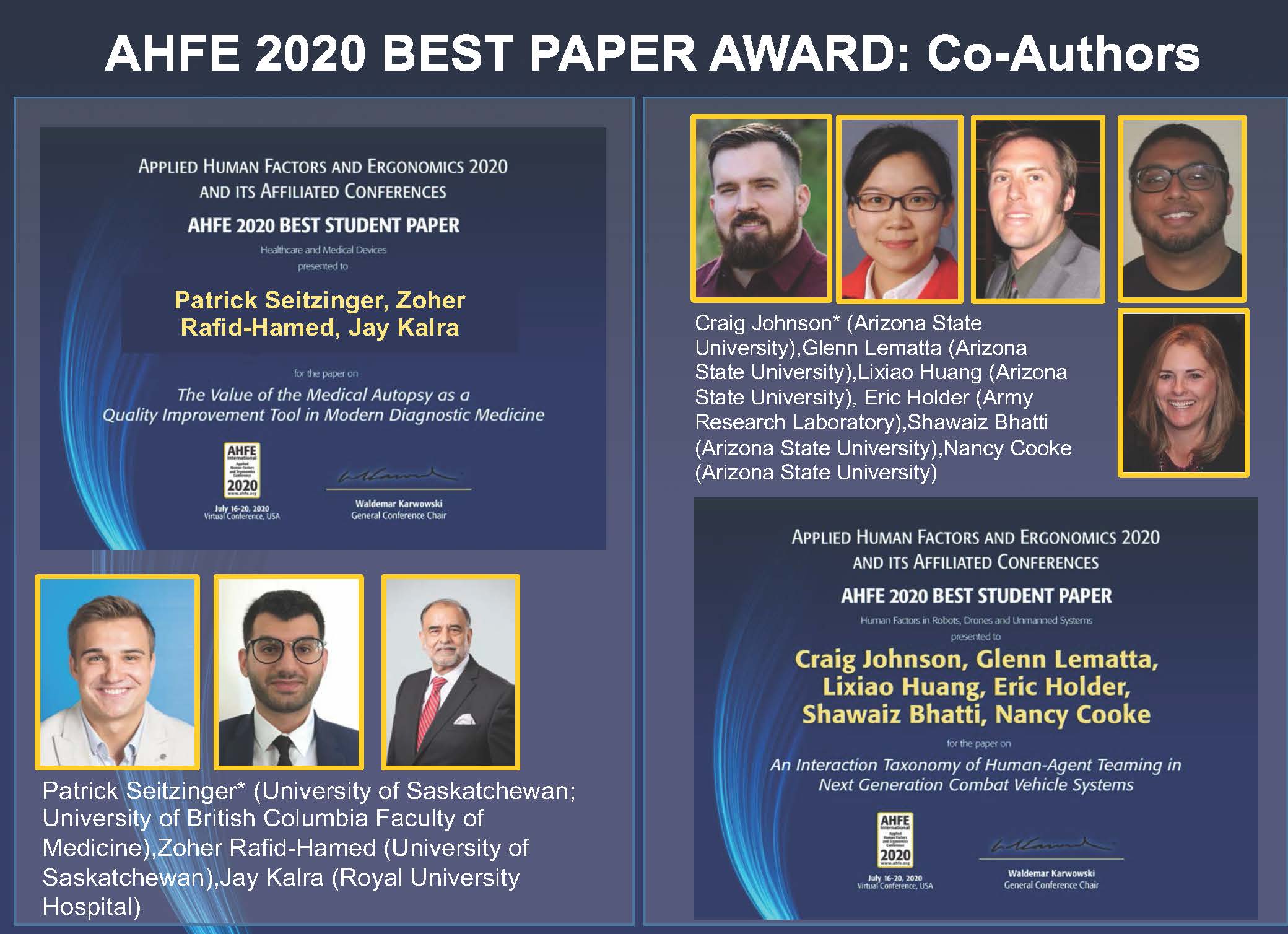
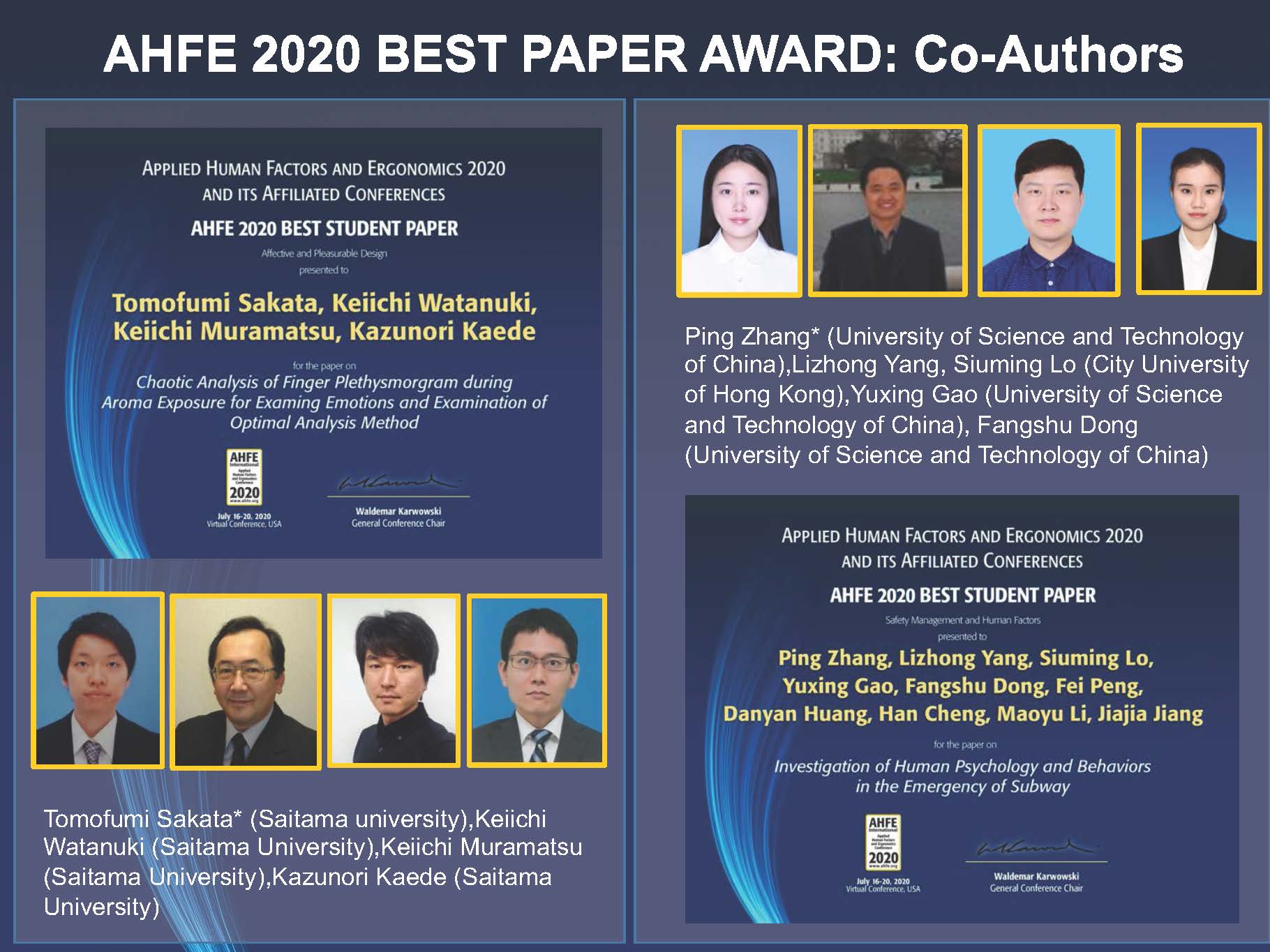
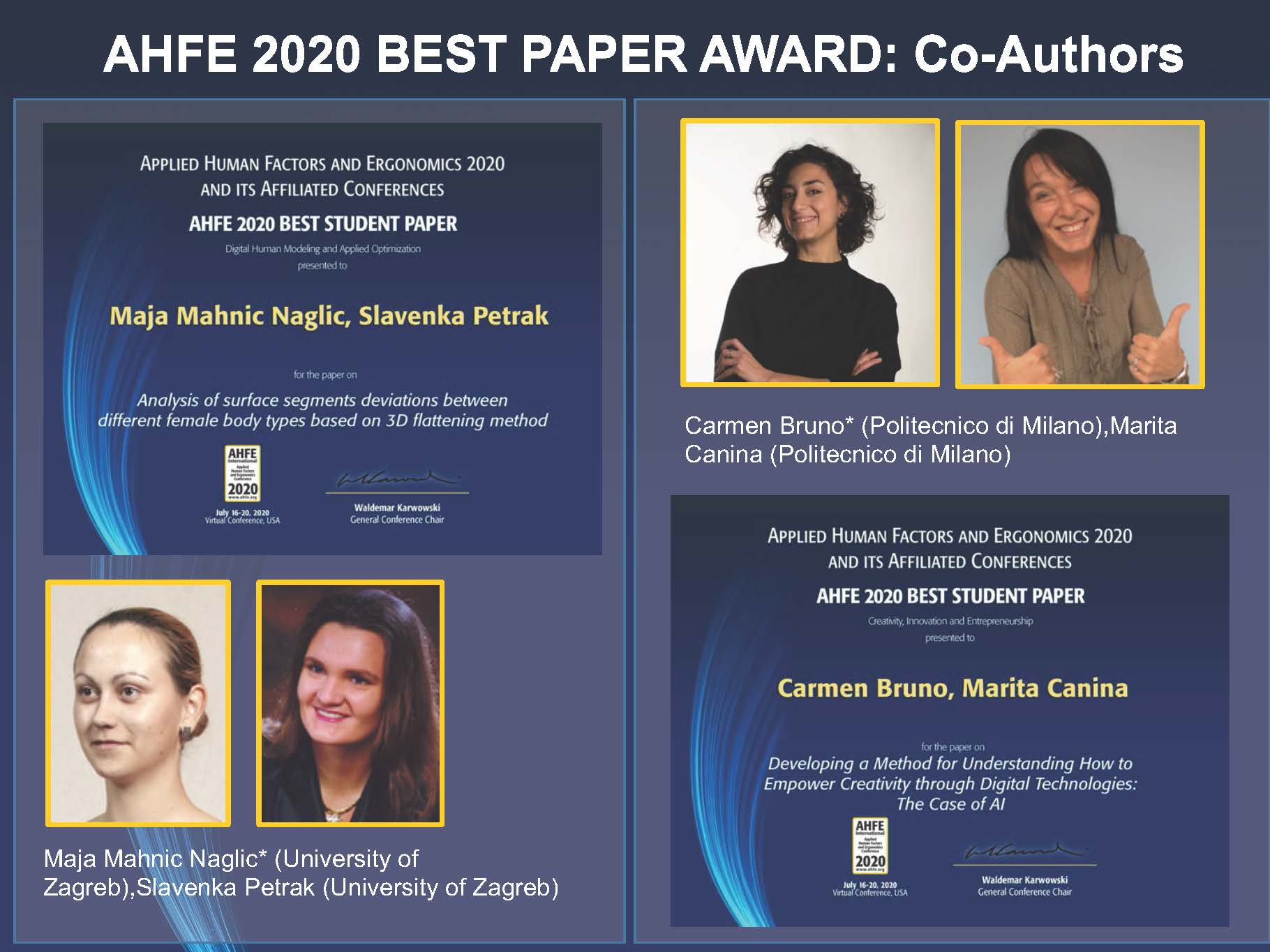
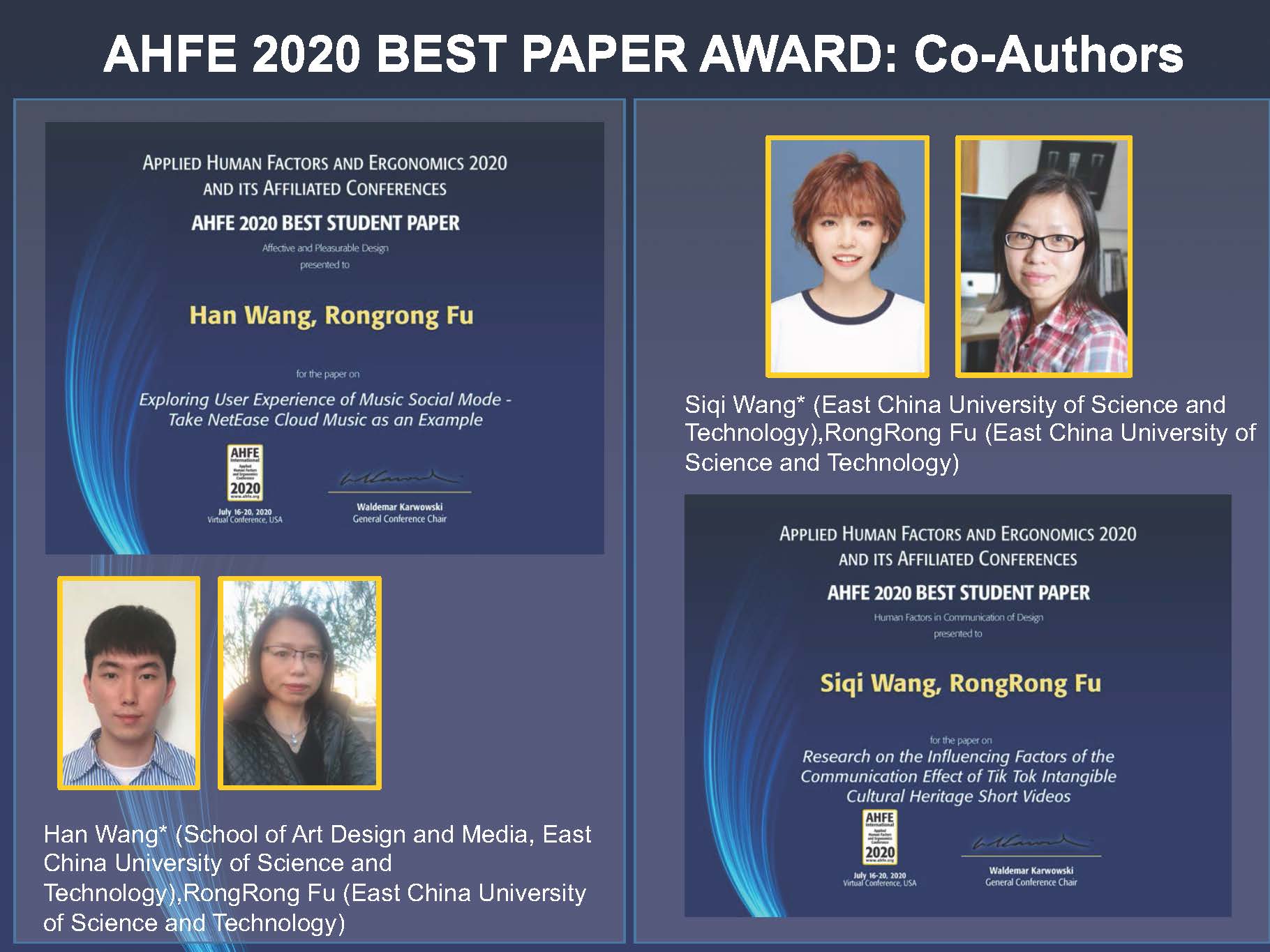
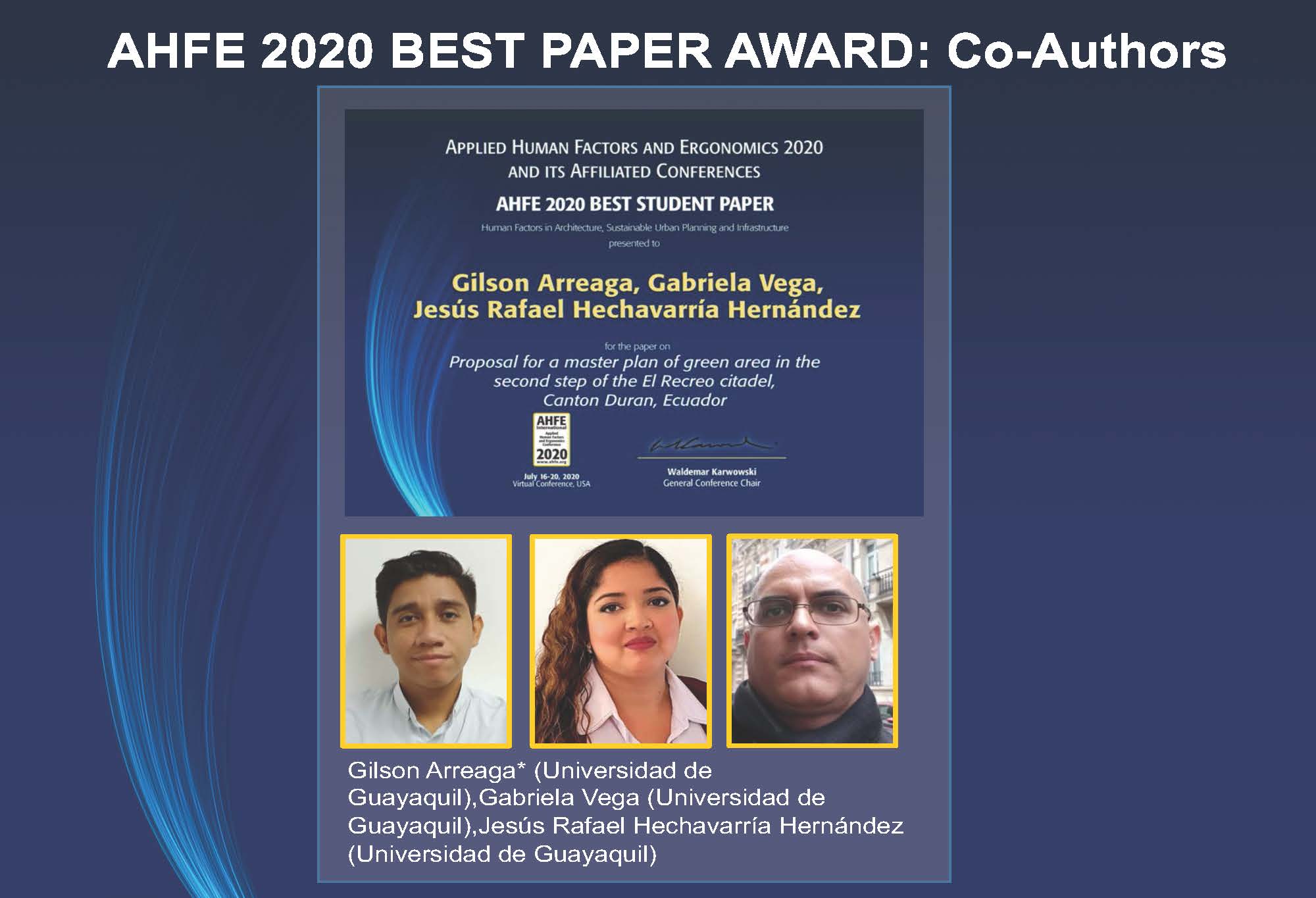
AHFE 2020 BEST STUDENT PAPER AWARDS


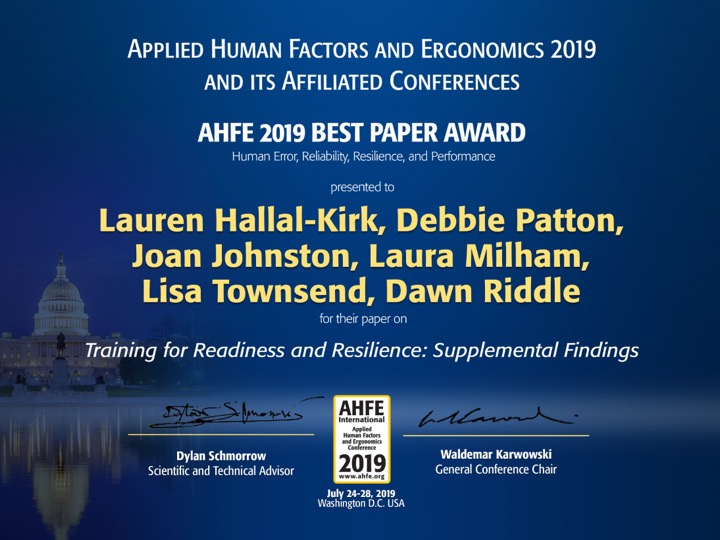
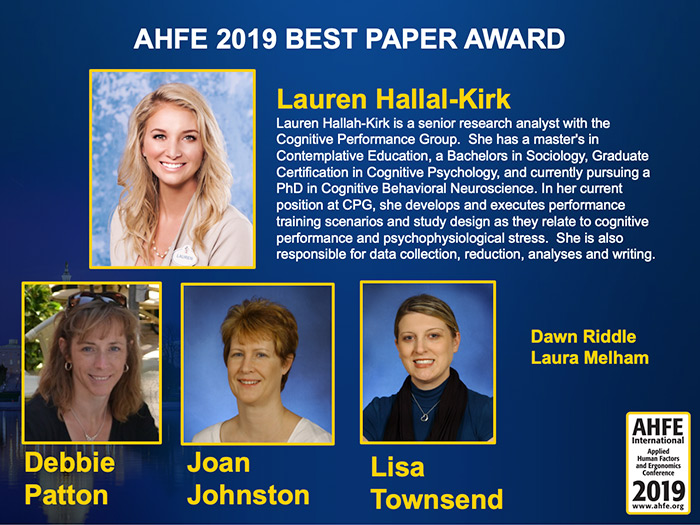
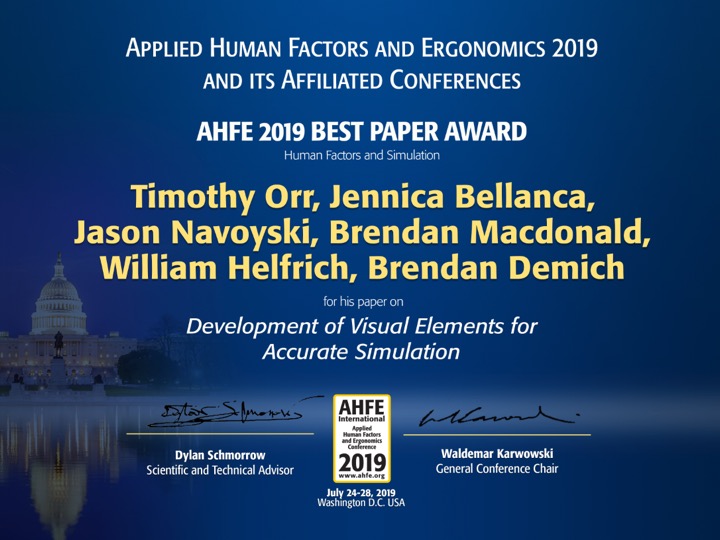
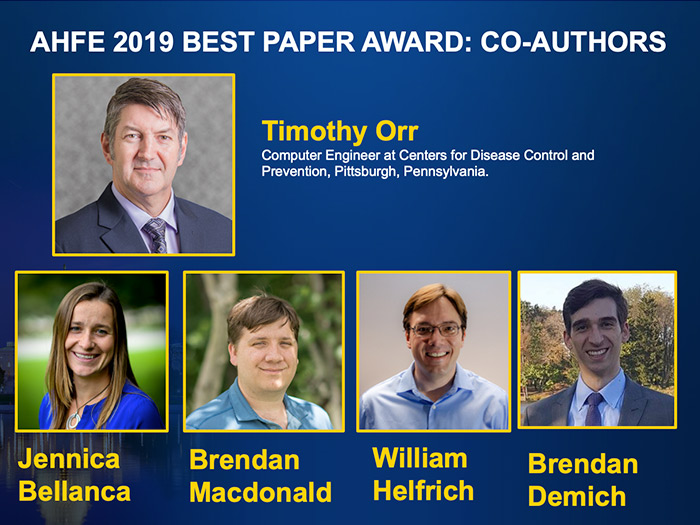
AHFE 2019 Best Paper Awards

🏆 Best Paper Awards


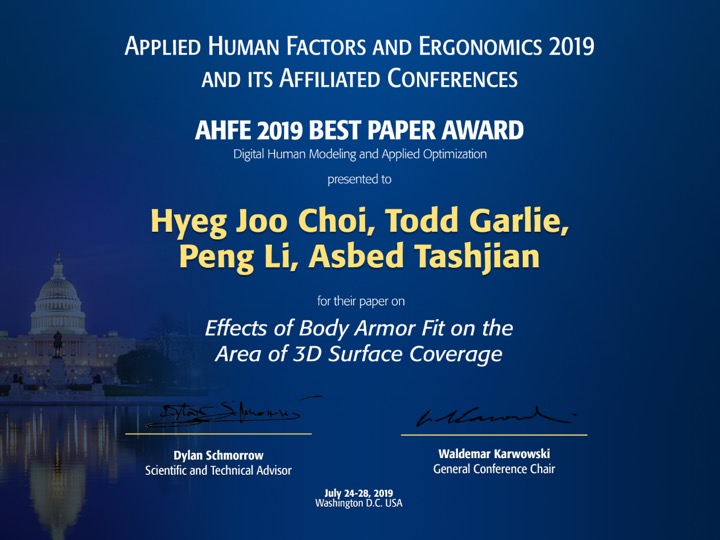
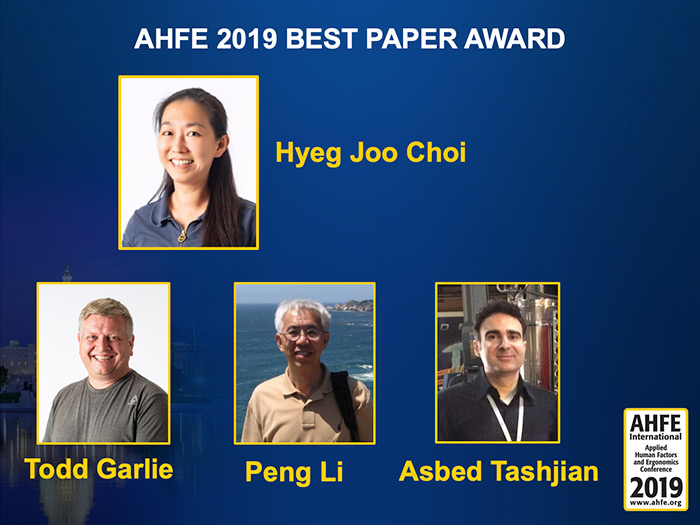
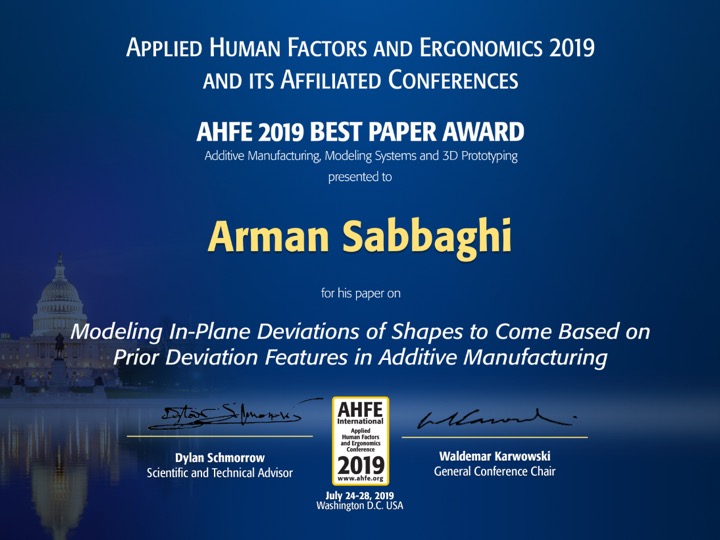
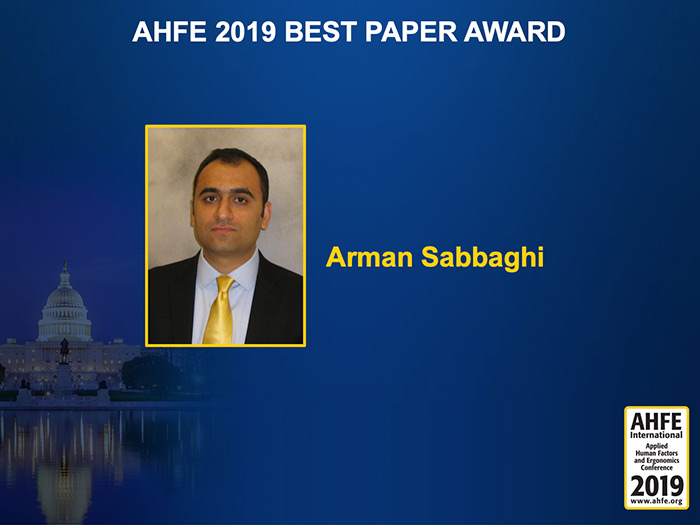
AHFE 2019 BEST PAPER AWARDS


AHFE 2018 Best Paper Awards

🏆 Best Paper Awards


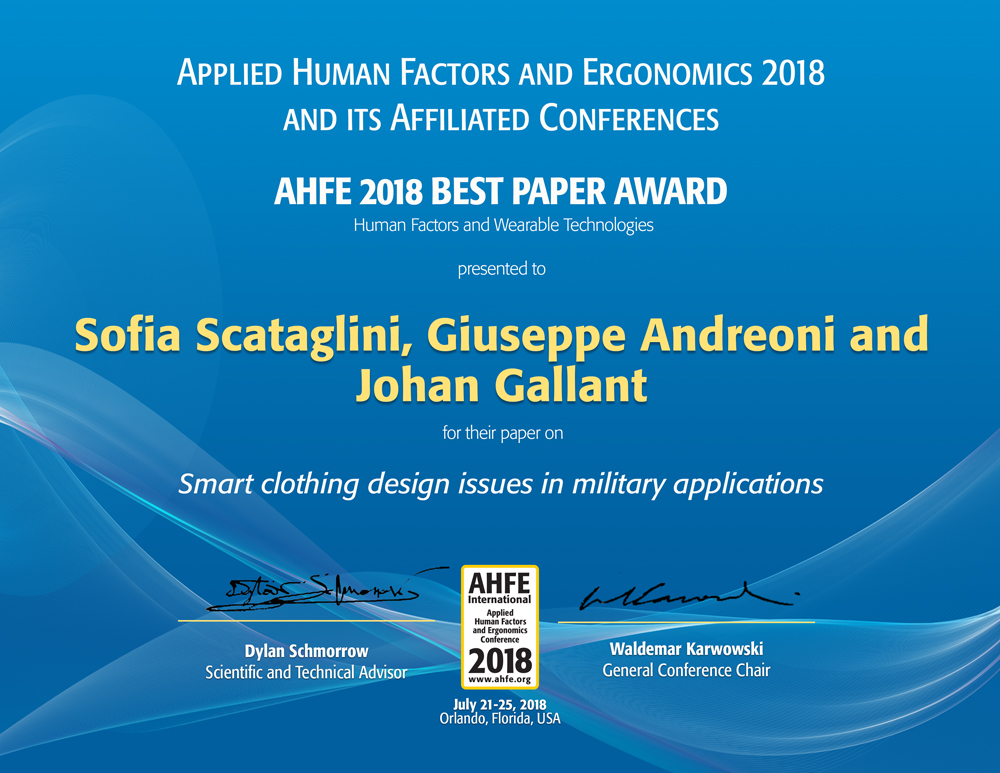
AHFE 2018 BEST PAPER AWARDS


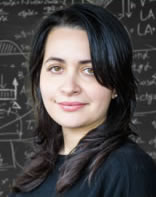
Sofia Scataglini

Sofia Scataglini, holds a PhD in Applied Science from Politecnico di Milano and Belgian Royal Military Academy.
She is full researcher at Belgian Royal Military Academy and Military Hospital Queen Astrid.
Sofia is the founder of the Digital Human Modeling by Women group (DHMW), which is dedicated to promoting women researchers around the world


Giuseppe Andreoni Johan Gallant
Giuseppe Andreoni is assistant professor at Industrial Design Faculty of Politecnico di Milano. He is director on the Campus Point, and at the same time he is the coordinator of the Sensibilab (Biomedical Sensors and Systems Lab.) and of the LyPhE (Laboratory of Physical Ergonomics) at the INDACO (Industrial Design, Art, Communication and fashion) Dept. of the Politecnico di Milano. Johan Gallant obtained a PhD from the University of Franche-Comté and he was trainee at the French-German research institute of Saint-Louis (ISL). He is assistant professor in ballistics and weapon systems at Belgian Royal Military Academy (ABAL). He also teaches at the Dutch Defence Academy and at the Military Academy in Tunisia.


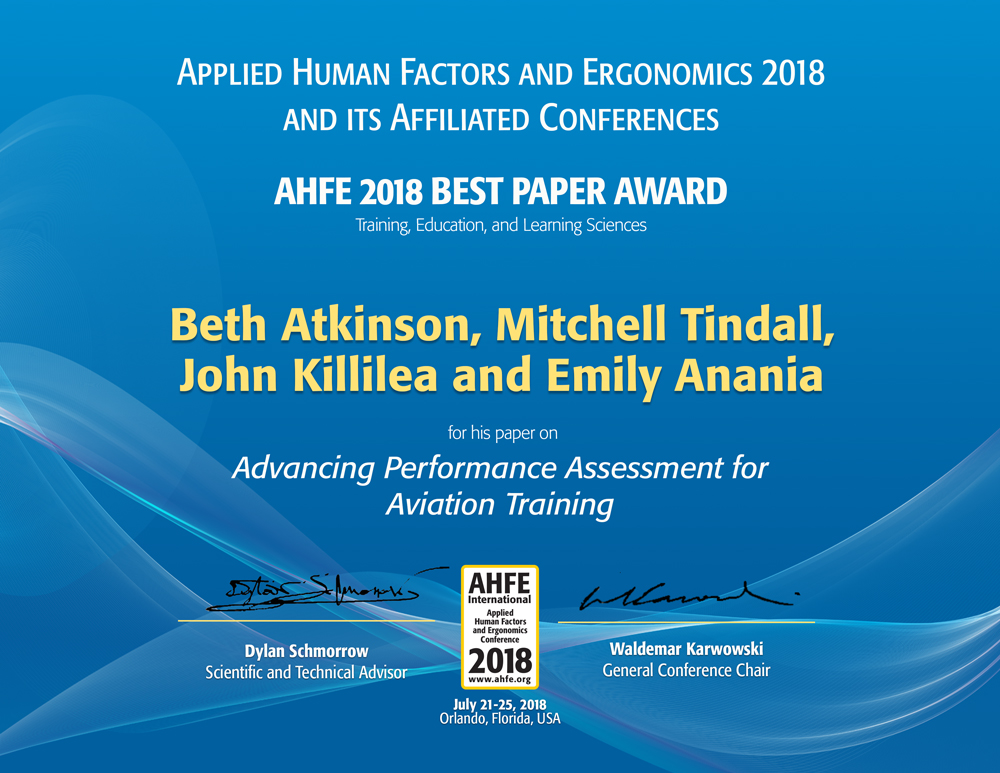
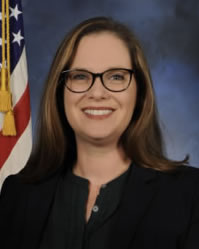
Beth Atkinson
Ms. Beth F. Wheeler Atkinson is a Senior Research Psychologist at NAWCTSD and a NAVAIR Associate Fellow. She has led several research and development efforts devoted to investigating capability enhancements for training and operational environments, and has successfully transitioned a post mission reporting and trend analysis tool that leverages automated performance measurement technology. Her research interests include instructional technologies (e.g., performance measurement, post-mission reporting/review), Human Computer Interaction (HCI)/user interface design and analysis, and aviation safety training and operations. She holds an M.A. in Psychology, Applied Experimental Concentration, from the University of West Florida.

John P. Killilea

Mitch Tindall


Emily Anania

John P. Killilea is a Research Psychologist supporting the Naval Air Warfare Center Training Systems Division in the BATTLE Laboratory. He holds a Masters in Modeling & Simulation, and is currently a Doctoral Candidate in the same field at the University of Central Florida. Mitch Tindall, PhD, is a Research Psychologist at Naval Air Warfare Center Training Systems Division in the BATTLE Laboratory. His Ph.D. is in Industrial-Organization (I-O) Psychology from University of Central Florida (UCF).
Emily Anania is a Research Psychologist with Don Selvy Enterprises, Inc., working with the Naval Air and Warfare Center Training Systems Division (NAWCTSD) She holds a Masters in Human Factors from Embry-Riddle Aeronautical University and is currently a Doctoral Candidate in the same field.


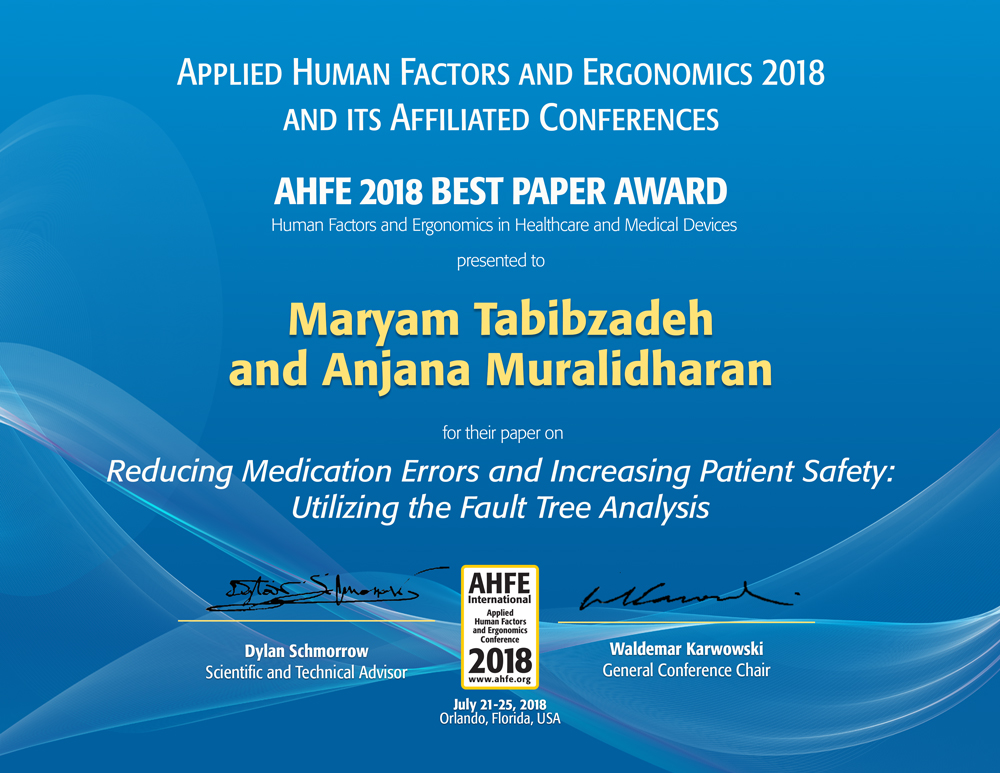
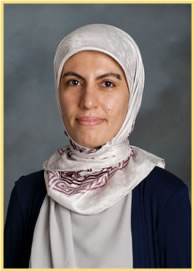
Maryam Tabibzadeh
Dr. Maryam Tabibzadeh is an Assistant Professor at the Department of Manufacturing Systems Engineering and Management at the California State University, Northridge. She received her PhD in Industrial and Systems Engineering from the University of Southern California. Her research has been focused on risk analysis of human and organizational factors, along with technical elements, in complex safety-critical and technology-intensive industries, such as offshore drilling and healthcare. She has been able to present and publish papers in the areas of risk assessment and safety management, accident investigation, and interoperability analysis of multiple emergency response agencies in different peer-reviewed conferences and journals both in the context of oil and gas industry and healthcare settings.

Sebastian Wille Ms. Anjana Muralidharan is a recent Master’s graduate in Engineering Management from the California State University, Northridge. She received her Bachelor’s degree in Computer Science. Anjana has conducted some voluntary research in the fields of root cause analysis and quality management. In addition, Human Resource Management is one of her areas of interest for future work.


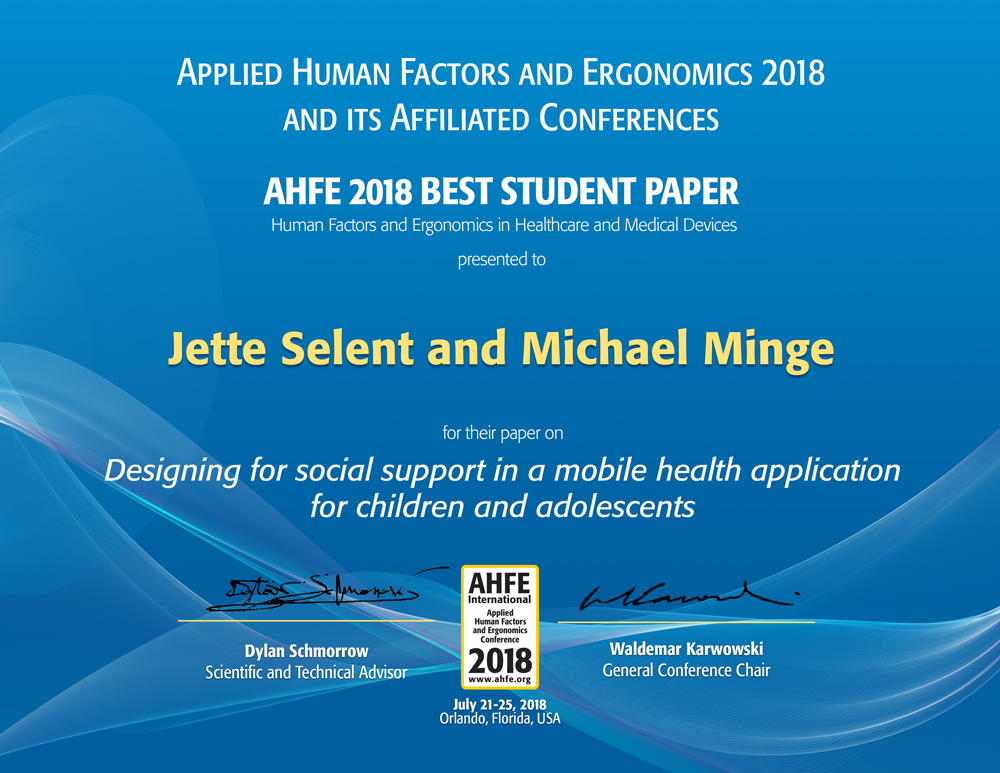
AHFE 2018 BEST STUDENT PAPER AWARDS


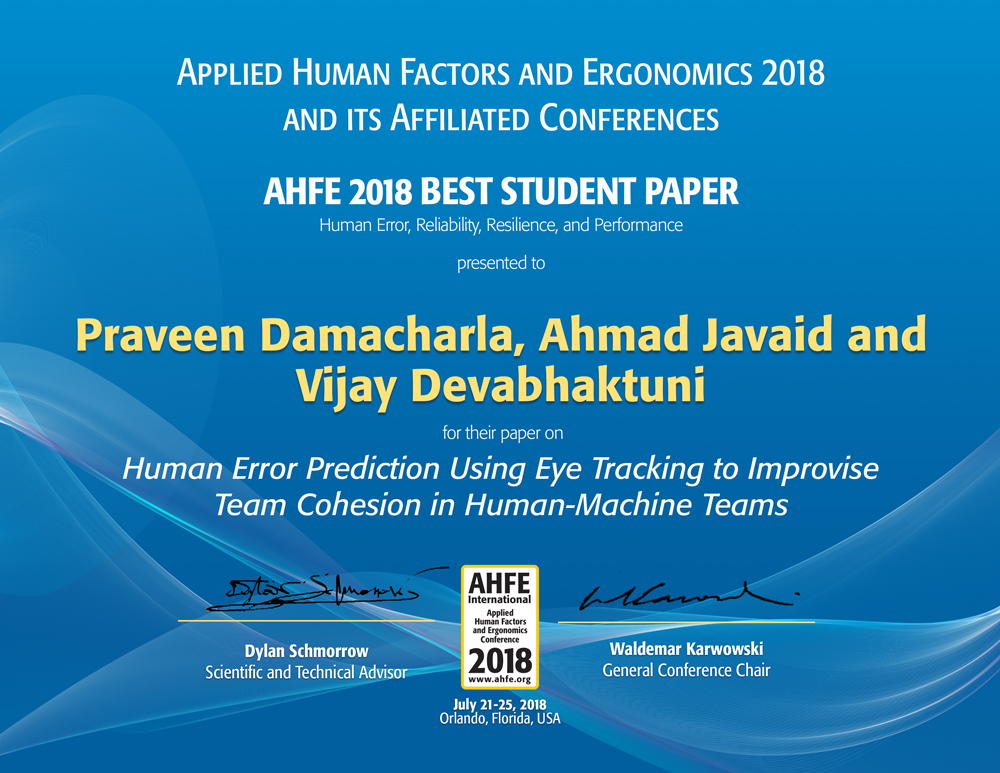
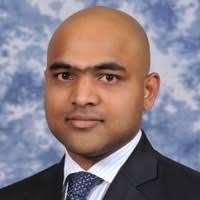
Praveen Damacharla
Praveen Damacharla received the B.Tech., degree in electrical and electronics engineering from the Koneru Lakshmaiah College of Engineering affiliated to Acharya Nagarjuna University, Guntur, A.P., India, in 2012, and is currently working towards his Ph.D. degree at the University of Toledo, Toledo, OH, USA. He is currently a Research Assistant with the Department of Electrical Engineering and Computer Science, University of Toledo. His research interests include Human-Machine Teaming, Human factors, Machine learning, Autonomous synthetic assistants and applied robotics. Mr. Damacharla was the recipient of Outstanding Teaching Assistant 2015 award presented by College of Engineering, The University of Toledo. He was also the recipient of the 2016 Advanced Leadership Academy scholarship from College of Business and Innovation, University of Toledo.


Ahmad Y. Javaid
Ahmad Y. Javaid received his B.Tech. (Hons.) Degree in Computer Engineering from Aligarh Muslim University, India in 2008. He received his Ph.D. degree from The University of Toledo in 2015 along with the prestigious University Fellowship Award. Previously, he worked for two years as Scientist Fellow in Ministry of Science & Technology, Government of India.


Vijay K. Devabhaktuni
Vijay K. Devabhaktuni received the B.Eng. degree in EEE and the M.Sc. degree in physics from BITS, Pilani, in 1996, and the Ph.D. in electronics from Carleton University, Canada, in 2003. From 2003 to 2004, he held the Natural Sciences and Engineering Research Council of the Canada Post-Doctoral Fellowship and spent the tenure researching with the University of Calgary.


Jette Selent
Jette Selent studied Human Factors at Technische Universität Berlin after completing her degree in psychology at the Humboldt-Universität zu Berlin. Thanks to her academic background and sound knowledge on topics like human-machine interaction, usability, user experience, and design thinking, she is now working as a User Experience Researcher in the software industry.


Michael Minge
Michael Minge studied psychology at Freie Universität Berlin and Human Factors at Technische Universität Berlin. He received a doctoral degree in engineering from Technische Universität Berlin. His research interests focus on user-centered design, usability engineering, user experience, gamification, and emotions in HCI. Currently, he is postdoctoral researcher at Technische Universität Berlin and works on the development of medical devices supporting mobility.

AHFE 2017 Best Paper Awards

🏆 Best Paper Awards

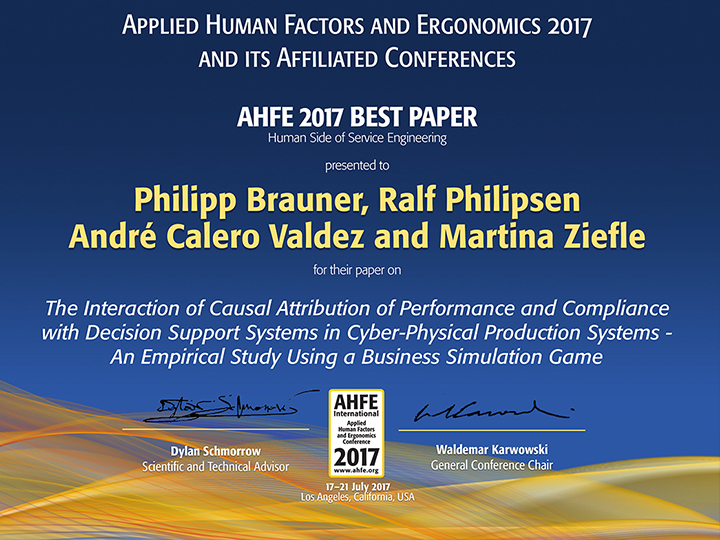
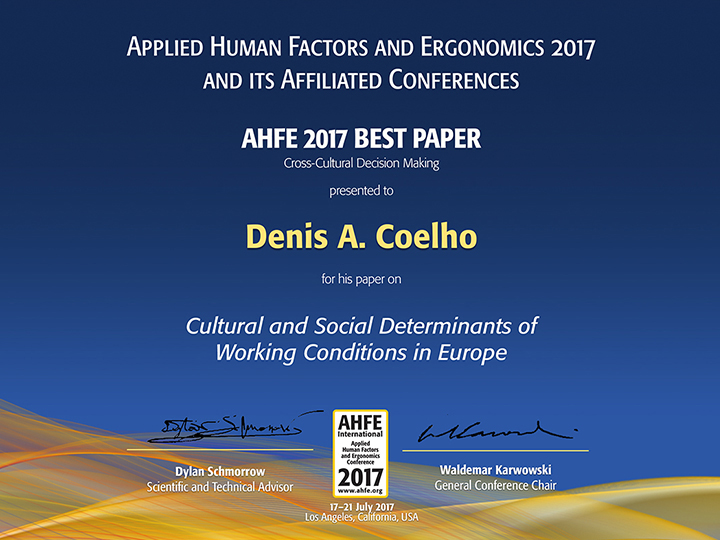
AHFE 2017 BEST PAPER AWARDS


Philipp Brauner
Dr. Philipp Brauner is a senior researcher at the Human-Computer Interaction Center at RWTH Aachen University, Germany and engineers holistic and viable ICT interventions to increase workers’ productivity and job satisfaction.


Ralf Philipsen André Calero Valdez Martina Ziefle
Ralf Philipsen is a researcher at the Human-Computer Interaction Center at RWTH Aachen University. His research addresses user acceptance and data visualization in different technology contexts with foci on mobility and infrastructure planning. In addition, he investigates decision-making processes in production enterprises, for example, in supply chain and quality management. André Calero Valdez holds a PhD in Psychology from RWTH Aachen University and works as a senior researcher at the Human-Computer Interaction Center at RWTH Aachen University. His research deals with how people derive actionable knowledge from data using information systems. He focuses on aspects of visualization, recommender systems and system complexity. Martina Ziefle is full professor for Communication Science at RWTH Aachen and director of the Human-Computer Interaction Center at RWTH Aachen University. Her research is directed to human-computer interaction and technology acceptance in different technologies, taking demands of user diversity into account. In addition to teaching and directing research in HumTec, Prof. Ziefle leads various projects funded by industrial and public authorities, dealing with the interaction and communication of humans with technology.


Denis Coelho
Denis Coelho, Ph.D. earned his doctoral degree in 2002 and now holds an extensive publication record in Human Factors and Ergonomics and Product Design. He is an international evaluator for Research Grant Proposals and Doctoral dissertations. He is the founding and active editor in chief of The International Journal of Human Factors and Ergonomics (indexed in Scopus and published by Inderscience). Founding Coordinator of the Industrial Design Engineering Masters programme at University of Beira Interior, Portugal. Assistant Professor of Human-Technology Interfaces.


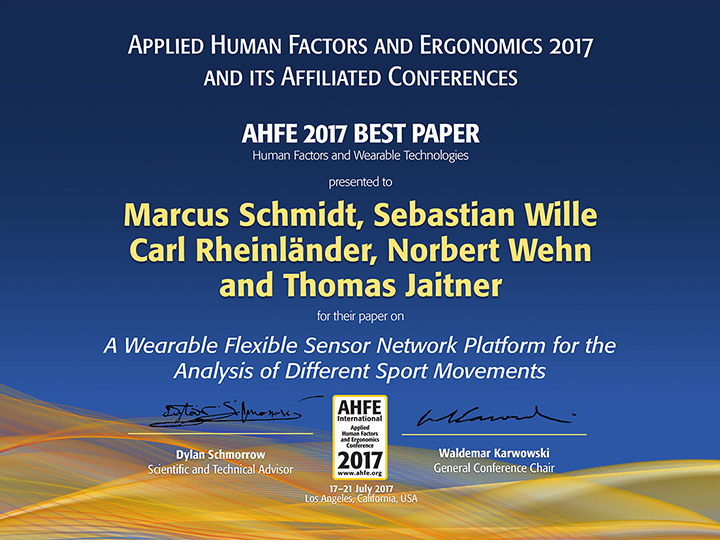
Marcus Schmidt
(Corresponding author)
Marcus studied mathematics and physical education at TU Dortmund University. Since finishing his degree (M.Ed.) in 2011 he works as a scientific employee at the institute for sport and sport science at TU Dortmund University. He will finish his phd this summer and his thesis is about the use of inertial measurement systems for jumping and sprinting diagnosis in track and field. Marcus main research interests are the use of sensor technology for in-field diagnosis of jumping and sprinting in several sports (track and field, volleyball, basketball, handball), as well as underlying aspects of motor learning.


Sebastian Wille Dipl.-Ing. Sebastian Wille joined 2010 the Microelectronics Systems Design Research Group of Prof. Wehn at TU Kaiserslautern. His research is about design and evaluation of Internet of things applications based on Wireless Sensor Networks. In his studies of electrical and information technology he won a prize from Richard-Hirschmann-Stiftung for "prominent study achievement" and the Klara-Röser prize "for notably scientific work". 2005 he won the third prize of german-wide Young Researcher competition in the area of technology. Begin 2016 he founded Wille Engineering, a company providing IT and electronic services.
Carl Christian Rheinländer
M. Eng. Carl C. Rheinländer joined the Microelectronics Systems Design Research Group of Prof. Wehn at TU Kaiserslautern in 2015. His research is about embedded ultra low power hardware designs and communication technologies for distributed interconnected systems.


Norbert Wehn
Norbert holds the chair for Microelectronic System Design in the department of Electrical Engineering and Information Technology at the University of Kaiserslautern. He has more than 250 publications in various fields of microelectronic system design and holds several patents. Two start-ups spinout of his research group. He is Vice-President of the University Kaiserslautern, associate editor of various journals and member of several scientific advisory boards. In 2003 he served as program chair for DATE 2003 and as general chair for DATE 2005 respectively. In 2014 he was general Co-Chair of FPL 2015.
Thomas Jaitner
Thomas Jaitner is professor for movement and training science at the TU Dortmund and head of the sections “Movement and Training” as well “Performance and Health”. Till 2016, he also was director of the Institute of Sports and Sports Science in Dortmund. Before he went to Dortmund, he was working at the Universities of Kaiserslautern, Leipzig and Frankfurt. His research focus is on the analysis of complex movement patterns and gross motor learning as well as on the development and application of wearable computing technologies for sports performance analysis.


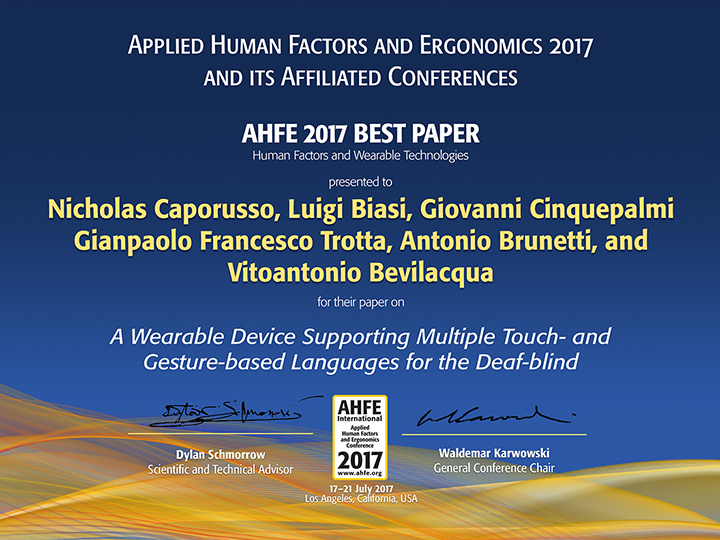
Nicholas Caporusso Nicholas Caporusso is an entrepeneur and a scientist in the field of Human-Machine Interaction. He got a MSc in Computer science (magna cum laude) and a PhD in Computer science and engineering, both awarded as the best theses. Then, he gained a Fulbright scholarship in Technology Entrepreneurship from Santa Clara University (California, US). He founded three companies (dbGLOVE - www.dbglove.com, QIRIS - www.qiris.org, and Paperleap - www.paperleap.com) and he has been awarded several prizes, including a Marie Skłodowska Curie fellowship. He has been nominated by MIT Technology Review Italy as one of the 10 best innovators under 35.

Luigi Biasi Giovanni Cinquepalmi Gianpaolo Francesco Trotta
Luigi Biasi gained his MSc in Electrical and Information Engineering (Magna cum Laude) at Polytechnic University of Bari, where he focused on assistive technology in both of his theses. Giovanni Cinquepalmi gained his MSc in Electrical and Information Engineering (Magna cum Laude) at Polytechnic University of Bari, where he focused on VR, on recognition of movement and gestures, and on assistive technology. Gianpaolo Francesco Trotta graduated in Computer Science Engineering at Polytechnic University of Bari in April 2015, with a final dissertation in Human Computer Interaction. Now he is a Ph.D. student at Polytechnic University of Bari in Mechanical Engineering. The research goal is to study, design and develop systems to use in medical and industrial environment using virtual, augmented and mixed reality.

Antonio Brunetti Antonio Brunetti is a Ph.D. Student in Electrical and Information Engineering at Polytechnic University of Bari, where he is working on Decision Support Systems (DSS) based on data and biomedical systems for the personalization and optimization of diagnosis, prognosis and innovative therapies. He obtained the Master Degree in Computer Engineering at the Polytechnic University of Bari, where he specialized in the fields of Human-Machine interaction and Image Processing applied to the medical field.
Vitoantonio Bevilacqua
Vitoantonio Bevilacqua obtained the Laurea Degree in Electronic Engineering and the Ph.D. in Electrical Engineering from Polytechnic of Bari, where he is currently Tenured Professor of Human Computer Interaction at the Department of Electrical and Information Engineering and previously he also taught Expert Systems, Medical Informatics and Image Processing. Since 1996 he has been working and investigating in the field of computer vision and image processing, human-machine interaction, bioengineering, machine learning and soft computing (neural networks, evolutionary algorithms, hybrid expert systems, deep learning).


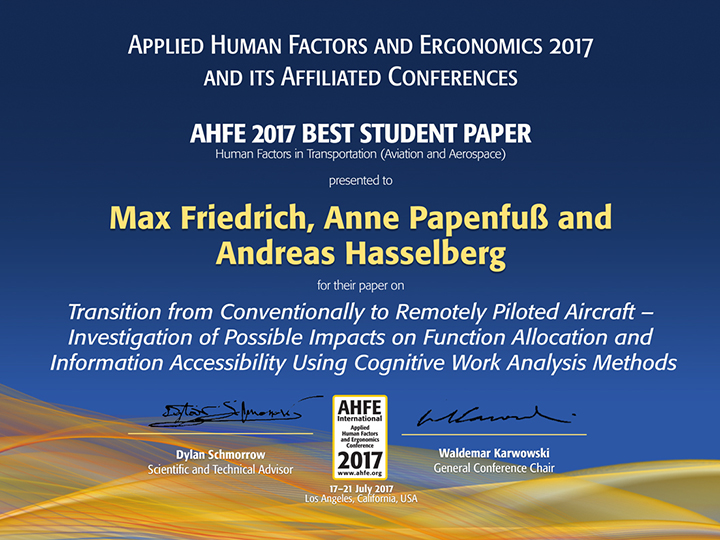
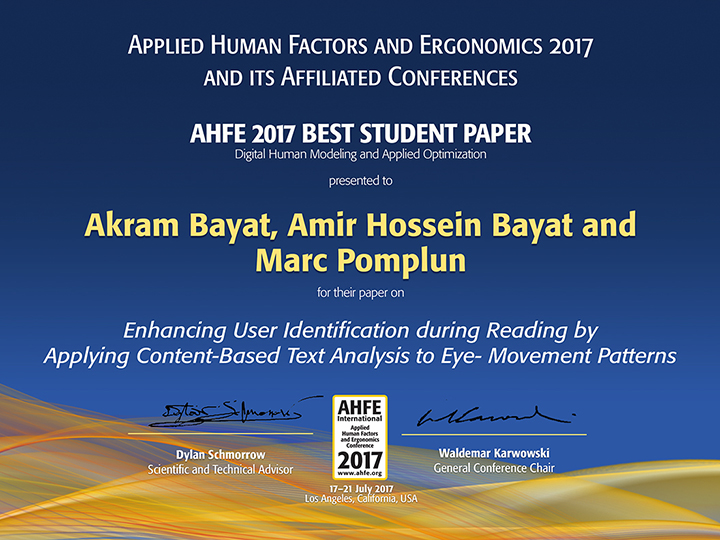
AHFE 2017 BEST STUDENT PAPER AWARDS


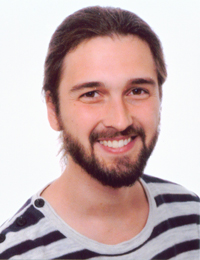
Max Friedrich
Max Friedrich is currently working on his PhD at the German Aerospace Center (DLR) at the Institute of Flight Guidance in Braunschweig, Germany. His PhD focuses on the development of a ground control station for Medium Altitude Long Endurance Remotely Piloted Aircraft Systems (MALE RPAS) operated in controlled airspace. Since September 2015 Max holds a Master of Science in psychology from the Technical University of Braunschweig. During his studies he focused on engineering and traffic psychology. His key research interests are cognitive work analysis (CWA) and perceptual psychology.


Anne Papenfuss
Anne Papenfuss conducts research in the Human Factors branch of the Institute of Flight Guidance of the German Aerospace Center in the development and evaluation of concepts and human machine interfaces for airport management, remote towers and remotely piloted systems. She graduated with a Magistra Artrium in Media Sciences from Braunschweig Technical University in 2007.
Andreas Hasselberg
Andreas Hasselberg received the diploma and Dr.-Ing. degrees in engineering from the University of Duisburg-Essen, Germany, in 2009 and 2014, respectively. He is member of the Human Factors group in the Institute of Flight Guidance of the German Aerospace Center (DLR), Braunschweig, Germany since 2010. He is involved in developing and validating new concepts for human-automation interaction for cockpits, air traffic control and remotely piloted aircraft systems. He was recently Coordinator of the EU-founded projects A-PiMod and MINIMA.


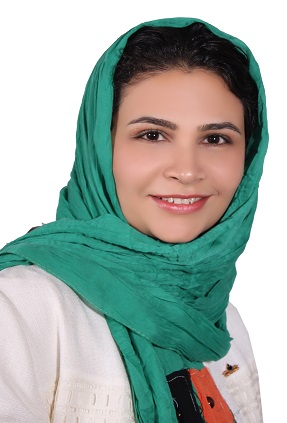
Akram Bayat
Akram Bayat is a Ph.D. candidate in computer Science at the Visual Attention Laboratory of the University of Massachusetts Boston advised by Professor Marc Pomplun. Akram received both the master of Electrical Engineering and the master of Computer Science prior to joining Ph.D. program. She is currently working on how to apply human attentional mechanism to deep neural network for the scene and object recognition. Akram has conducted several projects on Human activity recognition and eye-movement based user classification. She is also interested in computer vision, machine learning, data mining, and human-user interface design.

Amir Hossein Bayat
Amir Hossein Bayat received his BSc in Computer Engineering from K.N.Toosi University of Technology, in 2014 and his MSc degree in Artificial Intelligence from Iran University of Science and Technology in 2017. His research interests include deep learning, probabilistic graphical models, statistical machine learning, and computer vision.
Marc Pomplun
Marc Pomplun is a Professor of Computer Science at the University of Massachusetts Boston, where he joined the faculty in 2002. He received both his M.S. in Computer Science and his Ph.D. in Computer Science at Bielefeld University, Germany, in 1994 and 1998, respectively, under Professor Dr. Helge Ritter. He was a Post-Doctoral Fellow in the Department of Psychology at the University of Toronto and a Research Scientist in the Center for Vision Research and Department of Computer Science at York University, Toronto.


AHFE 2016 Best Paper Awards

🏆 Best Paper Awards


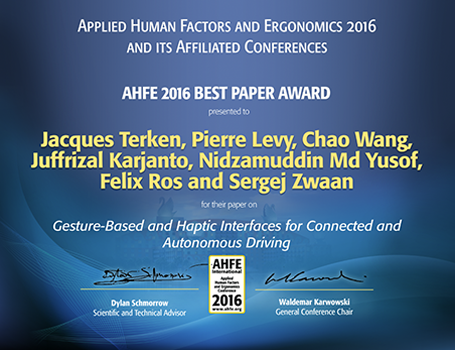
AHFE 2016 BEST PAPER AWARDS

Jacques Terken is associate professor in the Department for Industrial Design of Eindhoven University of Technology, the Netherlands. He was educated as a cognitive psychologist and received his PhD in 1985 from University Leijden, the Netherlands. For the last ten years, his research has focused on Automotive Human Factors. His research interests include the user experience of assisted and autonomous driving, covering topics such as situation awareness, the social nature of driving and shared control between humans and autonomous vehicles.


Pierre Levy


Pierre Levy
is assistant professor in Eindhoven University of Technology, the Netherlands. He graduated from Mechanical Engineering (specialty in Industrial Design) in Compiègne University of Technology, France (2001), and gained a PhD with honors in Kansei Science at the University of Tsukuba, Japan (2006). After a post-doctoral position at the Laboratory of Kansei Information Science at the University of Tsukuba, he was researcher and lecturer at Chiba University as well as lecturer at the University of Tsukuba.

Chao Wang


Chao Wang
has a graduate degree from Zhejiang University, Hangzhou, China. Currently, he is a PhD candidate in Eindhoven University of Technology, the Netherlands. His research focuses on social applications of connected vehicles, involving user research, UX design, prototyping in a driving simulator and a real car, conducting experiments and data analysis. Before starting his PhD project, he also has 3 years working experience both in automotive and IT companies as UX designer, responsible for in-vehicle HMI system design.


Juffrizal Karjanto received his Bachelor Degree in Mechanical Engineering from The Ohio State University (OSU), Ohio, USA in 2008. In 2012, he completed his Master of Innovation and Engineering Design from Universiti Putra Malaysia (UPM), Malaysia. He is a Lecturer in Universiti Teknikal Malaysia Melaka (UTeM). Currently, he is pursuing his Ph.D. in the Industrial Design Department, Eindhoven University of Technology (TU/e), Netherlands. Nidzamuddin Md. Yusof received his Bachelor Degree (Dipl.-Ing) in Mechanical Engineering from Fachhochschule Gelsenkirchen, Germany in 2009 and Master Degree in Innovation and Engineering Design from Universiti Putra Malaysia (UPM), Malaysia in 2012. He is a Lecturer in Universiti Teknikal Malaysia Melaka (UTeM) and has been involved in various research projects especially automotive vehicle area. Since 2014 he is a Ph.D Candidate in Eindhoven University of Technology (TU/e), Netherlands. His research focuses on driver interactions with autonomous vehicles.
Juff Karjanto Nidzamuddin Md. Yusof

Felix Ros is a graduate student in the Department for Industrial Design of Eindhoven University of Technology, The Netherlands. He is interested in creating useful products that fulfil a function through an aesthetic interaction. Furthermore, I’m interested in the relation between human and technology. His work on Stewart, a haptic interface designed for a self-driving car that allows for a haptic dialogue between car and driver, received international attention. Sergej Zwaan is graduated in 2017 from the Department for Industrial Design at Eindhoven University of Technology. He has the ambition to learn more about interacting with autonomous systems. Besides his study he is also developing soccer robots to learn more about robotic technology and to make a connection between design and technology
Felix Ros Sergej Zwaan


AHFE 2016 BEST STUDENT PAPER AWARDS

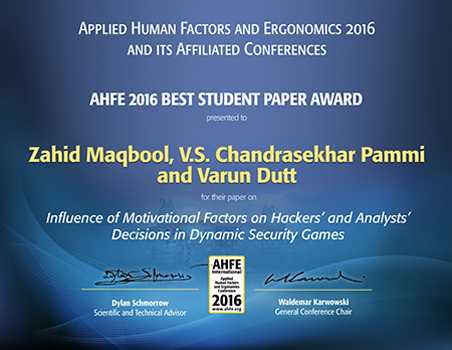
Zahid Maqbool is a Ph.D. candidate in the School of Computing and Electrical Engineering, Indian Institute of Technology (IIT) Mandi. Prior to joining IIT Mandi, Zahid completed a Master’s degree in Computer Science and Engineering from International Institute of Information Technology (IIIT) Bhubaneswar. He is currently working on a project from Department of Science and Technology, India, on how motivational factors, information availability, and technology constraints impact decision-making of analysts and hackers in simulated network games. His major areas of interests are game theory, machine learning, and data mining. Zahid is particularly interested in how these fields could be used to answers questions in policy making.


V. S. Chandrasekhar Pammi
is working as a Professor in the Centre of Behavioural and Cognitive Sciences, University of Allahabad. Chandrasekhar has worked on application of functional magnetic resonance imaging (fMRI) technique to understand different cognitive processes. Major areas of research include Neuroeconomics of decision making in normal and abnormal populations, Interaction of emotion, attention and motivation with the process of decision making, modeling decision making in individuals and over populations.


Varun Dutt
is working as an Assistant Professor in the School of Computing and Electrical Engineering and School of Humanities and Social Sciences at the Indian Institute of Technology (IIT) Mandi. Varun is the Review Editor of Frontiers in Cognitive Science and Frontiers in Decision Neuroscience journals. He is also the principal investigator of Applied Cognitive Science Laboratory at IIT Mandi. His major areas of research include Artificial Intelligence, Cognitive Modeling, Human-Computer Interaction, and Judgment and Decision Making.
V. S. Chandrasekhar Pammi Varun Dutt


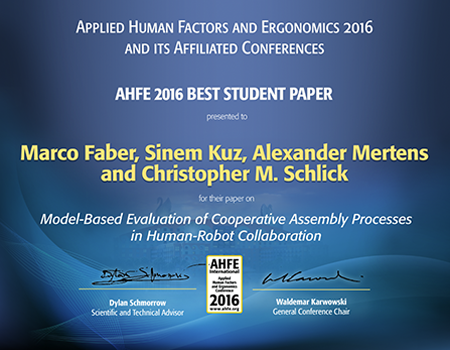
Marco Faber graduated 2012 in Computer Science with specialization in data management, data visualization and data exploration. Since 2012 Marco Faber is working as a research assistant at the Institute of Industrial Engineering and Ergonomics at the RWTH Aachen University in the department of Ergonomics and Human-Machine Systems. His main research is focused on human-robot collaboration within and transparent behavior of self-optimizing, socio-technical production systems.
Marco Faber

Sinem Ku Alexander Mertens Christopher M. Schlick
Sinem Kuz graduated in Computer Science at RWTH Aachen University with focus on data communication and data security. Since 2010 she is working as a research assistant at the Institute of Industrial Engineering and Ergonomics at the RWTH Aachen University. She managed several research projects in the context of human-centered design of user interfaces for industrial machines and human-robot interaction. Thereby, her main research is focused on the effect of anthropomorphic movements of industrial robots. Dr.-Ing. Dr. rer. medic. Alexander Mertens finished his master in computer science with focus on human-computer interaction and neurophysiology at RWTH Aachen University in 2008. After that he managed several research projects in the context of telemedical systems and services as well as accessibility for elderly and disabled people at the Institute of Industrial Engineering and Ergonomics of RWTH Aachen University. In 2012 he finished his PhD in Theoretical Medicine and in 2014 his PhD in Industrial Engineering. His research interests focus on designing target group specifics user interfaces for information and communication technology. Christopher M. Schlick received the Ph.D. degree (Dr.-Ing.) in Mechanical Engineering from Aachen University of Technology in 1999, and the Habilitation degree (Dr.-Ing. habil) also in Mechanical Engineering from Aachen University of Technology in 2004. He is now a full professor of industrial engineering and ergonomics at RWTH Aachen University and deputy director of the Fraunhofer Institute for Communication, Information Processing and Ergonomics FKIE.

AHFE 2015 Best Paper Awards

🏆 Best Paper Awards


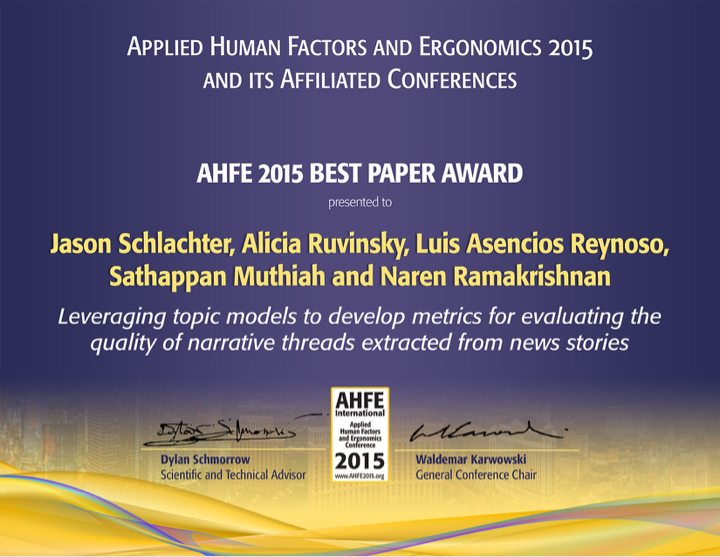
AHFE 2015 BEST PAPER AWARDS


Jason Schlachter
is a Senior Researcher in the Informatics Laboratory of Lockheed Martin's Advanced Technology Laboratories. He is currently leading research efforts in the areas of text analytics and sense making in social-cultural intelligence. He has prior work focused in the areas of artificial intelligence, robotics, and cognitive modeling. He holds a Master’s of Science in Artificial Intelligence and a Bachelors of Science in Psychology, both from the University of Georgia.


Alicia Ruvinsky

Naren Ramakrishnan

Luis Asencios Reynoso

Sathappan Muthiah


AHFE 2016 BEST STUDENT PAPER AWARDS


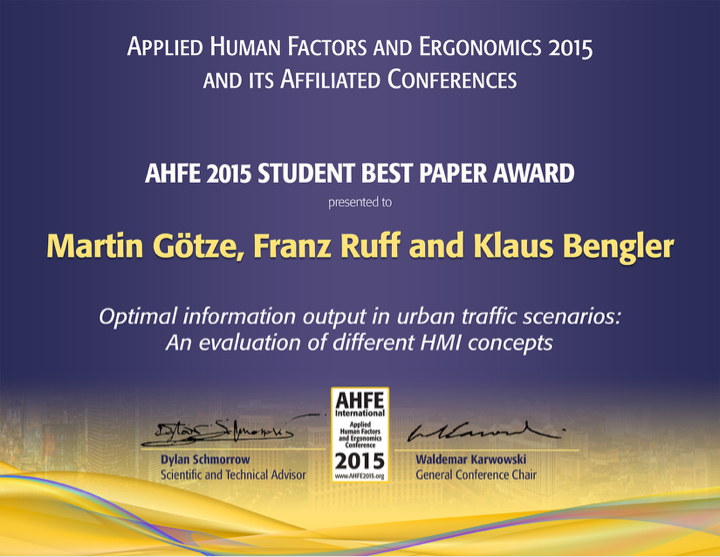
Martin Götze
earned his Master´s (Dipl-Ing.) in Mechanical Engineering and Management in 2011 at the Technical University of Munich. He currently works as a graduate research assistant at the university´s Institute of Ergonomics, where he is also pursuing his doctorate. His main research interest is human-machine-interaction concepts in vehicles for urban areas